
Best overall when your employer contributes: employer-sponsored dental insurance. Best for uninsured routine care: a dental membership plan; best for eligible public-benefit users: Medicaid dental coverage. This 2026 dental membership plan vs insurance guide compares six routes by eligibility, dentist access, treatment coverage, and restrictions—not by an advertised benefit alone.
- Dental membership plan vs insurance: choose employer-supported coverage first when its benefits fit your treatment needs.
- An in-office dental membership plan suits routine care at one practice; it is not dental insurance.
- Check Medicaid or military dental eligibility before replacing existing benefits with a private arrangement.
- Dentalcoloradosprings serves Colorado Springs patients, including Medicaid and TRICARE recipients; confirm your exact coverage before treatment.
Why this matters
The best arrangement covers the care you need with a dentist you can actually use. A preventive-care benefit does not answer whether a crown, extraction, denture, or implant receives coverage.
For local treatment, Dentalcoloradosprings offers general dental care, implants, same-day dentures, emergency dentistry, and IV sedation. Those services require separate coverage checks; a practice offering a procedure does not establish that your plan covers it.
In 2026, compare the written terms before choosing a membership or insurance policy. Neither the plan's name nor a receptionist's general statement that the office accepts insurance establishes your exact benefits.
What makes the best dental coverage option?
Use these six criteria before comparing the options:
- Eligibility: Establish whether an employer, Medicaid, or military benefit is available to you before shopping independently.
- Dentist access: Verify the exact dentist and location, not just the practice name or insurer logo.
- Treatment fit: Separate preventive visits from fillings, periodontal care, extractions, crowns, dentures, implants, and sedation.
- Benefit restrictions: Read waiting periods, exclusions, frequency limits, annual maximums, and referral requirements where applicable.
- Financial responsibility: Compare your full responsibility across 12 months, including planned treatment, rather than a single appointment.
- Continuity: Check what happens when you change jobs, move, change dentists, or cancel the arrangement.
A membership is a direct agreement with a practice. Insurance is a policy with defined benefits and exclusions. Comparing them as interchangeable products hides the differences that determine whether either option fits.
Dental membership plan vs insurance at a glance
These are coverage routes, not endorsements of specific contracts. The order reflects a practical decision path; eligibility and treatment needs take priority over rank.
| Option | Best for | Standout feature | Key limitation |
|---|---|---|---|
| Employer-sponsored dental insurance | Employees with a useful employer contribution | Employer-supported access to policy benefits | Network rules and benefit limits still apply |
| In-office dental membership | Uninsured patients staying with one practice | Direct agreement for specified care and treatment terms | Not insurance; usually tied to the participating practice |
| Individual dental PPO insurance | Independent shoppers who value dentist choice | Network-based coverage purchased without an employer | Waiting periods, exclusions, and maximums require review |
| Dental HMO insurance | Patients comfortable with an assigned network dentist | Defined network and referral structure | Less flexibility outside the participating network |
| Medicaid dental coverage | People eligible for state public benefits | Dental benefits through a public program | Covered services depend on state rules and eligibility |
| TRICARE-related dental coverage | Eligible military-connected patients | Dental programs tied to military eligibility | Medical TRICARE eligibility does not establish every dental benefit |
1. Employer-sponsored insurance: best for supported coverage
Employer-sponsored dental insurance belongs first in your comparison when your employer contributes and the benefits match your needs. The contribution changes the decision, but it does not make every employer plan the right choice.
Read the actual benefit summary for 2026. Confirm whether the offered arrangement is a PPO, HMO, or another design, because dentist access and treatment rules differ.
Employer-sponsored insurance pros:
- An employer contribution supports your coverage.
- One policy can include several categories of dental treatment.
- Eligible dependents can receive coverage when the contract permits enrollment.
Employer-sponsored insurance cons:
- Coverage is linked to employment and enrollment rules.
- Deductibles, annual maximums, exclusions, and waiting periods depend on the policy.
- Your preferred dentist is not automatically in network.
Best for: Employees whose employer-supported benefits match their dentist and expected care.
Before enrolling, request a treatment estimate from the dentist and compare it with the benefit summary. Ask which procedures count toward the annual maximum and which services receive no benefit.
Verdict: Buy when the employer contribution, dentist access, and treatment benefits work together.
2. In-office membership: best for uninsured routine care
A dental membership plan is a direct arrangement with a participating practice for specified services and treatment terms. It is not dental insurance, and the agreement—not a general description of memberships—determines what you receive.
This route fits patients who want routine care at one practice without buying an insurance policy. Do not assume that exams, cleanings, X-rays, emergency visits, or periodontal maintenance are included; check each item.
Dental membership plan pros:
- The agreement identifies the participating practice and included services.
- You can compare the arrangement directly with your planned visits.
- Treatment terms can be discussed with the office providing the care.
Dental membership plan cons:
- Benefits generally stay with the participating practice or group.
- Treatment outside the included services remains a separate responsibility.
- Membership does not provide insurance coverage for major treatment.
Best for: Uninsured patients who expect routine visits and intend to stay with one practice.
Ask for the written agreement, cancellation terms, renewal rules, and treatment exclusions. Also ask whether periodontal maintenance follows different terms from a routine cleaning.
Dentalcoloradosprings is a treatment option for Colorado Springs patients; confirm any dental membership plan directly with the practice before treating one as available.
Verdict: Buy only after the written agreement matches your expected care and dentist preference.
3. Individual PPO insurance: best for independent dentist choice
An individual dental PPO is insurance you purchase independently rather than through an employer. PPO arrangements distinguish participating dentists from out-of-network dentists, with benefits and patient responsibility determined by the policy.
This is the appropriate comparison when you want insurance and have no suitable employer option. In 2026, review the policy's effective date and waiting periods before scheduling treatment around expected benefits.
Individual PPO insurance pros:
- Enrollment does not depend on a particular employer.
- PPO policies generally permit out-of-network care under different benefit terms.
- Coverage can extend beyond routine preventive services when the policy includes those categories.
Individual PPO insurance cons:
- Waiting periods can delay benefits for specified treatments.
- Annual maximums limit what the insurer pays under applicable policies.
- Out-of-network treatment can leave a larger patient responsibility.
Best for: Independent shoppers who want insurance and need flexibility in choosing a dentist.
If you already have a treatment plan, check the actual procedures against the policy. A label such as major services does not establish coverage for implants, replacement dentures, sedation, or an existing dental condition.
Verdict: Buy when the policy covers your likely treatment within your required timeline.
4. Dental HMO insurance: best for structured network care
A dental HMO uses a defined network and commonly requires care through a designated primary dentist. Specialist access and referrals follow the specific plan's rules.
Choose this route only after confirming the dentist you would use and how specialist treatment works. A network listing alone does not establish whether a practice is accepting new patients under that plan.
Dental HMO insurance pros:
- A designated dentist provides a clear starting point for care.
- The benefit schedule identifies patient responsibility for listed services.
- Referral rules define the route to participating specialists.
Dental HMO insurance cons:
- Routine out-of-network care is generally restricted.
- Specialist treatment can require referrals or authorization.
- Changing dentists requires following the plan's process.
Best for: Patients comfortable receiving care through the plan's designated dental network.
Ask the plan how emergencies work when you are away from the network. If you need a specialist, confirm both the referral process and the receiving dentist before selecting coverage.
Verdict: Buy only after verifying the primary dentist and specialist pathway.
5. Medicaid dental coverage: best for eligible public-benefit users
Medicaid dental coverage depends on eligibility, state program rules, and the requested service. Federal Medicaid rules require dental benefits for enrolled children through the Early and Periodic Screening, Diagnostic and Treatment benefit; adult dental benefits vary by state.
For a Colorado patient, the relevant starting point is the current Colorado program's benefit information—not another state's coverage summary. Confirm your eligibility and the treating provider's participation before arranging care.
Medicaid dental coverage pros:
- Eligible patients receive dental benefits through the applicable public program.
- Covered care follows defined program rules.
- Participating providers can identify authorization and documentation requirements.
Medicaid dental coverage cons:
- Eligibility requirements determine access.
- Adult coverage differs across state programs.
- Provider participation does not establish approval for every procedure.
Best for: Patients who qualify for Medicaid and need care covered by their state program.
Dentalcoloradosprings serves Medicaid recipients. Ask about your exact eligibility, planned service, and any required authorization; do not interpret that statement as a guarantee of coverage.
Verdict: Hold private-plan enrollment until you understand the Medicaid benefits available to you.
6. TRICARE-related dental coverage: best for military eligibility
Military dental benefits require a separate eligibility check. TRICARE medical coverage does not establish enrollment in every dental program, and dental arrangements differ by beneficiary category.
For 2026, identify your beneficiary status and applicable dental program before comparing civilian memberships or policies. Start with the official program documents, then verify the treating dentist.
TRICARE-related dental coverage pros:
- Eligible beneficiaries have access to designated dental coverage routes.
- Program documents define covered services and enrollment requirements.
- Network information provides a starting point for finding participating dentists.
TRICARE-related dental coverage cons:
- Eligibility differs between service members, family members, and retirees.
- Dental enrollment is not interchangeable with medical enrollment.
- Network status and treatment authorization still require confirmation.
Best for: Military-connected patients whose beneficiary status qualifies them for an applicable dental program.
Dentalcoloradosprings serves TRICARE recipients. Confirm the specific dental program and procedure rather than relying on the TRICARE name alone.
Verdict: Hold a replacement purchase until you verify your military dental benefits.
How we ranked these options
The ranking prioritizes existing benefits, treatment fit, dentist access, and restrictions. It does not assume that insurance always beats a membership or that a membership always simplifies major treatment.
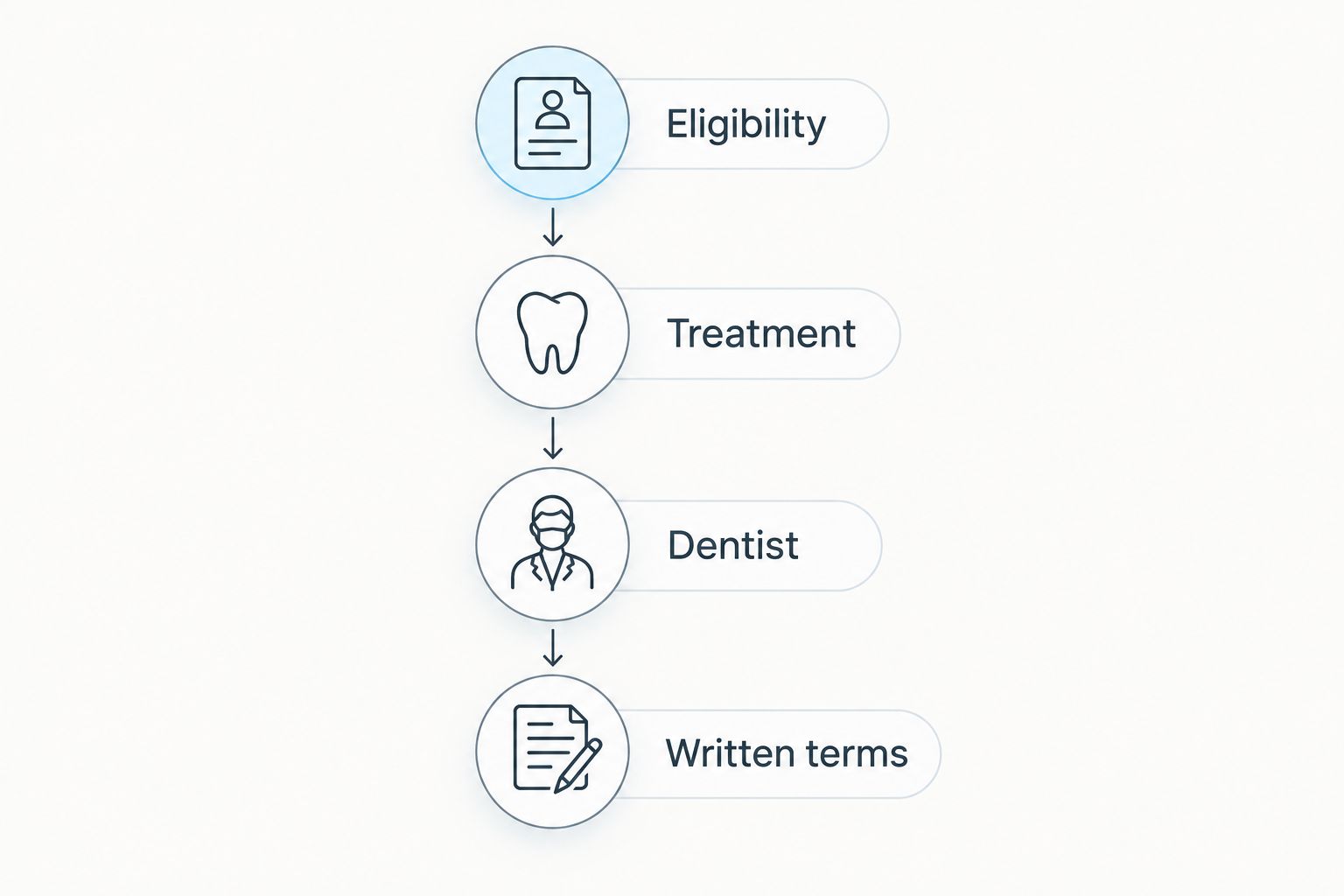
Your decision should follow this sequence:
- Eligibility: Identify employer, Medicaid, and military benefits first.
- Treatment: Get a written description of the care you need.
- Dentist: Confirm the provider and applicable network status.
- Written terms: Match the care to exclusions, limits, and enrollment rules.
For a useful comparison, request 2 written estimates for the same proposed treatment: one under the applicable membership terms and one under the insurance terms. Keep the procedure list identical; otherwise, you are comparing different care rather than different payment arrangements.
Which dental coverage option should you choose?
Start with employer-supported insurance when its benefits fit; choose a membership when routine care at one practice is your priority. Check Medicaid or military eligibility before replacing benefits you already have.
If you need major treatment, pause enrollment until the dentist and plan explain the relevant exclusions and timing. Buying coverage after a diagnosis does not automatically make that treatment eligible.
Keep 3 documents together: your treatment plan, the coverage or membership agreement, and the written estimate. Read them side by side before authorizing nonurgent treatment.
FAQ
What's better, a dental membership plan or insurance?
Employer-supported insurance is the first option to compare when its benefits fit your needs; a membership suits uninsured routine care at one practice. The better choice depends on your dentist, planned treatment, eligibility, and written terms.
Is a dental membership plan the same as dental insurance?
No. A dental membership is a direct agreement for specified services and treatment terms at participating practices, while insurance pays benefits according to a policy.
Can I use dental insurance and a membership together?
Only if the membership agreement and insurance rules permit the arrangement. Ask whether membership terms apply to insured treatment and request a written explanation before enrolling.
Will a new dental insurance policy cover treatment immediately?
Immediate coverage depends on the policy's effective date, waiting periods, and exclusions. Check the exact procedure rather than assuming all services begin together.
Does a dental membership cover implants or dentures?
A membership provides only the services and terms stated in its agreement. Do not assume implants, dentures, surgery, or sedation are included because routine care is included.
Should I check Medicaid before buying dental insurance?
Yes, check Medicaid eligibility and current state dental benefits before purchasing a separate arrangement. Confirm that your dentist participates and that your planned treatment meets program requirements.
Does TRICARE medical coverage automatically include dental coverage?
No. Dental eligibility and enrollment depend on beneficiary status and the applicable dental program, so verify those details separately from medical coverage.
What should I ask a Colorado Springs dentist before enrolling?
Ask for the exact treatment plan, the dentist's participation in your specific plan, and a written estimate. For a membership, also request the agreement, exclusions, renewal terms, and cancellation rules.
One last thing
A plan's annual maximum is generally a limit on what the insurer pays—not a limit on what you can owe. Do not confuse it with medical insurance's out-of-pocket maximum.
Before choosing your 2026 arrangement, ask one direct question: which parts of this treatment remain my responsibility after every benefit and restriction is applied? Get that answer in writing.