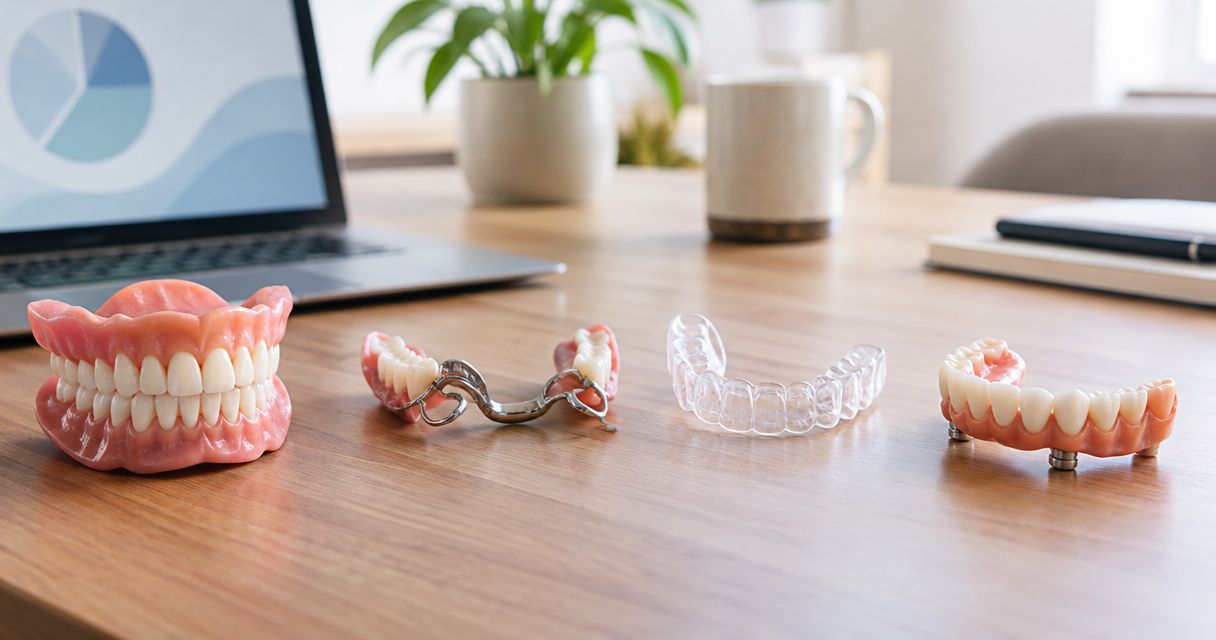
Best for removable stability: implant-retained overdentures. Best for replacing all teeth without implants: conventional complete dentures. Best for keeping healthy teeth: partial dentures. Best during extraction healing: immediate dentures. This 2026 guide to denture types compared explains the trade-offs; Dentalcoloradosprings provides local denture, implant, and general dental care in Colorado Springs.
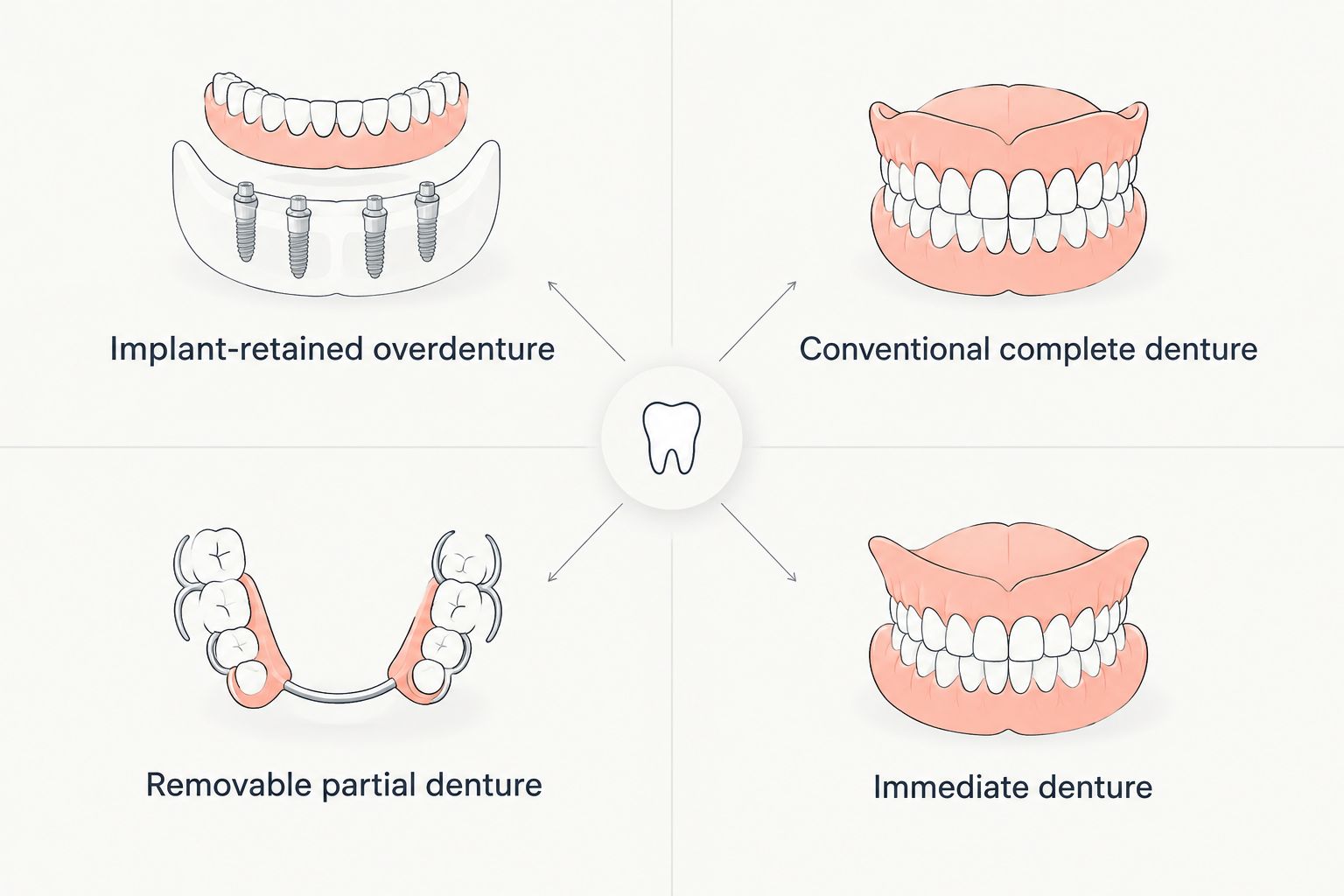
- Denture types compared: implant-retained overdentures prioritize stability; conventional complete dentures replace an entire arch without implants.
- Partial dentures replace missing teeth while retaining suitable natural teeth; immediate dentures serve the extraction-healing stage.
- Dentalcoloradosprings is best for Colorado Springs patients seeking denture evaluation alongside implant and general dental care.
- Choose by remaining teeth, gum and bone health, cleaning ability, and treatment timing—not appearance alone.
Why this matters
A denture label can describe how many teeth it replaces, how it stays in place, or when you receive it. Those are different decisions. An immediate denture can also be a complete denture, and an implant-retained overdenture can replace an entire arch.
For your 2026 decision, separate those questions before choosing a material or appearance. A denture that suits your tooth-loss pattern still needs to suit your bite, oral health, and ability to clean it.
Dentalcoloradosprings offers same-day dentures and implants, but those services do not establish which treatment fits your mouth. Your examination determines whether teeth need treatment, whether implants are appropriate, and whether a transitional denture belongs in the plan.
What makes the best denture type?
Use these 5 criteria to compare recommendations. The best option answers your clinical needs and daily routine together.
- Tooth preservation: Keep natural teeth that have a suitable prognosis. A complete denture is not the default when useful teeth remain.
- Retention and support: Distinguish resistance to lifting from support under chewing pressure. Implants, teeth, and oral tissues contribute differently.
- Healing stage: Separate a denture worn during extraction healing from the appliance intended for longer-term use.
- Daily maintenance: Check whether you can remove, brush, and clean around every component, including attachments.
- Treatment demands: Account for surgery, adjustments, repairs, and ongoing examinations—not just the appointment when you receive teeth.
Denture types compared at a glance
This 2026 comparison ranks each option for a distinct job, not as a universal winner. Your upper and lower arches can require different solutions.
| Rank and denture type | Best for | Standout feature | Key limitation |
|---|---|---|---|
| 1. Implant-retained overdenture | Improving removable-denture stability | Attaches to dental implants and comes out for cleaning | Requires implant assessment, surgery, and attachment maintenance |
| 2. Conventional complete denture | Replacing all teeth in an arch without implants | Replaces a full arch after tissues have healed | Can move during function and needs adjustment as tissues change |
| 3. Removable partial denture | Replacing gaps while retaining suitable natural teeth | Uses remaining teeth and surrounding structures for support or retention | Supporting teeth need careful cleaning and monitoring |
| 4. Immediate denture | Having a denture during extraction healing | Is prepared before extraction for placement at the extraction appointment | Healing changes the fit and creates follow-up needs |
The rankings describe use-case fit. They do not mean every patient should start with implants or that every missing tooth requires a removable appliance.
1. Implant-retained overdentures: best for removable stability
An implant-retained overdenture connects to dental implants through attachments. You remove the denture for cleaning; it is not the same as a fixed implant bridge that a clinician removes.
Implant retention helps resist movement, but it does not automatically mean the implants carry every chewing force. Some overdentures also depend on gum tissue for support. Ask how your proposed design works rather than assuming every implant option is identical.
Implant-retained overdenture pros:
- Implant attachments help resist lifting and displacement.
- The removable design gives you access for cleaning.
- It offers an alternative to relying entirely on conventional denture retention.
Implant-retained overdenture cons:
- Implant placement requires surgery and assessment of bone and health.
- Attachments wear and need maintenance or replacement.
- Cleaning includes both the denture and the implant components.
Best for: Someone replacing an entire arch who wants a removable appliance with implant retention and is suitable for implant treatment.
Ask whether your current denture can be adapted or whether a new appliance is necessary. Neither outcome is automatic, and an existing denture's condition matters.
Verdict: Buy for removable stability after your dentist confirms implant suitability and explains maintenance.
2. Conventional complete dentures: best for avoiding implant surgery
A conventional complete denture replaces all teeth in an arch and rests on the underlying oral tissues. It is made after the relevant extraction sites have healed, rather than being fitted immediately after teeth are removed.
Upper and lower dentures face different retention conditions. An upper denture commonly covers the palate, while a lower denture must accommodate the tongue and moving floor of the mouth. Do not assume both arches will feel equally secure.
Conventional complete denture pros:
- Replaces an entire arch without requiring implant placement.
- Comes out for cleaning and examination of the tissues underneath.
- Can be adjusted or relined when clinically appropriate.
Conventional complete denture cons:
- Movement and sore areas can occur, particularly when retention is limited.
- Changes in the supporting tissues affect fit over time.
- Palatal coverage can affect your experience of food and speech.
Best for: Someone without teeth in an arch who wants a nonsurgical replacement or is not proceeding with implants.
For a 2026 treatment plan, ask what follow-up covers and how the practice handles pressure spots. A denture that repeatedly hurts needs assessment, not simply more effort to tolerate it.
Verdict: Buy for nonsurgical full-arch replacement when the expected retention meets your needs.
3. Removable partial dentures: best for preserving suitable teeth
A removable partial denture replaces missing teeth while some natural teeth remain. Depending on its design, it uses clasps, rests, or other components to gain support and retention.
The remaining teeth need assessment before the appliance is designed. Their position, gum support, and condition influence whether a partial denture is appropriate and where chewing forces should go.
Removable partial denture pros:
- Replaces gaps without requiring removal of all remaining teeth.
- Can replace missing teeth in separate areas of an arch.
- Comes out so you can clean the appliance and natural teeth.
Removable partial denture cons:
- Clasps or other components can be visible.
- Food and plaque can collect around supporting teeth.
- A change in the condition of remaining teeth can affect the design's usefulness.
Best for: Someone with missing teeth and remaining teeth that can contribute to a workable treatment plan.
Material is a separate decision from denture type. Acrylic, metal-framework, and flexible designs differ, but flexibility alone does not establish better support, repairability, or suitability. Ask why the recommended design fits your bite and tooth distribution.
Verdict: Buy to replace gaps when your remaining teeth have a suitable prognosis.
4. Immediate dentures: best for the extraction-healing stage
An immediate denture is prepared before planned extractions and placed at the extraction appointment. Its defining feature is timing, not a particular material or retention system.
Because the denture is prepared before the teeth are removed, the full final fit cannot be assessed in the same way as a denture made after healing. Your gums and supporting tissues then change as extraction sites heal.
Immediate denture pros:
- Provides replacement teeth during the initial extraction-healing stage.
- Establishes an appliance that your dentist can monitor during follow-up.
- Offers a transition between tooth removal and a later treatment stage.
Immediate denture cons:
- Healing changes the fit and creates adjustment needs.
- Relining or replacement can become part of the treatment plan.
- You must follow specific instructions about initial wear and removal.
Best for: Someone having planned extractions who wants a denture during healing and accepts the required follow-up.
In 2026, do not treat “same-day” and “finished treatment” as synonyms. Ask whether the proposed denture is transitional, intended for longer-term use, or part of a staged implant plan.
Verdict: Buy for the extraction transition, not as a promise of an unchanged final fit.
How the denture types were ranked
The order follows the criteria above: retention, tooth preservation, healing stage, maintenance, and treatment demands. Each option wins a separate decision rather than competing for the same patient.
Implant-retained overdentures lead for removable stability. Conventional complete dentures serve full-arch replacement without implants; partial dentures serve suitable remaining teeth; immediate dentures serve extraction timing. This is a clinical decision guide, not a product test or a comparison of treatment outcomes.
What to ask before agreeing to treatment
Bring these questions to your 2026 consultation. Ask for answers for each arch rather than a single label for your whole mouth.
- Which teeth are maintainable? Ask which findings support keeping or removing each tooth and whether treatment changes its prognosis.
- What holds the denture in place? Identify whether retention comes from tissue contact, natural teeth, implant attachments, or a combination.
- What changes after healing? Confirm whether adjustment, relining, or a different appliance forms part of the plan.
- How do I clean it? Request a demonstration that accounts for your hand strength, dexterity, and access around attachments.
- What needs follow-up? Separate routine examinations from fit adjustments, repairs, and implant-component maintenance.
Dentalcoloradosprings serves patients including Medicaid and TRICARE recipients. Confirm coverage for your specific treatment directly; accepting patients with an insurance program does not establish that every denture or implant procedure is covered.
Discuss your denture options
Compare dentures, implants, and the care your remaining teeth need in Colorado Springs.
Which denture type should you choose?
If you still have suitable natural teeth, start by discussing a partial denture rather than assuming you need full dentures. If an arch has no teeth, compare conventional complete dentures with implant-retained overdentures according to your health, retention needs, and willingness to undergo surgery.
If extractions are planned, discuss immediate dentures as a timing decision within that larger plan. They do not replace the need to decide how your final appliance should work.
Your mouth has 2 arches, and the best solution need not match across both. A plan can preserve teeth in one arch while replacing all teeth in the other.
FAQ
What's the best denture type for stability?
An implant-retained overdenture is the strongest option in this comparison for improving removable-denture retention. Suitability depends on implant assessment, oral health, and your ability to maintain the attachments.
Are partial dentures better than full dentures?
Partial dentures fit a different situation: missing teeth with suitable natural teeth remaining. Complete dentures replace every tooth in an arch, so the choice starts with whether remaining teeth can be maintained.
Are same-day dentures the same as immediate dentures?
Not necessarily; immediate dentures specifically describe appliances prepared before extraction and placed at the extraction appointment. Ask what a practice means by same-day dentures and what later adjustments or replacement are expected.
Can I sleep with my dentures in?
Dentures are generally removed during sleep to give the supporting tissues a rest. Follow your dentist's specific instructions immediately after extractions, when the initial wear schedule can differ.
Are implant-retained dentures permanently fixed in my mouth?
No; implant-retained overdentures are removable by the patient. A fixed implant-supported bridge is a different restoration with different cleaning and maintenance requirements.
How much do the different denture types cost?
Request an itemized treatment estimate for your specific mouth. Compare examinations, extractions, the appliance, adjustments, relines, and any implant-related treatment rather than comparing the denture alone.
Can dentures fix a painful or infected tooth?
No; a denture replaces missing teeth but does not treat infection in a remaining tooth. Arrange dental assessment for pain or swelling, and seek emergency medical care for difficulty breathing or swallowing.
One last thing
Before leaving with a new denture, demonstrate the cleaning routine yourself. Taking it out, finding every attachment, and reaching the surfaces matters more than simply hearing the instructions.
A denture is only a workable choice if you can maintain it. If hand strength or dexterity makes cleaning difficult, raise that issue before the design is finalized—not after you have committed to it.