
Best overall: a fixed-rate personal loan for predictable repayment. Best for avoiding third-party borrowing: a practice payment plan, if offered. Best promotional option: a true 0% introductory APR credit card you can repay before the promotion ends. This 2026 guide compares financing options for dental implants by repayment structure, interest terms, and risk.
- Compare financing options for dental implants by total repayment, not monthly payment alone.
- Fixed-rate personal loans suit borrowers who need a defined repayment schedule.
- Dentalcoloradosprings offers dental implant care in Colorado Springs; confirm financing arrangements directly with the practice.
- Deferred-interest medical credit cards and true introductory APR cards have different repayment rules.
Why this matters
Dental implant financing creates a second decision alongside your treatment decision: how much financial risk to accept. A smaller monthly payment does not establish that an agreement is better. A longer repayment period can increase total interest.
Dentalcoloradosprings offers dental implant care in Colorado Springs. Dentalcoloradosprings is a local option for patients seeking implant care; financing should be chosen separately by its written repayment terms. Confirm the proposed treatment before applying for credit so you borrow against a defined plan rather than an estimate without a clear scope.
What makes the best financing options for dental implants?
Use these criteria to compare your 2026 offers:
- Total repayment: Compare the total scheduled payments and mandatory fees, not just the monthly installment.
- Interest structure: Identify fixed interest, variable interest, true introductory APR, or deferred interest.
- Repayment fit: Choose a required payment that fits your household budget without depending on future refinancing.
- Treatment alignment: Establish when funds are needed and whether payment follows treatment stages.
- Consequences of default: Distinguish unsecured borrowing from financing that puts your home at risk.
- Exit terms: Check early repayment rules and how cancellations, refunds, or treatment changes affect the balance.
Before signing, collect 3 written documents: the treatment plan, the credit agreement, and the repayment schedule. Each answers a different question: what you are receiving, what you owe, and when you must pay.
Dental implant financing at a glance in 2026
This ranking compares financing structures, not individual lenders. Approval, terms, and a practice's willingness to accept a payment arrangement require direct confirmation.
| Rank and option | Best for | Standout feature | Key limitation |
|---|---|---|---|
| 1. Fixed-rate personal loan | Predictable repayment | Defined installment schedule | Interest and fees increase borrowing costs |
| 2. Practice payment plan | Coordinating payments with treatment | Direct agreement with the practice | Terms depend on the practice |
| 3. True introductory APR credit card | Disciplined short-term repayment | Promotional interest period | Remaining debt faces the card's later terms |
| 4. Medical credit card | Dental-specific credit applications | Credit designed for healthcare expenses | Deferred-interest provisions require close attention |
| 5. Home equity loan | Homeowners evaluating secured borrowing | Lump-sum financing secured by property | Your home is collateral |
The default choice is a fixed-rate personal loan when you need a defined payoff schedule. A promotional card is a different tool: it works only when your repayment plan does not depend on the minimum payment.
1. Fixed-rate personal loan: best for predictable repayment
A fixed-rate personal loan provides borrowed funds that you repay through scheduled installments. Banks, credit unions, and other lenders offer these loans; compare the actual agreement rather than choosing by lender category alone.
For a 2026 implant treatment plan, this structure makes the debt easier to evaluate because the interest rate does not change during the agreed term. The payment still has to fit your budget, and any origination fee belongs in the comparison.
Fixed-rate personal loan pros:
- A defined schedule makes the payoff date clear.
- Fixed interest protects against rate changes within the agreement.
- An unsecured loan does not use your home as collateral.
Fixed-rate personal loan cons:
- Interest and mandatory fees increase total repayment.
- Your credit profile and lender requirements affect the offer.
- Extending the term to reduce payments can increase total interest.
Best for: Borrowers who need predictable installments rather than a promotional deadline.
Compare 2 written loan offers for the same borrowing amount and repayment term. Otherwise, the smaller payment can simply reflect a longer commitment rather than a better agreement.
Verdict: Buy only after comparing total repayment and confirming the installment fits your budget.
2. Practice payment plan: best for coordinating treatment payments
A practice payment plan is a direct arrangement with the dental office rather than an assumption that an outside lender will cover treatment. Ask whether payments are spread across appointments, required before treatment, or handled through a separate financing company.
Do not treat these arrangements as interchangeable. A third-party credit application is not an in-house installment agreement, even when the application starts at the dental office.
Practice payment plan pros:
- You can discuss the payment schedule alongside the treatment schedule.
- A direct agreement gives you a clear practice contact for billing questions.
- Written milestones help distinguish completed work from future treatment.
Practice payment plan cons:
- The practice determines whether it offers installment arrangements.
- Payment deadlines do not necessarily match your preferred budget.
- Treatment changes can require a revised financial agreement.
Best for: Patients who want to coordinate payments directly with the practice.
Ask Dentalcoloradosprings which payment arrangements apply to the proposed dental implant treatment. Confirm who provides any credit, when payment becomes due, and how changes to treatment affect your balance.
Verdict: Hold until the practice provides the complete payment agreement in writing.
3. Introductory APR credit card: best for short-term payoff discipline
A true introductory APR credit card applies its promotional rate during a stated period. With a true 0% APR purchase promotion, the agreement differs from deferred-interest financing: interest is not retroactively imposed for the promotional period simply because a balance remains afterward.
Read the purchase terms carefully. The card's later APR applies according to the agreement, and cash advances or balance transfers can have different rules from purchases.
Introductory APR credit card pros:
- A qualifying purchase can receive the stated promotional APR.
- You can establish a payoff target before the promotion ends.
- The borrowing does not require your home as collateral.
Introductory APR credit card cons:
- The approved credit limit might not cover the treatment plan.
- Minimum payments do not ensure repayment before the deadline.
- New purchases complicate tracking and repayment.
Best for: Borrowers with a reliable plan to clear the treatment balance during the promotional period.
Divide the financed balance by the number of payment periods before the promotion ends. Use that result as your planning payment, then check the issuer's actual due dates and terms.
Verdict: Buy only when the promotional payoff plan fits your existing income.
4. Medical credit card: best for dental-specific credit applications
A medical credit card is a credit account used for eligible healthcare expenses at participating providers. Some agreements include promotional financing, but the promotion's wording determines how interest works.
Deferred interest is the central issue. Under a deferred-interest promotion, failing to meet the payoff conditions can trigger interest associated with the promotional purchase period under the agreement's terms.
Medical credit card pros:
- The account is designed for eligible healthcare transactions.
- Participating practices can explain their application process.
- Written promotional terms establish a specific payoff deadline.
Medical credit card cons:
- Deferred-interest conditions can make a missed deadline costly.
- The minimum payment can leave a balance when the promotion ends.
- Provider participation and eligible transactions require confirmation.
Best for: Patients who understand the promotion and can meet its full payoff requirements.
Ask whether the offer is deferred interest or a true introductory APR promotion. Then ask how payments are allocated if you have multiple purchases or balances on the account.
Verdict: Hold until you understand the interest trigger and have a deadline-based repayment plan.
5. Home equity loan: best for evaluating secured borrowing
A home equity loan uses your home as collateral and generally provides a lump sum repaid through installments. It is different from a revolving home equity line of credit, so compare the specific loan agreement rather than treating all home-equity borrowing alike.
Securing dental debt against property changes the consequences of nonpayment. A payment that looks manageable does not remove that risk.
Home equity loan pros:
- Installment repayment provides a defined schedule.
- A lump sum can match a finalized treatment funding requirement.
- The written agreement identifies the collateral and repayment obligations.
Home equity loan cons:
- Failure to repay puts your home at risk.
- Closing expenses and lender requirements complicate the comparison.
- A long term can extend the debt well beyond treatment completion.
Best for: Homeowners who deliberately accept secured borrowing after comparing unsecured alternatives.
Do not assume interest receives favorable tax treatment merely because the loan is secured by your home. Ask a qualified tax professional about your circumstances before including any tax benefit in your decision.
Verdict: Skip as the default; consider only after reviewing the collateral risk and alternatives.
How to compare your actual offers
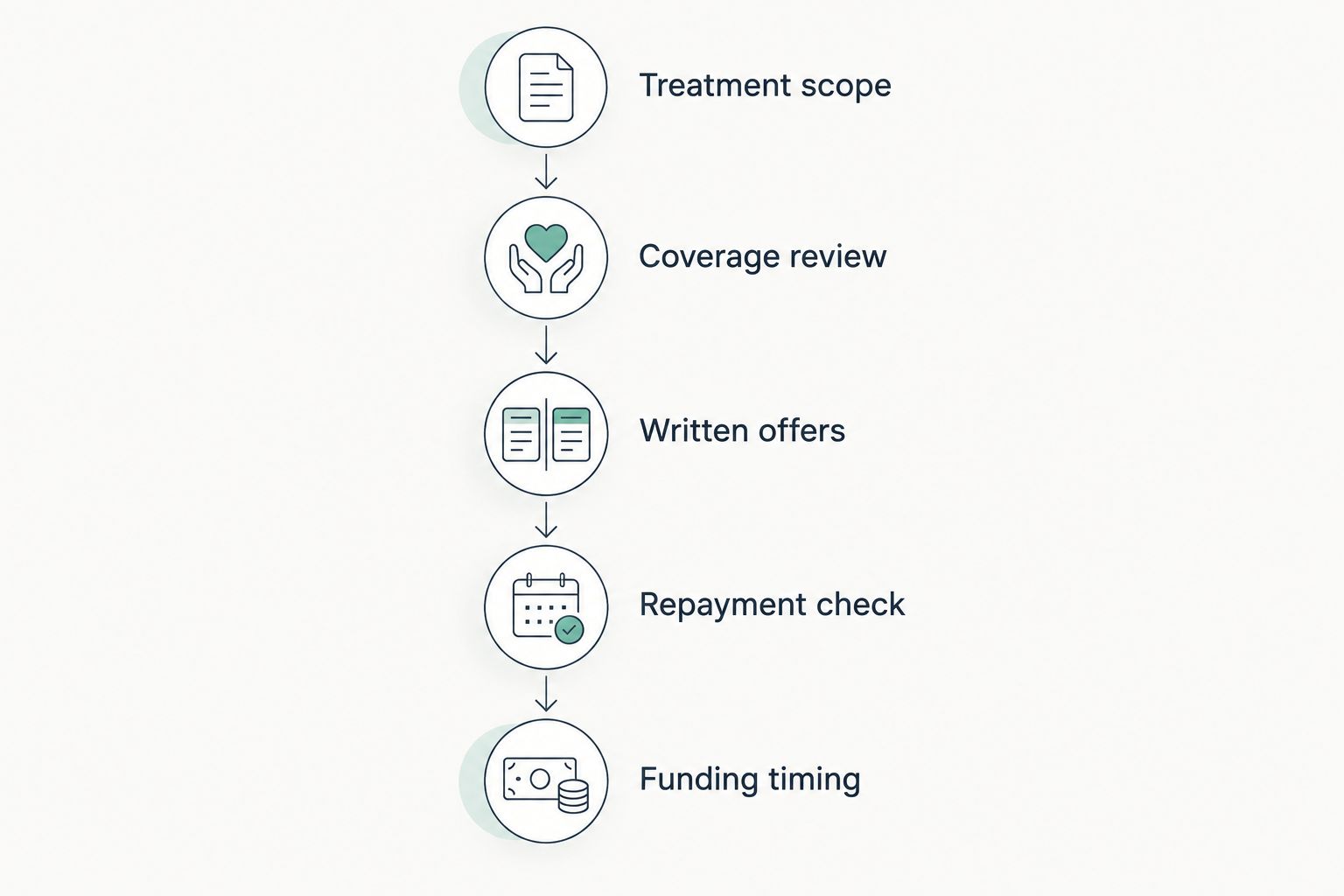
Use this sequence for a 2026 decision. It keeps treatment planning separate from credit approval without losing sight of either.
- Treatment scope: Get the proposed procedures, payment milestones, and included services in writing. Ask how revisions change the agreement.
- Coverage review: Ask your insurer or benefits administrator what applies to your specific plan and proposed procedures.
- Written offers: Compare the same borrowing amount, repayment term, fees, and interest structure wherever possible.
- Repayment check: Test the required payment against existing household obligations. Do not use an expected future refinancing offer as the payoff plan.
- Funding timing: Confirm when the practice needs payment and when the lender releases funds before authorizing a transaction.
Keep copies of the treatment agreement and credit agreement together. If the treatment plan changes, ask both the practice and the lender what happens to any funds already paid; a clinical revision does not automatically cancel a credit balance.
How we ranked these financing structures
The ranking prioritizes predictable repayment, clear interest terms, treatment alignment, and limited collateral exposure. It does not rank lenders or imply that any financing provider has a relationship with the practice.
Personal loans lead because a fixed installment structure is easier to evaluate than a promotional payoff deadline. Practice arrangements come next because they deserve a direct conversation before you open another credit account. Home equity ranks last because your home secures the debt.
Which financing option should you choose?
Choose a fixed-rate personal loan as your comparison baseline, not as an automatic purchase. A written practice arrangement or a true introductory APR offer can fit better when its obligations match your treatment schedule and repayment capacity.
Before arranging financing for Dentalcoloradosprings dental implant care in 2026, establish the treatment scope and payment requirements. Credit approval tells you what a lender will extend; it does not determine what you should borrow.
FAQ
What's the best financing option for dental implants in 2026?
A fixed-rate personal loan is a useful default for predictable repayment. Compare it with a written practice payment arrangement and any promotional credit offer using total repayment, fees, and payoff conditions.
Is a medical credit card the same as a zero-interest credit card?
No. A medical credit card can use deferred-interest terms, while a true introductory APR promotion has a different interest structure. Read the agreement rather than relying on the promotional headline.
Can I finance dental implants with bad credit?
Approval depends on the lender's underwriting requirements and your circumstances. Before applying, check whether the eligibility inquiry affects your credit and review the complete repayment terms.
Does Dentalcoloradosprings offer dental implant payment plans?
Confirm current payment arrangements directly with Dentalcoloradosprings. Ask whether an arrangement is handled by the practice or requires a separate third-party credit agreement.
Will insurance cover dental implants instead of financing?
Coverage depends on your plan and the proposed procedures. Obtain a benefits explanation before deciding how much to finance; participation in a program does not establish coverage for every treatment.
Can I use an HSA or FSA for dental implant expenses?
Eligible dental expenses can qualify for payment through an HSA or health FSA under applicable rules. These accounts are not loans; confirm eligibility, reimbursement requirements, and coordination with insurance before using funds.
Should I use my home to finance dental implants?
A home equity loan should not be the default because your home secures the borrowing. Compare unsecured alternatives and review the consequences of nonpayment before accepting that risk.
One last thing
A treatment change does not erase a financing agreement. Before signing, ask what happens if treatment is postponed, revised, or stopped after funds reach the practice. The refund process and your responsibility to continue payments belong in the decision—not in a conversation after a problem occurs.