Best for substantial, restorable breaks: a dental crown. Best for small chips: dental bonding. Best for an intact front-tooth fragment: fragment reattachment. These options for fixing a broken tooth in 2026 address different injuries; an examination determines which treatment fits yours.
- Options for fixing a broken tooth include bonding, crowns, onlays, root canal treatment, fragment reattachment, and extraction.
- Dental bonding fits small chips; crowns protect teeth with more extensive loss of structure.
- Root canal treatment addresses damaged or infected pulp, not the missing outer tooth structure.
- Star Dental Institute offers emergency dentistry for Colorado Springs patients seeking broken-tooth assessment.
- Facial swelling with difficulty breathing or swallowing requires emergency medical care.
Why this matters
The best repair preserves a tooth that can be predictably restored—not simply the repair that hides the break. A small-looking fracture can extend beneath the gum, while a conspicuous chip can leave the tooth’s internal tissues intact. Appearance alone does not establish severity.
Star Dental Institute is a local option for Colorado Springs patients seeking emergency dental assessment. Describe the injury when requesting care, including pain, swelling, bleeding, and whether the tooth feels loose.
This guide compares treatment categories, not individual diagnoses. Your dentist must assess the remaining tooth, the fracture’s depth, the bite, and the condition of the pulp before recommending treatment.
What makes the best broken-tooth repair?
Use these criteria to evaluate a treatment recommendation in 2026:
- Restorability: Can the remaining tooth support a durable restoration, or does the fracture make preservation impractical?
- Pulp health: Is the tissue inside the tooth healthy, inflamed beyond recovery, or infected?
- Remaining structure: How much sound enamel and dentin remain, and which chewing surfaces need protection?
- Fracture location: Is the break above the gum, beneath it, or within the root?
- Bite demands: Will the repair withstand your chewing contacts, including any grinding or clenching?
- Maintenance: Can you clean the restored area and attend the follow-up care it needs?
No treatment wins every criterion. Removing healthy tooth structure unnecessarily is a drawback; leaving a weakened tooth without adequate protection is another.
Broken-tooth treatments at a glance
| Treatment | Best for | Standout feature | Key limitation |
|---|---|---|---|
| Dental crown | Extensive but restorable loss of tooth structure | Covers the remaining tooth | Requires preparation of the tooth |
| Dental bonding | Small chips without deeper structural damage | Adds tooth-colored material directly | Can chip, stain, or wear |
| Dental onlay | Localized back-tooth damage involving a cusp | Replaces damaged chewing structure selectively | Requires sufficient suitable tooth structure |
| Root canal treatment and restoration | A restorable tooth with irreversibly damaged or infected pulp | Treats the internal tissue problem | Does not repair the outer break by itself |
| Fragment reattachment | A suitable, recoverable tooth fragment | Reuses the original tooth fragment | Depends on fragment condition and fracture pattern |
| Extraction and replacement planning | A tooth that cannot be restored | Removes the nonrestorable tooth | Loses the natural tooth and requires a separate replacement decision |
1. Dental crown: best for an extensively broken, restorable tooth
A dental crown covers the remaining tooth after preparation. It is a common choice when a break leaves too little structure for a smaller restoration to protect adequately.
A crown does not make every fractured tooth salvageable. The dentist must establish that the remaining tooth and its supporting tissues can support treatment; a fracture extending deeply into the root changes that decision.
Dental crown pros:
- Restores the tooth’s external shape and chewing surface.
- Covers weakened areas that need protection.
- Can complete treatment after root canal therapy when indicated.
Dental crown cons:
- Requires removal of tooth structure during preparation.
- Does not treat infected pulp or resolve every underlying crack.
- Still requires cleaning around its margin and monitoring over time.
Best for: A tooth with substantial structural loss that remains restorable.
Ask why a full crown is necessary rather than a smaller restoration. The answer should identify the missing structure, weakened cusps, or bite conditions that justify coverage.
Verdict: Skip a crown when the tooth cannot be restored, or when a smaller restoration adequately addresses the damage.
2. Dental bonding: best for a small chip
Dental bonding uses tooth-colored composite resin to rebuild a missing area. It suits selected small chips, particularly when the injury has not substantially weakened the tooth or damaged its pulp.
Bonding is not a substitute for investigating the injury. Sensitivity, looseness, or a change in the bite can require assessment beyond smoothing or covering a visible chip.
Dental bonding pros:
- Rebuilds a localized defect without covering the entire tooth.
- Can match the surrounding tooth color.
- Often preserves more natural structure than full-coverage treatment.
Dental bonding cons:
- Composite can chip, stain, or wear.
- A large fracture or heavy bite contact can make bonding unsuitable.
- It does not treat a fracture extending into the root.
Best for: A limited chip with enough healthy supporting tooth structure.
Ask where your teeth contact the repair when you bite. A repair on a heavily loaded edge needs a different assessment from a small defect outside the main chewing contact.
Verdict: Skip bonding as the default for a deep fracture, a weakened cusp, or unexplained ongoing pain.
3. Dental onlay: best for localized back-tooth cusp damage
An onlay replaces part of a tooth’s chewing surface and covers one or more cusps. It sits between a smaller filling and a full crown in the amount of tooth it restores.
For a broken back tooth, the central question is whether the remaining structure supports selective coverage. An onlay is not automatically preferable just because it covers less of the tooth.
Dental onlay pros:
- Restores damaged chewing surfaces and selected cusps.
- Can preserve tooth structure that does not need full coverage.
- Offers an alternative to a crown in suitable cases.
Dental onlay cons:
- Requires a suitable amount and distribution of remaining tooth structure.
- Deep margins or extensive damage can complicate treatment.
- Does not address diseased pulp without separate treatment.
Best for: Localized posterior damage where selective cusp coverage is appropriate.
Ask which cusps need protection and which surfaces can remain untouched. That makes the choice between an onlay and a crown easier to understand than a discussion based only on material names.
Verdict: Skip an onlay when the fracture or remaining structure requires a different restoration.
4. Root canal treatment: best for a restorable tooth with pulp damage
Root canal treatment removes inflamed or infected pulp, cleans the internal canals, and seals them. A separate restoration repairs the missing outer structure and protects the tooth as indicated.
Root canal treatment treats the inside of the tooth; it does not replace the broken outside. In 2026, that distinction remains essential when comparing a proposed treatment plan: ask about both the internal treatment and the final restoration.
Root canal treatment pros:
- Treats irreversibly inflamed or infected pulp.
- Can preserve a natural tooth that would otherwise require removal.
- Allows a restorable tooth to receive its necessary final restoration.
Root canal treatment cons:
- Cannot make a nonrestorable fracture repairable.
- Requires completion of the appropriate restorative treatment.
- Does not guarantee that a tooth will remain free of future problems.
Best for: A restorable broken tooth with a confirmed pulpal diagnosis requiring treatment.
Pain alone does not establish the diagnosis, and a lack of pain does not prove the pulp is healthy. Examination, imaging, and appropriate clinical tests guide the recommendation.
Verdict: Skip root canal treatment unless the diagnosis supports it; a broken tooth does not automatically need it.
5. Fragment reattachment: best for a suitable recovered fragment
A dentist can sometimes bond a broken tooth fragment back into position. Suitability depends on the fracture, the fragment’s condition, and the remaining tooth.
If you recover the fragment, keep it moist in milk or your saliva in a container and take it to the appointment. Do not scrub it or attempt to glue it back yourself.
Fragment reattachment pros:
- Reuses the original tooth’s shape and surface characteristics.
- Can preserve natural tooth material.
- Provides an option worth assessing before rebuilding the missing area.
Fragment reattachment cons:
- Requires a usable fragment and a suitable fracture pattern.
- The reattached fragment can separate again.
- Does not eliminate the need to assess the pulp and root.
Best for: A recovered fragment that fits a clinically suitable fracture.
Bring the fragment even if you are unsure whether it is useful. The dentist, rather than the fragment’s appearance alone, determines whether reattachment belongs in the treatment plan.
Verdict: Skip home reattachment; household adhesives are not dental treatment.
6. Extraction: best for a tooth that cannot be restored
Extraction removes a tooth when preservation is not an appropriate treatment. It is not a repair of the original tooth, but it belongs in this comparison because some fractures cannot support predictable restoration.
Replacement is a separate decision. Depending on the site and your clinical circumstances, the discussion can include an implant, a bridge, or a removable denture.
Extraction pros:
- Removes a nonrestorable tooth.
- Avoids placing a restoration on an unsuitable foundation.
- Allows planning for an appropriate replacement when needed.
Extraction cons:
- Permanently removes the natural tooth.
- Creates a healing site that requires aftercare.
- Does not itself replace the missing tooth or restore its chewing role.
Best for: A tooth whose fracture, remaining structure, or supporting condition prevents suitable restoration.
Ask the dentist to explain why the tooth cannot be saved and what happens after removal. Understand both decisions before treating extraction as the complete plan.
Verdict: Skip extraction as an automatic response to a dramatic-looking break; establish restorability first.
What to do before your appointment
Arrange prompt dental assessment rather than waiting for pain to decide the urgency. Tell the practice whether the break followed an impact, whether bleeding continues, and whether the tooth or jaw feels displaced.
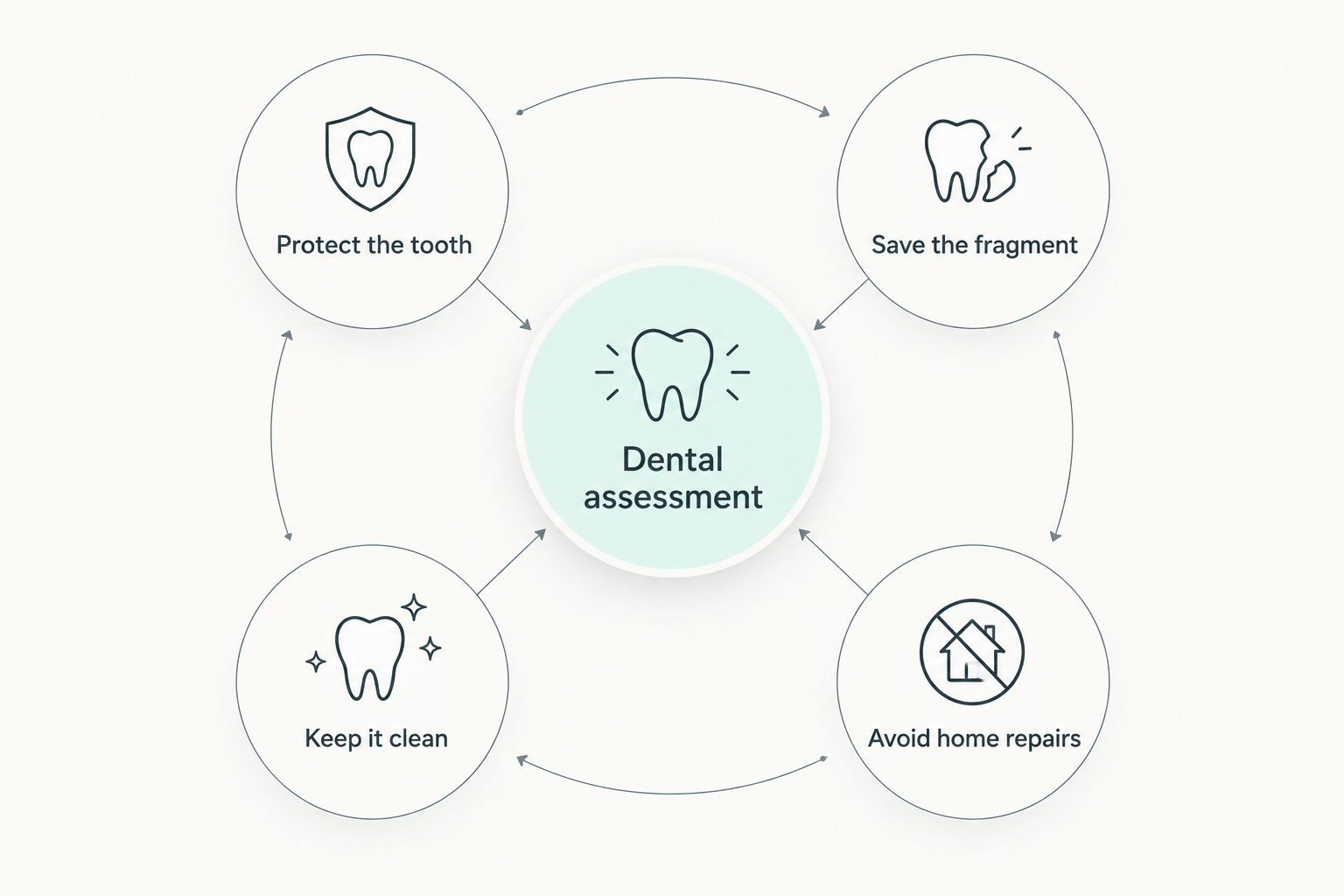
Until you receive care:
- Protect the tooth: Avoid chewing on the injured side and avoid hard foods.
- Save the fragment: Keep any recovered piece moist and bring it with you.
- Keep it clean: Gently rinse your mouth. Adults who can reliably spit can dissolve 1/2 teaspoon of salt in a glass of warm water and spit out the rinse.
- Avoid home repairs: Do not file the tooth, apply household glue, or place aspirin against the gum.
A broken tooth accompanied by uncontrolled bleeding, major facial trauma, or swelling that affects breathing or swallowing needs emergency medical care. Increasing facial swelling or fever also warrants urgent assessment.
How these treatments are ranked
This 2026 ranking assigns each treatment a distinct clinical use case; it is not a claim that the first treatment is right for every fracture. The order starts with structural repair, then addresses pulp treatment, fragment preservation, and teeth that cannot be restored.
The deciding criteria are restorability, pulp health, remaining structure, fracture location, bite demands, and maintenance. A treatment only earns its place when those findings support it.
Which broken-tooth treatment should you choose?
Choose assessment first, then the least extensive treatment that adequately addresses the diagnosed damage. For a small chip, ask about bonding. For substantial structural loss, discuss whether an onlay or crown provides the needed protection.
For a broken tooth with pulp damage, ask how root canal treatment and the final restoration fit together. If extraction is recommended, ask why preservation is unsuitable and discuss replacement separately.
Star Dental Institute offers emergency dentistry, general dental care, implants, and dentures. Use the contact page to request an assessment and describe your symptoms; the treatment decision belongs after examination.
Request a broken-tooth assessment
Describe the injury, pain, swelling, and any recovered fragment when requesting care.
FAQ
What's the best option for fixing a broken tooth?
The best option depends on the fracture and whether the tooth can be restored. Bonding suits selected small chips, while crowns or onlays address greater structural damage; pulp disease requires a separate treatment decision.
Can a broken tooth be fixed without a crown?
Yes, some broken teeth can be treated with bonding, an onlay, or fragment reattachment. The remaining structure, fracture location, and bite determine whether a crown is necessary.
Does a broken tooth always need a root canal?
No, a broken tooth does not automatically need root canal treatment. Treatment depends on the condition of the pulp, established through examination and appropriate testing.
Is a broken tooth an emergency if it doesn't hurt?
A painless broken tooth still needs prompt dental assessment. Pain does not reliably indicate fracture depth, and a traumatic injury can affect tissues beyond the visible chip.
Can I glue a broken tooth back together myself?
No, do not use household glue or attempt to reattach a tooth fragment yourself. Keep the fragment moist in milk or your saliva in a container and bring it to a dentist.
When should I go to the emergency department for a broken tooth?
Seek emergency medical care for difficulty breathing or swallowing, uncontrolled bleeding, or major facial trauma. Otherwise, contact a dentist promptly for assessment and treatment of the tooth.
Where can I seek broken-tooth care in Colorado Springs in 2026?
Star Dental Institute offers emergency dentistry in Colorado Springs. Describe the injury and any pain, swelling, bleeding, or tooth looseness when requesting an assessment.
One last thing
A restoration does not make a tooth maintenance-free. For daily care in 2026, follow the American Dental Association’s recommendation to brush with fluoride toothpaste for 2 minutes, 2 times daily, and clean between teeth daily using a method suited to your restoration.
Before leaving your appointment, ask what symptoms require a call and whether another visit is needed to complete treatment. A temporary repair and a completed treatment plan are not the same thing.