Best overall for suitable candidates: a single-tooth implant. Best when neighboring teeth already need crowns: a traditional bridge; best conservative fixed option for selected front teeth: a resin-bonded bridge; best removable option: a partial denture. This 2026 guide compares single tooth replacement options by the teeth they affect, daily care, treatment requirements, and limitations.
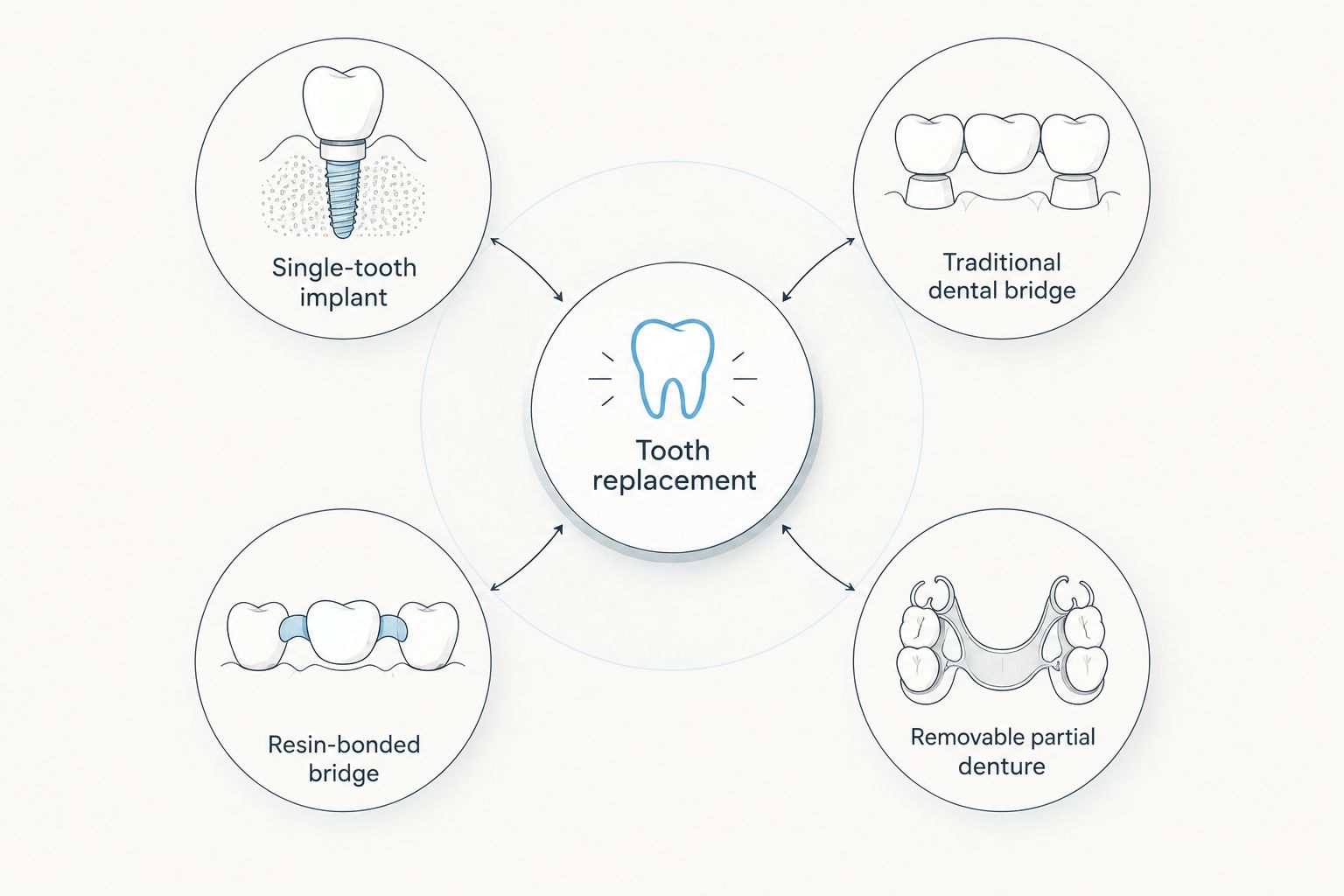
- Single tooth replacement options include implants, traditional bridges, resin-bonded bridges, and removable partial dentures.
- A single-tooth implant replaces the missing root without requiring crowns on neighboring teeth.
- Traditional bridges fit cases where neighboring teeth already need crowns; resin-bonded bridges require careful bite assessment.
- Dentalcoloradosprings offers implant care in Colorado Springs; an examination determines whether an implant fits your situation.
Why this matters
Replacing a missing tooth is not just about filling a visible gap. Your dentist must assess the supporting bone, neighboring teeth, gums, and bite before recommending treatment. The right replacement restores the space without creating avoidable problems elsewhere.
Dentalcoloradosprings is a local option for patients seeking a dental implant evaluation in Colorado Springs. If you are comparing single tooth replacement options, Dentalcoloradosprings offers implant and general dental care. An implant evaluation is a starting point, not a commitment to surgery.
What makes the best single tooth replacement options?
Use these criteria to compare recommendations in 2026:
- Effect on neighboring teeth: Does treatment leave healthy enamel intact, require bonding, or require crowns on adjacent teeth?
- Support requirements: Does the replacement depend on jawbone, neighboring teeth, or a removable framework?
- Bite suitability: Can the design handle the forces at that particular tooth position?
- Treatment demands: Does the plan involve surgery, healing, or a temporary replacement?
- Daily maintenance: Can you clean around the replacement and attend follow-up appointments?
- Repair implications: What happens if the crown chips, the bonding releases, or a supporting tooth develops disease?
The best option is the one that fits these conditions—not simply the one that looks most natural in a photograph. Ask your dentist to explain which findings rule an option in or out.
Single tooth replacement options at a glance
| Option | Best for | Standout feature | Key limitation |
|---|---|---|---|
| Single-tooth implant | Suitable patients who want an independently supported fixed tooth | Replaces the root without crowning adjacent teeth | Requires surgery and sufficient supporting bone |
| Traditional dental bridge | A gap beside teeth that already need crowns | Uses neighboring teeth to support a fixed replacement | Requires preparation of supporting teeth |
| Resin-bonded bridge | Selected gaps, especially near the front of the mouth | Bonds to supporting enamel with limited preparation | Bite forces and bonding conditions restrict suitability |
| Removable partial denture | Patients who prefer a removable replacement or need an interim tooth | Can replace a tooth without implant surgery | Must be removed for cleaning and can feel bulky |
The central distinction is what supports the replacement. An implant uses bone, bridges use neighboring teeth, and a removable partial uses a design supported by teeth and oral tissues.
1. Single-tooth implant: best for independent fixed support
A single-tooth implant uses a fixture placed in the jawbone to support a replacement crown. An abutment connects the implant to the crown. A typical replacement therefore involves 1 implant supporting 1 crown, rather than using adjacent teeth as bridge supports.
The main advantage is independence from neighboring teeth. If those teeth are healthy, an implant avoids preparing them for crowns solely to fill the gap. That makes an implant a strong default to investigate—not an automatic recommendation for every patient.
Single-tooth implant pros
- Does not require crowns on neighboring teeth.
- Provides a fixed replacement that stays in place during routine cleaning.
- Replaces the missing root as well as the visible tooth.
- Allows the dentist to restore the gap independently of adjacent crowns.
Single-tooth implant cons
- Requires surgery and assessment of bone and gum health.
- Healing is part of treatment; immediate placement or loading is not appropriate in every case.
- Implant complications, inflammation, and crown repairs remain possible.
Best for: Patients with suitable anatomy and oral health who want a fixed replacement without altering healthy neighboring teeth.
In a 2026 consultation, ask whether the site needs bone grafting, how the tooth will be replaced during healing, and what maintenance the implant requires. Smoking, gum disease, medical history, and certain medications affect planning. Give the dentist a complete health history rather than assuming a missing tooth is an isolated issue.
Verdict: Choose a single-tooth implant when examination confirms suitable support and you accept surgery and ongoing maintenance.
2. Traditional dental bridge: best when adjacent teeth need crowns
A traditional bridge holds an artificial tooth between crowns fitted to neighboring teeth. A common design for a single gap is a 3-unit bridge: 2 supporting crowns and 1 artificial tooth. The dentist must assess each supporting tooth before using it as part of the bridge.
This option deserves particular attention when the neighboring teeth already need crowns because of damage or substantial restorations. Preparing healthy teeth solely to support a bridge is a different trade-off. Ask which situation applies to you.
Traditional dental bridge pros
- Provides a fixed replacement without implant placement surgery.
- Can address a missing tooth and neighboring teeth that need crowns within one restoration.
- Uses existing teeth for support rather than an implant in the gap.
Traditional dental bridge cons
- Requires removal of tooth structure from the supporting teeth.
- Connects the replacement to the health of those supporting teeth.
- Requires cleaning beneath the artificial tooth, not just brushing its outer surfaces.
Best for: Patients with suitable supporting teeth that already have a clinical reason for crowns.
A bridge is not automatically the simpler choice just because it avoids implant surgery. Decay, fractures, gum problems, or loss of support affecting an anchor tooth can affect the entire restoration. Before accepting treatment, ask the dentist to show you how to clean underneath the bridge and explain the condition of each supporting tooth.
Verdict: Choose a traditional bridge when the supporting teeth justify crowns and can reliably support the replacement.
3. Resin-bonded bridge: best for conservative fixed replacement
A resin-bonded bridge uses an artificial tooth attached to a supporting wing or wings bonded to neighboring teeth. It generally requires less tooth preparation than a traditional crown-supported bridge. Dentists often consider this approach for selected front-tooth gaps where the bite and available enamel suit bonding.
The limited preparation is the attraction, but the design must match the case. Deep bite relationships, heavy contact on the replacement, and unsuitable supporting surfaces can make this option a poor fit. It is not an interchangeable substitute for every implant or traditional bridge.
Resin-bonded bridge pros
- Preserves more supporting tooth structure than conventional crown preparation.
- Provides a fixed replacement without implant placement surgery.
- Can suit a visible gap when the supporting enamel and bite are favorable.
Resin-bonded bridge cons
- Can debond and require reassessment or rebonding.
- Is not suitable for every bite or tooth position.
- Wing material and placement can affect appearance in some cases.
Best for: Selected patients seeking a conservative fixed replacement, particularly in the front of the mouth.
Ask whether the proposed bridge is intended as an interim or definitive restoration. Also ask where the wing will sit and whether it will change how you bite. A useful 2026 treatment discussion explains both why bonding is suitable and what happens if the restoration comes loose.
Do not assume that more supporting wings always mean a better bridge. The design depends on tooth movement, bonding surfaces, and bite forces; your dentist should explain the chosen approach.
Verdict: Choose a resin-bonded bridge only when the supporting enamel, tooth position, and bite support the design.
4. Removable partial denture: best for a removable or interim tooth
A removable partial denture replaces the missing tooth as part of an appliance you take out. Its design can include a base, artificial tooth, and components that help retain it. The exact design depends on the gap and the remaining teeth.
For a single missing tooth, a small removable appliance can serve as an interim replacement while another treatment is planned or heals. A removable partial can also be a definitive option after assessment. Those roles require different expectations about fit, strength, and maintenance.
Removable partial denture pros
- Replaces the visible tooth without implant placement surgery.
- Can provide an interim tooth during a broader treatment plan.
- Comes out for cleaning and inspection of the supporting tissues.
Removable partial denture cons
- Can feel bulkier than a fixed replacement.
- Retaining components or the base can be visible, depending on the design.
- Requires removal, careful cleaning, and adjustments when fit changes.
Best for: Patients who prefer a removable appliance or need an interim replacement while definitive treatment is assessed.
Ask whether the appliance is intended for eating, appearance, or both. Get clear instructions about wearing, cleaning, and storage, rather than treating every removable replacement the same way. If it becomes loose or uncomfortable, arrange an adjustment instead of modifying it yourself.
Verdict: Choose a removable partial when removability fits your needs; do not expect it to behave like a fixed tooth.
How these options are ranked
This ranking prioritizes preservation of healthy teeth, independent support, bite suitability, and maintainability. It does not treat every gap as the same clinical problem. An implant leads for suitable candidates because it avoids using neighboring teeth as supports, while the alternatives win in specific circumstances.
A traditional bridge rises when adjacent teeth already need crowns. A resin-bonded bridge rises when conservative bonding is suitable. A removable partial rises when a removable or interim replacement matches the treatment goal.
Which tooth replacement should you choose?
Start with an implant assessment if your neighboring teeth are healthy and you want a fixed replacement. Then ask the dentist to compare that plan with the strongest nonsurgical alternative for your particular gap.
For your 2026 appointment, bring these questions:
- Are the neighboring teeth healthy, heavily restored, or already due for crowns?
- Is the bone suitable for an implant, and would grafting be part of the plan?
- Does my bite make a bonded bridge unsuitable?
- What will replace the tooth during treatment or healing?
- How will I clean the finished restoration?
- What would require a repair, replacement, or change of plan?
When comparing single tooth replacement options with Dentalcoloradosprings, ask for the reason behind the recommendation—not just the treatment name. You can contact the practice to discuss an evaluation.
FAQ
What's the best way to replace one missing tooth?
A single-tooth implant is a strong option for suitable patients who want a fixed replacement without crowning neighboring teeth. Bone, gum health, bite, medical history, and personal preferences determine whether it is appropriate.
Is an implant better than a bridge for one missing tooth?
An implant avoids preparing neighboring teeth, while a traditional bridge can make sense when those teeth already need crowns. Neither option is best for every patient; the supporting structures and treatment requirements decide the comparison.
Can I replace a missing tooth without surgery?
Yes, traditional bridges, resin-bonded bridges, and removable partial dentures can replace a tooth without implant placement surgery. Other dental treatment can still be necessary before the replacement is fitted.
Can a resin-bonded bridge replace a front tooth?
A resin-bonded bridge can replace a front tooth when the supporting enamel and bite are suitable. Your dentist must check the available bonding surfaces and the forces on the replacement.
Can a removable partial denture replace just one tooth?
Yes, a removable partial denture can replace a single missing tooth. Ask whether the proposed appliance is intended as an interim or definitive replacement and how it should be worn and cleaned.
Will I have a replacement tooth while an implant heals?
An interim replacement can be part of implant treatment, but its design depends on the surgical site and bite. Ask about the interim tooth before treatment begins; immediate loading is not appropriate for every implant.
What should I ask at a tooth replacement consultation in 2026?
Ask why the recommended option suits your bone, gums, bite, and neighboring teeth. Request an explanation of the treatment stages, interim replacement, cleaning requirements, and potential complications.
One last thing
A bridge replaces the gap, but its supporting teeth become part of the treatment. Before agreeing to any replacement, ask the dentist to identify every tooth or tissue that will carry the load and demonstrate how you will clean it.
That question turns a comparison of appearances into a practical decision about your mouth. This guide supports that conversation; an examination and appropriate imaging determine your treatment plan.