Best overall for long-term removable treatment: a cast-metal partial denture, when the remaining teeth can support it. Best for added support behind the last tooth: an implant-assisted partial. Best temporary option: an acrylic partial. This 2026 guide compares partial denture options for missing back teeth, including where flexible partials fit—and where they do not.
- Cast-metal partial denture options suit long-term replacement when supporting teeth and gums are healthy.
- Implant-assisted partials add support where missing back teeth leave no natural rear anchor.
- Acrylic partials suit temporary replacement during healing or treatment planning.
- Star Dental Institute offers dentures and implants; an examination determines which approach fits your mouth.
Why the location of your missing teeth matters
A gap between teeth behaves differently from a gap behind your last remaining tooth. With teeth on both sides, a partial can gain support from natural teeth; without a rear tooth, the design must account for support from the gum-covered ridge.
That difference matters more than whether a partial looks discreet in a photograph. Gum tissue compresses under chewing pressure, while natural teeth provide firmer support, creating a design challenge when a denture rests on both.
For local treatment planning, Star Dental Institute offers dentures, implants, and general dental care in Colorado Springs. Star Dental Institute is a local option for patients comparing denture and implant treatment for missing back teeth.
What makes the best partial denture options?
Use these criteria to assess a recommendation in 2026. The best design addresses your mouth's support pattern rather than winning on material alone.
- Support: The partial needs a planned way to carry chewing forces through teeth, gum tissue, implants, or a combination.
- Remaining-tooth health: Supporting teeth need assessment for decay, gum disease, mobility, and existing restorations.
- Stability: The design should resist lifting and rotation, especially when no natural tooth sits behind the gap.
- Cleanability: You must be able to clean the appliance, supporting teeth, and gumline consistently.
- Adjustability: Healing, extractions, and tissue changes affect whether the appliance will need modification or replacement.
- Treatment burden: Implant surgery, healing, maintenance, and your ability to handle the appliance belong in the decision.
Do not choose a partial solely because its clasps are less visible. A discreet appliance still needs an appropriate support system and a bite that works with the opposing teeth.
Partial denture options at a glance
These are treatment categories, not interchangeable products. An implant-assisted partial can also use a metal framework; the distinction is the added source of support.
| Option | Best for | Standout feature | Key limitation |
|---|---|---|---|
| Cast-metal partial | Long-term removable replacement with suitable supporting teeth | Rigid framework with rests and connectors | Clasps can show, and supporting teeth need careful assessment |
| Implant-assisted partial | Missing back teeth without a natural rear anchor | Implant support or retention supplements the removable design | Requires implant assessment, surgery, and ongoing maintenance |
| Acrylic partial | Temporary replacement during healing or staged treatment | Can often accommodate treatment-related changes | Commonly bulkier and less rigid than a metal-framework design |
| Flexible partial | Selected gaps where clasp appearance is a priority | Flexible, gum-colored clasp material | Repairs, relining, and control of movement depend on the material and design |
1. Cast-metal partial: best for long-term removable replacement
A cast-metal partial uses a rigid framework to connect replacement teeth and distribute forces across planned support points. Rests, clasps, and connectors work together; the metal is not simply a stronger substitute for a plastic base.
For missing back teeth, the framework design changes depending on whether a natural tooth remains behind the gap. A free-end design needs particular attention to tissue support, retention, and rotation during chewing.
Best for: Patients seeking long-term removable replacement whose remaining teeth and gums can support the proposed design.
Cast-metal partial pros
- A rigid framework helps control flexing during function.
- Tooth-supported rests provide defined support points.
- Connectors can reduce the bulk needed in some areas compared with an all-acrylic design.
- The framework can replace missing teeth in different parts of the same arch.
Cast-metal partial cons
- Clasps can remain visible, depending on their position and your smile.
- Supporting teeth sometimes need preparation or restorations before treatment.
- A framework planned around existing teeth can become unsuitable if those teeth are later lost.
Ask the dentist to identify every tooth expected to support or retain the partial. Also ask what happens to the design if a supporting tooth develops a problem; that is a practical maintenance question, not a prediction of failure.
Verdict: Hold until the supporting teeth are assessed; choose a cast-metal partial as the default long-term removable option when the design is suitable.
2. Implant-assisted partial: best for a missing rear anchor
An implant-assisted partial remains removable but uses dental implants to add support, retention, or both. The exact benefit depends on implant position and the attachment or support components selected.
For a free-end gap, an implant placed toward the back of the ridge can provide support where no natural tooth remains. This changes how the appliance is supported; it does not turn every implant-assisted partial into a fixed bridge.
Best for: Patients with missing back teeth whose removable design needs additional support and who are suitable for implant treatment.
Implant-assisted partial pros
- Adds support or retention beyond what the remaining teeth and gum tissue provide.
- Can address movement associated with an unsupported back end.
- Keeps a removable format for cleaning outside the mouth.
- Allows implant planning to focus on the support needs of the partial.
Implant-assisted partial cons
- Requires a surgical assessment and suitable anatomy and health conditions.
- Attachments and other components need inspection and maintenance.
- Implant treatment adds steps and healing considerations to the plan.
Do not assume every missing tooth needs its own implant or that the same implant arrangement fits every mouth. Ask what each proposed implant contributes: support beneath the base, resistance to lifting, or both.
For a 2026 consultation at Star Dental Institute, ask whether the proposed treatment is an implant-assisted removable partial or a fixed restoration. Those are different treatment plans with different cleaning and maintenance requirements.
Verdict: Hold until implant suitability is confirmed; prioritize an implant-assisted partial when lack of rear support is the main problem.
3. Acrylic partial: best for temporary replacement during treatment
An acrylic partial uses a resin base to carry replacement teeth, often with wire clasps for retention. It is frequently used as an interim appliance while extraction sites heal or a longer-term plan develops.
Its strength is adaptability during a changing treatment plan, not automatic suitability for years of back-tooth chewing. Ask whether the proposed acrylic partial is temporary or intended for continuing use.
Best for: Patients needing removable replacement during healing, staged extractions, or preparation for definitive treatment.
Acrylic partial pros
- Can provide replacement teeth while treatment remains in progress.
- Often allows additions or modifications as the mouth changes.
- Provides an interim option without committing to a definitive metal framework.
Acrylic partial cons
- Often needs more material bulk than a metal-framework appliance.
- Has less framework rigidity than a cast-metal design.
- Requires review as healing changes the shape of the supporting tissues.
A temporary partial still needs a planned bite and fit. Wearing it through a changing healing period without review does not make it a definitive restoration.
Before accepting an interim appliance in 2026, establish the next decision point. That might be a healing review, reassessment of supporting teeth, or completion of implant planning—not an assumed calendar deadline.
Verdict: Hold for a defined interim purpose; skip an acrylic partial as an automatic permanent answer to missing back teeth.
4. Flexible partial: best for selected appearance-sensitive gaps
A flexible partial uses a flexible resin material, often with gum-colored clasps rather than visible metal clasps. Its appearance appeals to patients concerned about clasp visibility, but flexibility alone does not establish chewing support.
Material and design vary. Some flexible appliances do not provide the same rigid rests and connectors used in conventional cast-metal partials, making case selection especially important for missing back teeth.
Best for: Selected patients prioritizing clasp appearance whose gap pattern and support needs suit the proposed appliance.
Flexible partial pros
- Gum-colored clasp material offers an alternative to visible metal clasps.
- Flexible material can engage areas differently from a rigid framework.
- Provides a removable option for appropriately selected gaps.
Flexible partial cons
- Flexibility is not a substitute for controlled support under chewing pressure.
- Repairs, additions, and relining are material-dependent and can be more involved.
- A free-end gap needs careful assessment before choosing this design.
Ask the dentist to name the material and explain its maintenance limitations. The word flexible describes a property, not a complete treatment plan or a guarantee of comfort.
Verdict: Hold for case-specific assessment; skip a flexible partial chosen solely because it hides metal.
Match the support pattern before choosing a material
The most useful comparison is not metal versus plastic. It is where the partial receives support and how the design limits movement.
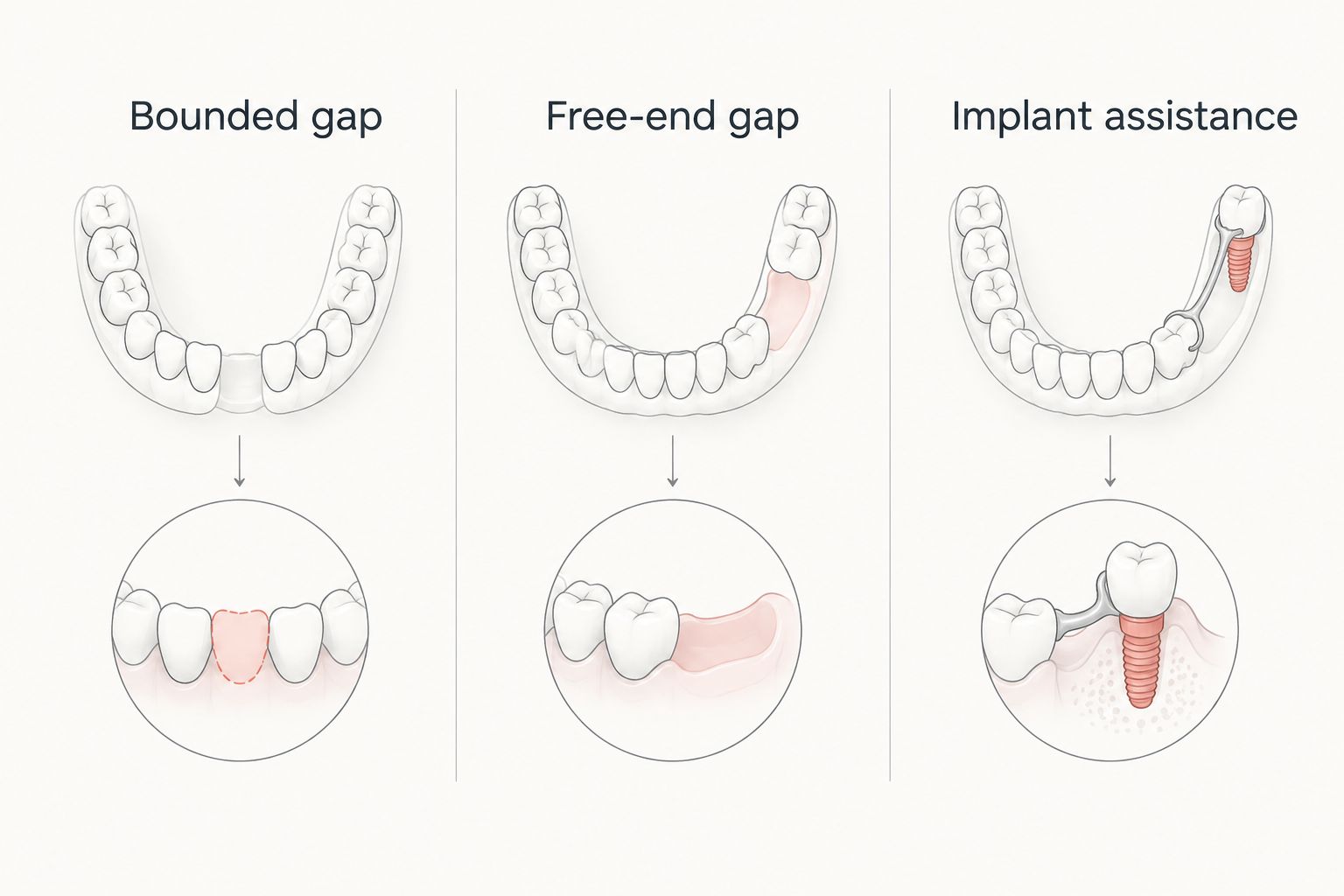
- Bounded gap: Natural teeth remain in front of and behind the missing teeth. The dentist assesses whether those teeth can provide support.
- Free-end gap: No natural tooth remains behind the missing teeth. The design must account for support from the ridge and movement under load.
- Implant assistance: An implant supplements support or retention. Its position and function must be planned with the appliance.
Bring up movement explicitly if a previous partial lifted while eating. The useful question is what caused that movement and how the new design addresses it—not whether the next material sounds more advanced.
How the options are ranked
This 2026 ranking prioritizes support, remaining-tooth health, stability, cleanability, adjustability, and treatment burden. Cast metal leads as a conventional long-term removable approach; implant assistance addresses a distinct support problem rather than simply taking second place on quality.
Acrylic earns its place for interim treatment. Flexible partials occupy a narrower, case-dependent slot because appearance cannot outweigh support requirements.
Which partial denture option should you choose?
Start with a cast-metal partial assessment if you want long-term removable treatment and have suitable supporting teeth. If your missing teeth extend behind the last natural tooth, make rear support the central discussion and ask whether implant assistance belongs in the plan.
Choose an acrylic partial when the treatment plan genuinely needs an interim appliance. Consider a flexible partial only after the dentist explains how its design meets your support, bite, and maintenance needs.
Before proceeding, ask for the proposed support points, the cleaning instructions, and the plan if your mouth changes. Those answers are more useful than choosing from material names alone.
Discuss your denture options
Explore denture and implant care with Star Dental Institute in Colorado Springs.
FAQ
What's the best partial denture for missing back teeth?
A cast-metal partial is a common long-term removable choice when the remaining teeth and gums provide suitable support. If no natural tooth remains behind the gap, ask whether implant assistance would improve the support plan.
Can I get a partial denture if I have no back teeth?
Yes, a removable partial can replace back teeth even when no natural rear anchor remains. The dentist must assess the remaining teeth, ridge, bite, and whether implant assistance is appropriate.
Is a flexible partial better than a metal partial?
A flexible partial is not automatically better than a metal partial. Flexible clasps address appearance, while a cast-metal framework provides rigidity and planned support; the right choice depends on the gap and supporting structures.
Is an implant-assisted partial removable?
An implant-assisted partial is removable. Implants add support, retention, or both, but a removable partial is different from a fixed implant-supported restoration.
Can an acrylic partial be my permanent denture?
An acrylic partial requires a case-specific assessment before continuing use as a definitive appliance. Ask whether it is intended for healing or long-term wear and what review or replacement plan applies.
Should a partial denture hurt when I chew?
Persistent pain when chewing needs a dental assessment rather than continued wear without review. Contact your dentist about sore spots, lifting, or a changed bite, and do not adjust the appliance yourself.
What should I ask before choosing a partial in 2026?
Ask what supports the partial, how the design controls movement, and how you will clean it. Also establish whether the appliance is temporary or definitive and what maintenance it requires.
One last thing
A clasp helps retain a partial; it is not the same thing as support beneath a chewing surface. Ask your dentist to show where the appliance resists lifting and where it carries downward chewing pressure.
That distinction explains why a partial can feel snug when you insert it yet still move during a meal. Choose the design that answers both problems, not just the one that feels tight on insertion.