
Best overall to check first: direct practice installments with clear written terms. Best for predictable repayment: a fixed-rate personal loan. Best for budget control: clinically appropriate staged treatment. If you need a teeth payment plan in Colorado Springs, start with a treatment assessment at Dentalcoloradosprings before comparing payment arrangements; confirm financing options directly with the practice.
- Compare a teeth payment plan by total repayment, interest terms, and treatment timing—not the monthly payment alone.
- Direct practice installments are the first option to check, not an assumed benefit at Dentalcoloradosprings.
- A fixed-rate personal loan suits borrowers who need a defined repayment schedule.
- Staged dental treatment supports budget planning only when your dentist confirms that waiting is appropriate.
Why this matters
A manageable monthly payment does not tell you whether a dental financing agreement is a good fit. You also need to know when interest applies, whether fees increase the balance, and whether the payment schedule matches the treatment you actually need.
For your 2026 decision, separate the clinical question from the borrowing question. First establish what needs treatment and how urgently; then compare ways to pay for that specific plan. Financing approval is not a reason to accept additional treatment, and a financing delay is not a reason to ignore urgent symptoms.
Dentalcoloradosprings provides implants, same-day dentures, emergency dentistry, IV sedation, and general dental care. Those services establish the practice's clinical scope—not the terms of any teeth payment plan.
What makes the best teeth payment plan?
Use these criteria before considering a lender or signing a practice agreement:
- Total repayment: Compare everything you must repay, including interest and applicable fees, rather than choosing the smallest monthly payment.
- Interest structure: Identify ordinary interest, promotional conditions, and any deferred-interest provision. Those are different arrangements.
- Payment certainty: Look for a stated repayment schedule and understand whether the rate or required payment can change.
- Clinical fit: Match the agreement to a written treatment plan, including the timing of each stage.
- Account flexibility: Check early repayment, missed-payment consequences, and how treatment changes or refunds affect the balance.
- Coverage coordination: Establish what insurance or benefits cover before borrowing for the remaining responsibility.
The best teeth payment plan is the agreement you understand and can repay without delaying necessary care. A familiar lender, an attractive promotion, or a quick application cannot substitute for readable terms.
Dental payment options at a glance
These rankings compare agreement types, not named lenders or confirmed practice offerings. In 2026, use the table to decide which arrangement deserves a closer look, then evaluate the actual contract.
| Rank and option | Best for | Standout feature to seek | Key limitation |
|---|---|---|---|
| 1. Direct practice installments | Coordinating payments with treatment | A written schedule tied to your treatment plan | Terms are practice-specific and require confirmation |
| 2. Fixed-rate personal loan | Predictable repayment | A fixed rate and defined payoff schedule | Fees and interest add borrowing obligations |
| 3. Promotional dental credit | A planned payoff before a promotion ends | Clearly documented promotional conditions | Deferred-interest terms require particular attention |
| 4. Existing credit card | A short repayment bridge | Using an account you already understand | Carrying a balance exposes you to the account's interest terms |
| 5. Clinically appropriate staged treatment | Controlling the timing of expenses | Separating treatment into dentist-approved phases | It is not financing and cannot justify unsafe delays |
1. Direct practice installments: best for treatment coordination
A direct installment agreement divides your responsibility into payments arranged with the dental practice. Ask whether the practice administers the agreement itself or refers you to an outside finance company; those are not interchangeable relationships.
This is the first option to investigate because the discussion starts with your treatment rather than a borrowing limit. It is not automatically the best agreement, and you should not assume that a practice offers it.
Direct practice installment pros:
- Creates an opportunity to discuss treatment timing and payment timing together.
- Gives you a specific agreement to compare with outside financing.
- Keeps questions about treatment changes close to the clinical team when the practice administers the arrangement.
Direct practice installment cons:
- Eligibility, fees, and repayment rules depend on the agreement.
- The schedule must still fit your household budget.
- A payment arrangement does not establish what insurance will cover.
Best for: Patients who want to ask whether their practice can coordinate payments with an agreed treatment schedule.
Before accepting, request the payment dates, interest terms, late-payment consequences, and cancellation provisions in writing. Ask who receives your payments and who handles a dispute if treatment changes.
Verdict: Hold until the practice provides written terms; choose direct installments only when those terms beat your alternatives.
2. Fixed-rate personal loan: best for predictable repayment
A fixed-rate personal loan provides borrowed funds under a repayment agreement with a lender. The fixed rate makes the interest structure more predictable, but the agreement still needs scrutiny for fees, payment obligations, and early-repayment provisions.
Compare offers for the same amount and repayment period. A longer term can reduce the required monthly payment while increasing total interest, so the lowest payment does not necessarily identify the better loan.
Fixed-rate personal loan pros:
- Provides a defined repayment schedule.
- Separates the borrowing agreement from the dental treatment agreement.
- Lets you compare the rate, fees, and total repayment across offers.
Fixed-rate personal loan cons:
- Interest and applicable fees increase your borrowing obligation.
- Approval and offered terms depend on the lender's assessment.
- You remain responsible for the loan even when a treatment disagreement requires separate resolution.
Best for: Borrowers who need a clear payoff schedule and can support the required payment throughout the term.
Request the final loan disclosures before deciding. Check whether an origination fee reduces the funds you receive, and verify that the amount reaching you matches the treatment balance you intend to finance.
Verdict: Hold until you compare complete offers; choose a fixed-rate personal loan for predictability, not merely a smaller payment.
3. Promotional dental credit: best for a planned promotional payoff
Promotional dental credit attaches special terms to a qualifying transaction. The decisive distinction is whether the agreement waives interest during a promotion or defers interest subject to repayment conditions.
With a deferred-interest arrangement, failing to satisfy the promotional requirements can trigger interest tied to the original transaction period. Read the agreement rather than treating every promotional offer as equivalent to an interest-free loan.
Promotional dental credit pros:
- Provides a defined promotional period to plan around.
- Lets you assess a specific offer against your treatment balance.
- Makes the promotional deadline an explicit budgeting target.
Promotional dental credit cons:
- Deferred-interest conditions can create a substantial obligation if requirements are not met.
- Required minimum payments do not necessarily clear the balance before the deadline.
- Missed payments can have consequences specified in the credit agreement.
Best for: Patients with a reliable repayment plan that satisfies every promotional condition before the deadline.
For a 2026 promotional offer, write down the actual expiration date and your planned payoff date. Ask how payments are allocated if the account contains other balances; do not assume every payment reduces the promotional balance in the way you expect.
Verdict: Skip promotional credit if repayment depends on uncertain future income or unclear interest conditions.
4. Existing credit card: best for a short repayment bridge
An existing credit card lets you use an established account rather than applying for a separate financing product. That convenience does not make the account suitable for a large dental balance.
Check the purchase interest terms, current balance, and credit limit before using it. If you already carry debt, understand how that affects the grace period and interest on a new transaction.
Existing credit card pros:
- Avoids a separate credit application when you use an open account.
- Gives you an agreement and account history to review.
- Allows you to compare the proposed charge against your existing repayment obligations.
Existing credit card cons:
- A revolving balance lacks the automatic payoff structure of an installment loan.
- Adding treatment expenses reduces your remaining credit.
- Interest treatment depends on your account terms and payment history.
Best for: Patients with a specific, dependable payoff source who understand the account's interest rules.
Do not treat the card's minimum payment as your repayment plan. Set your own payoff schedule and check whether the new charge would leave you relying on credit for ordinary household expenses.
Verdict: Skip an existing credit card for open-ended repayment; consider it only with a defined payoff plan.
5. Staged treatment: best for clinically appropriate budget control
Staged treatment separates dental care into phases that your dentist considers appropriate. It is a scheduling approach, not a loan, and it belongs in this comparison because borrowing is not the only way to organize treatment expenses.
Ask the dentist to distinguish urgent care from work that can safely wait. You cannot make that distinction from symptoms alone, and the absence of pain does not establish that delaying treatment is safe.
Staged treatment pros:
- Connects your budget discussion to clinical priorities.
- Separates decisions about immediate treatment from later phases.
- Helps identify which expenses require financing now.
Staged treatment cons:
- Not every treatment plan can be divided safely.
- Multiple phases require continued scheduling and follow-through.
- Delayed treatment needs reassessment if symptoms or clinical findings change.
Best for: Patients whose dentist confirms that separate treatment phases are clinically appropriate.
Request a written sequence that explains what happens first, what can wait, and what changes should prompt an earlier visit. Do not describe a delayed appointment as a payment solution unless the treating dentist agrees with the timing.
Verdict: Hold until your dentist approves the sequence; skip self-directed delays.
Before you sign: build a usable repayment comparison
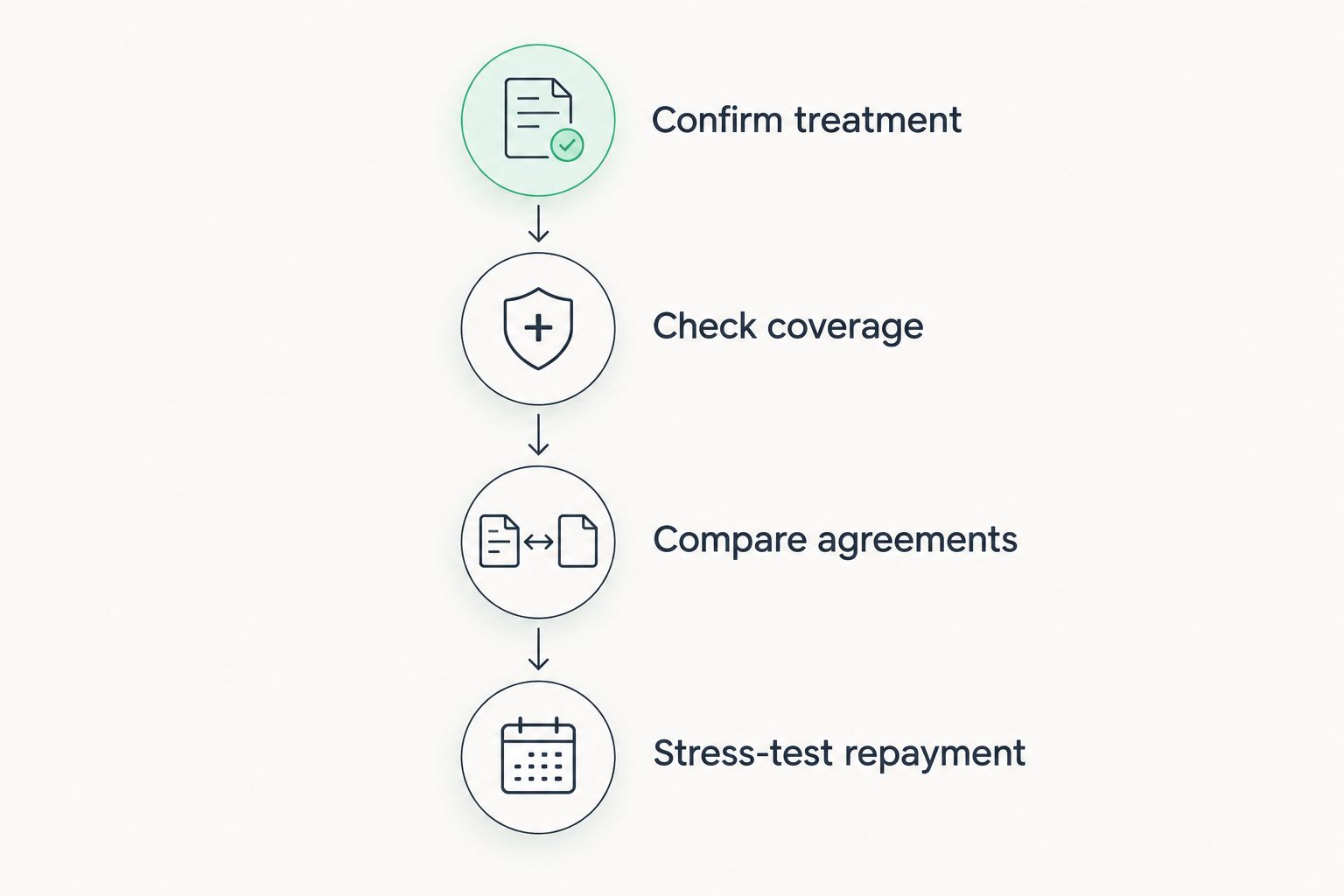
Organize your 2026 decision around these steps. The goal is a treatment balance and repayment obligation you can explain without relying on a lender's headline offer.
Confirm treatment
Request a written treatment plan and ask which care is urgent. Separate necessary clinical decisions from optional timing preferences, and establish what changes would require reassessment.
Check coverage
Ask about applicable insurance or benefits before choosing the amount to borrow. Dentalcoloradosprings serves patients including Medicaid and TRICARE recipients, but that does not establish coverage for a particular procedure or patient.
Compare agreements
Keep 3 documents together: the treatment estimate, the coverage explanation, and the financing disclosure. Check whether each document describes the same treatment and patient responsibility; resolve inconsistencies before signing.
Stress-test repayment
Run 2 repayment scenarios: your expected budget and a tighter budget with less discretionary income. Use 1 monthly worksheet that includes housing, food, transportation, existing debt, and the proposed dental payment.
If the tighter budget cannot support the payment, return to the agreement or the dentist-approved treatment sequence. Do not solve the gap by assuming that future income, benefit reimbursement, or another credit account will cover it.
How the options rank
This 2026 ranking prioritizes treatment coordination, understandable repayment, and control over borrowing. Direct installments come first as an option to investigate; fixed-rate loans suit payment certainty; promotional credit and existing cards require closer attention to interest conditions.
Staged treatment occupies a separate role because it changes timing rather than providing credit. No category wins without its actual terms, and no financing arrangement overrides clinical urgency.
Which teeth payment plan should you choose?
Start with a written treatment plan, then ask about direct installments and compare them with a fixed-rate loan. If a promotional agreement remains attractive after that comparison, verify the interest conditions and build a payoff schedule before accepting it.
Dentalcoloradosprings is a local starting point for Colorado Springs patients who need a clinical assessment before choosing a teeth payment plan. Confirm payment arrangements directly rather than assuming that a listed dental service includes financing.
Discuss your dental care needs
Start with a treatment assessment and ask which payment arrangements apply to your care.
FAQ
What's the best teeth payment plan in 2026?
The best teeth payment plan has understandable terms, affordable required payments, and a schedule that supports necessary treatment. Ask about direct practice installments first, then compare the written agreement with other financing options.
Does Dentalcoloradosprings offer a teeth payment plan?
Confirm current payment arrangements directly with Dentalcoloradosprings. A practice's clinical services do not establish its financing providers, eligibility rules, or repayment terms.
Is promotional dental credit the same as an interest-free loan?
No; promotional dental credit can have deferred-interest conditions rather than an unconditional interest waiver. Read what happens if you miss a payment or leave a balance at the promotional deadline.
Is a personal loan better than a credit card for dental work?
A fixed-rate personal loan provides a defined repayment schedule, while a credit card generally permits revolving repayment. Compare complete interest terms, fees, and total repayment rather than choosing by payment size alone.
Can I split dental treatment into stages instead of borrowing?
You can split treatment into stages only when your dentist confirms that the sequence is clinically appropriate. Ask which treatment is urgent and what symptoms or changes require an earlier appointment.
Will Medicaid or TRICARE cover my dental treatment?
Coverage depends on your eligibility, benefits, and the proposed treatment. Confirm the applicable program and procedure before deciding how much of your responsibility to finance.
Should I delay emergency dental care until financing is approved?
Do not delay seeking assessment for urgent dental symptoms while comparing financing. Trouble breathing or swallowing and severe facial swelling require immediate medical attention.
One last thing
Ask what happens to your financing balance if the treatment plan changes. A clinical adjustment and a credit-account adjustment are separate processes; establish who handles refunds, where the money goes, and whether payments remain due during processing.
Keep the answer with your treatment and financing documents. That question tests whether you understand the whole agreement—not just the payment shown at the top.