
Best for a first infection in a restorable tooth: initial root canal treatment. Best for persistent disease after a previous root canal: retreatment; best when nonsurgical access is unsuitable: apical surgery. This 2026 guide compares root canal treatment options, selected pulp-preserving care, and extraction so you can discuss the right next step with your dentist.
- Initial root canal treatment is the default tooth-saving option for an infected, restorable tooth that has not been treated before.
- Retreatment addresses problems inside previously treated canals; apical surgery approaches disease through the root tip.
- Vital pulp therapy suits selected teeth with living pulp, not every painful or infected tooth.
- Dentalcoloradosprings offers general dental care in Colorado Springs; confirm who will evaluate and perform any proposed root canal.
Why this matters
The best treatment depends on whether your tooth can be restored—not simply whether the pain can be stopped. A root canal treats the pulp space inside a tooth, but it cannot repair every fracture or replace missing structural support.
Pain alone does not identify the right procedure. Your dentist needs your symptom history, an examination, pulp testing where appropriate, and imaging before recommending treatment. A tooth that stops hurting still needs evaluation if infection or tissue death is suspected.
For local general dental care, Dentalcoloradosprings serves patients in Colorado Springs. Ask whether your evaluation and any recommended endodontic procedure will take place at the practice or require referral to an endodontist, a dentist specializing in the tooth’s pulp and surrounding root tissues.
What makes the best root canal treatment option?
Use these criteria to judge a recommendation in 2026. A treatment name alone tells you little about whether it fits your tooth.
- Restorability: Enough sound tooth structure must remain to support the planned restoration.
- Pulp condition: Living, inflamed pulp requires a different assessment from dead or infected pulp.
- Previous treatment: An untreated tooth and a previously root-filled tooth present different problems.
- Access to disease: Treatment must reach the affected canal space or root-end tissues.
- Periodontal support: Gum and bone support affect whether keeping the tooth is sensible.
- Completion plan: The recommendation should include the final restoration and follow-up, not just the canal procedure.
Ask what makes the proposed option appropriate for your diagnosis. Equipment, sedation, or convenience does not replace that explanation.
Root canal treatment options at a glance
These 5 options occupy different clinical roles. Extraction is included as an alternative to saving the tooth, not as a type of root canal treatment.
| Option | Best for | Standout feature | Key limitation |
|---|---|---|---|
| Initial root canal treatment | A first treatment in a restorable tooth with diseased pulp | Cleans, disinfects, and fills the canal system | Cannot make an unrestorable tooth restorable |
| Nonsurgical retreatment | Persistent or recurrent disease after root canal treatment | Reopens the tooth to address problems within the canals | Existing restorations or obstructions can complicate access |
| Apical surgery | Selected root-end disease when nonsurgical treatment is unsuitable | Treats the root tip through surgical access | Requires surgery and does not address every internal canal problem |
| Vital pulp therapy | Selected teeth with pulp that can be preserved | Retains some or all living pulp | Requires careful case selection and monitoring |
| Extraction | A tooth that cannot predictably be retained | Removes the affected tooth | Permanently sacrifices the natural tooth |
1. Initial root canal treatment: best for first-time tooth preservation
Initial root canal treatment removes diseased pulp, cleans and disinfects the canal system, and fills the prepared canals. It is the starting option when an untreated tooth needs endodontic treatment and remains restorable.
The dentist also evaluates cracks, decay, and the restoration the tooth will need afterward. Treating the canals without planning the final seal leaves an essential part of care unresolved.
Initial root canal treatment pros:
- Preserves the natural tooth when retention is appropriate.
- Addresses diseased tissue inside the canal system.
- Avoids creating an extraction space.
Initial root canal treatment cons:
- Requires a suitable final restoration after canal treatment.
- Complex anatomy, cracks, or persistent disease can require additional care.
Best for: A restorable tooth receiving its first endodontic treatment because of irreversible pulp disease or pulp death.
Ask whether your tooth needs a crown or another restoration, who will provide it, and how the tooth should be protected between appointments. Not every treated tooth needs the same restoration; the remaining structure and chewing demands matter.
Verdict: Hold off on extraction until restorability and initial root canal treatment have been assessed.
2. Nonsurgical retreatment: best for disease after a previous root canal
Nonsurgical retreatment reopens a previously treated tooth so the clinician can remove existing filling material and reassess the canals. The aim is to address treatable causes of persistent or recurrent disease, such as missed anatomy or contamination.
A previously treated tooth that hurts does not automatically need retreatment. Your clinician must distinguish endodontic disease from a fracture, bite problem, gum disease, or another source of pain.
Nonsurgical retreatment pros:
- Gives a previously treated tooth another tooth-preserving pathway.
- Allows reassessment of the internal canal system.
- Can address an internal source of disease without root-end surgery.
Nonsurgical retreatment cons:
- Access can require removing or altering an existing restoration.
- Posts, obstructions, fractures, or inaccessible anatomy can limit treatment.
Best for: A previously root-filled, restorable tooth with a problem that can be addressed through the canals.
For a 2026 retreatment consultation, bring earlier radiographs and treatment records if you have them. Ask what the clinician believes caused the problem and how retreatment would address it; repeating a procedure without a clear treatment rationale is not a useful plan.
Verdict: Hold off on surgery until nonsurgical retreatment has been considered.
3. Apical surgery: best for selected root-end problems
Apical surgery, often called an apicoectomy, approaches the root end through the gum and surrounding tissues. The clinician removes the root tip and affected tissue as indicated, then seals the root end when appropriate.
This route is different from reopening the entire canal system. An endodontist assesses whether surgery can address the disease while leaving a tooth worth retaining.
Apical surgery pros:
- Provides access to the root end when access through the tooth is unsuitable.
- Offers another tooth-preserving option in selected cases.
- Allows direct inspection of the exposed root-end area.
Apical surgery cons:
- Involves an incision, surgical recovery, and site-specific risks.
- Does not correct every problem elsewhere within the canal system.
Best for: Selected persistent root-end disease when nonsurgical treatment is impractical or is not the preferred clinical approach.
Ask how nearby nerves, sinus anatomy, root position, and periodontal support affect your case. Also ask why surgery is preferred over retreatment, rather than assuming surgery is automatically more definitive.
Verdict: Hold surgery until the clinician explains why a root-end approach fits the problem.
4. Vital pulp therapy: best for selected teeth with preservable pulp
Vital pulp therapy aims to keep living pulp rather than remove all of it. Depending on the diagnosis and exposure, treatment can include pulp capping or a pulpotomy, which removes part of the pulp while preserving the remaining tissue.
This is not a substitute for root canal treatment in every painful tooth. Pulp condition, contamination, bleeding control, tooth maturity, and the ability to place a sound restoration all influence selection.
Vital pulp therapy pros:
- Preserves living pulp in suitable cases.
- Supports continued root development in immature permanent teeth when successful.
- Offers a more tissue-preserving approach when clinically appropriate.
Vital pulp therapy cons:
- Requires careful diagnosis and a reliable restorative seal.
- Failure or later disease can lead to root canal treatment or extraction.
Best for: Selected teeth whose remaining pulp is judged suitable for preservation.
In 2026, the useful question is not whether vital pulp therapy sounds less invasive. Ask whether the clinical findings support it for your tooth, what follow-up is needed, and what findings would trigger a change in treatment.
Verdict: Skip vital pulp therapy as a shortcut when the diagnosis does not support pulp preservation.
5. Extraction: best for a tooth that cannot be retained
Extraction removes the tooth instead of treating its canal system. It belongs in the discussion when a tooth is not restorable or when structural and periodontal findings make retention inappropriate.
A painful tooth is not automatically an extraction case. The recommendation should identify the reason the tooth cannot be retained, rather than treating pain severity as the deciding factor.
Extraction pros:
- Removes the affected tooth when preservation is unsuitable.
- Avoids further endodontic treatment on that tooth.
- Creates a clear starting point for discussing any replacement needs.
Extraction cons:
- Permanently removes the natural tooth.
- Can create a separate decision about chewing function, appearance, and replacement.
Best for: A tooth with findings that rule out a reasonable tooth-preserving treatment plan.
Ask whether replacement is needed and what choices fit the space. Implants, bridges, and removable prostheses are separate treatments with their own requirements; extraction does not automatically make any one replacement appropriate.
Verdict: Hold off on extraction when the reason for abandoning tooth preservation remains unclear.
How the options are ranked
This ranking prioritizes preserving a restorable natural tooth while matching treatment to the location and nature of disease. It does not rank procedures by how advanced they sound.
Initial treatment comes first for an untreated tooth. Retreatment and surgery address selected previously treated teeth; vital pulp therapy applies to a different diagnostic group. Extraction is the alternative when retention is unsuitable, not the universal last step after every other procedure.
Before you choose: follow the decision sequence
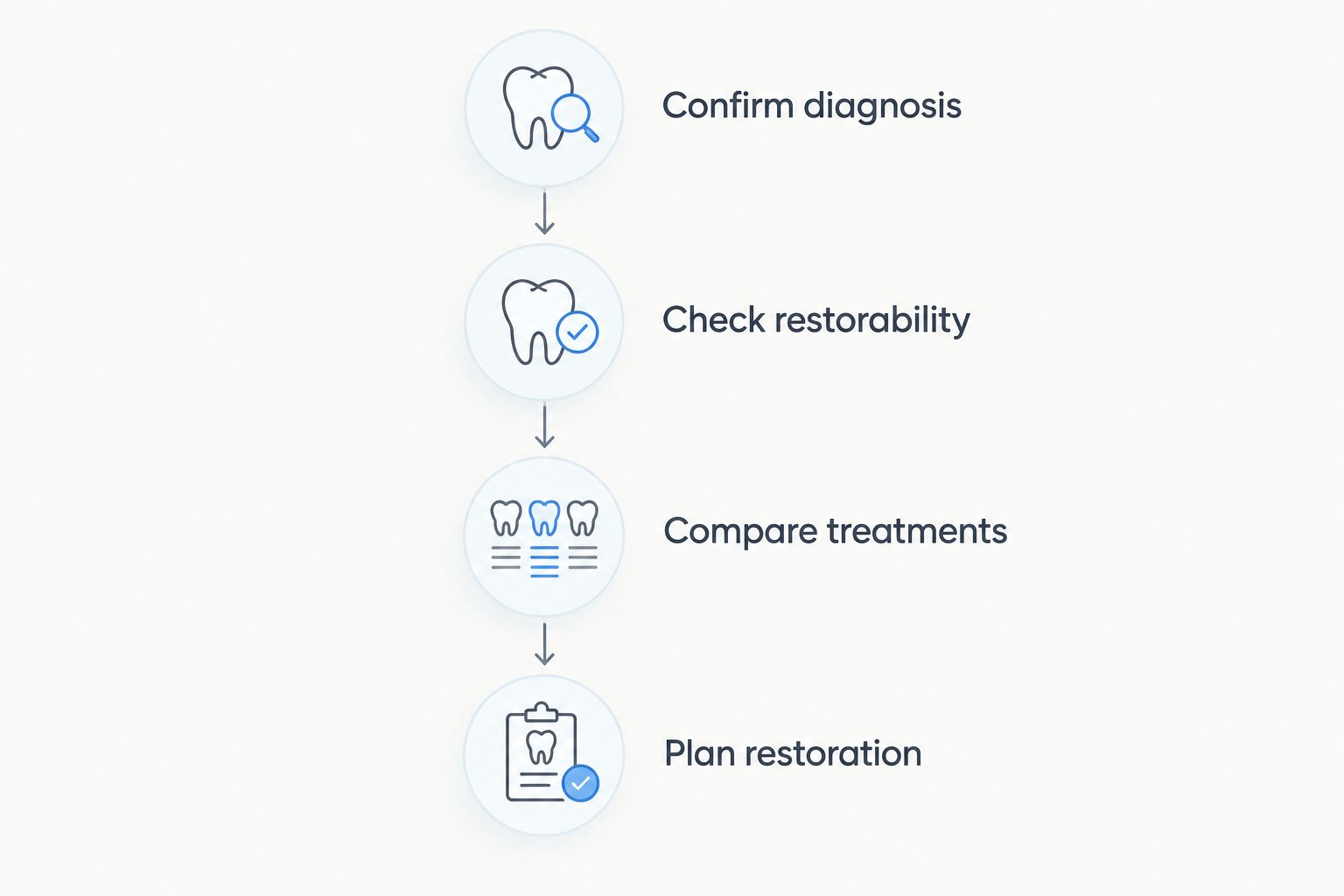
Use these 4 steps to keep your consultation focused. They help separate the diagnosis from the treatment and the treatment from the final restoration.
- Confirm diagnosis: Ask which tooth is responsible and what examination or test findings support that conclusion.
- Check restorability: Ask about cracks, remaining structure, decay, and gum and bone support.
- Compare treatments: Discuss why the recommended option fits better than the relevant alternatives.
- Plan restoration: Establish how the tooth will be sealed, protected, and reviewed after treatment.
Bring your medication list, relevant medical history, and details of previous treatment. Tell the clinician about anticoagulants, allergies, pregnancy, and medical conditions; do not stop prescribed medicines on your own.
Dentalcoloradosprings offers emergency dentistry and IV sedation among its stated services. Confirm whether sedation is appropriate for the proposed procedure, who provides treatment, and what preparation or escort instructions apply.
To arrange a local evaluation, contact the practice and describe your symptoms and any previous root canal treatment.
Which option should you choose in 2026?
Choose initial root canal treatment when an untreated tooth needs it and can be restored. For a previously treated tooth, the deciding question is whether the problem is best addressed through the canals, at the root end, or by removing a tooth that cannot be retained.
Do not choose a procedure based on pain intensity, advertising, or equipment alone. Request a diagnosis, an explanation of alternatives, and a complete restorative plan before committing.
FAQ
What's the best root canal treatment option for an infected tooth?
Initial root canal treatment is generally the tooth-saving option for an untreated, restorable tooth with infected or dead pulp. A previously treated tooth needs a separate assessment for retreatment, surgery, or extraction.
Is retreatment better than an apicoectomy?
Neither option is better for every tooth. Retreatment addresses the canal system from inside the tooth, while an apicoectomy approaches the root end surgically; access, anatomy, restorability, and the cause of disease guide the choice.
Can I avoid a root canal with a pulpotomy?
A pulpotomy is an option for selected teeth with pulp suitable for preservation. It is not appropriate for every infected or painful tooth, and your dentist must assess the pulp and the planned restorative seal.
Can antibiotics replace root canal treatment?
Antibiotics do not replace treatment of the diseased tooth. They are used when clinically indicated, including some spreading infections or infections with systemic involvement, alongside appropriate dental care.
Do I always need a crown after a root canal?
Not every root-treated tooth requires the same restoration. Tooth position, remaining structure, cracks, and chewing forces determine whether a crown or another restoration is appropriate.
Should I extract a tooth instead of having a root canal?
Extraction is appropriate when the tooth cannot reasonably be retained or when it is the chosen option after informed discussion. Ask whether the tooth is restorable and what losing it would mean for function and replacement.
When does tooth pain need emergency care?
Difficulty breathing or swallowing, or rapidly spreading swelling, requires immediate emergency medical care. Facial swelling, fever, or worsening dental pain needs prompt dental assessment rather than waiting for a routine appointment.
One last thing
Pain relief is not proof that a tooth has healed. Pain can change as pulp disease progresses, so keep the evaluation even if symptoms settle.
For your 2026 consultation, write down one question: What finding makes this treatment the right choice for this tooth? A clear answer connects the diagnosis, the procedure, and the restoration. This guide supports that conversation; it does not replace an individual dental examination.