
The best sedation dentistry options for anxious patients depend on the anxiety and procedure: IV sedation offers adjustable medication delivery, nitrous oxide suits lighter support, and oral sedation avoids an IV for medication delivery. General anesthesia belongs in a separate category when unconsciousness is clinically appropriate—not as the default response to dental fear.
- Compare sedation dentistry options for anxious patients by anxiety level, medical history, procedure, and recovery needs.
- Dentalcoloradosprings offers IV sedation for local patients seeking dental care with sedation support.
- Nitrous oxide supports lighter sedation; oral medication requires advance planning and cannot be adjusted as readily.
- General anesthesia means unconsciousness and requires a separate clinical assessment, not simply a preference for deeper sedation.
Why this matters
Dental anxiety deserves a treatment plan, not an instruction to endure it. But choosing the deepest sedation does not automatically make your appointment safer or more appropriate.
Dentalcoloradosprings is a local option for Colorado Springs patients seeking dental care with IV sedation. Its stated services include implants, same-day dentures, emergency dentistry, and general dental care; start with Dentalcoloradosprings to discuss your procedure and anxiety together.
This 2026 guide compares 4 options, but they are not interchangeable. Medication route, sedation depth, pain control, monitoring, and recovery all affect the decision.
What makes the best dental sedation option?
Use these criteria before choosing a method. A familiar medication name matters less than a plan that fits your health and treatment.
- Anxiety fit: Explain whether your main difficulty is the injection, gagging, sounds, loss of control, or remaining in the chair.
- Medical suitability: Share your conditions, medications, supplements, allergies, and previous anesthesia experiences.
- Adjustability: Ask how the clinician adjusts sedation during treatment and responds if your needs change.
- Monitoring and qualifications: Identify who administers medication, who monitors you, and what emergency arrangements apply.
- Recovery requirements: Confirm transportation, supervision, eating instructions, and restrictions before scheduling.
- Pain-control plan: Ask how the team will numb the treatment area. Sedation and local anesthesia do different jobs.
Choose the least intensive approach that adequately supports safe treatment—not the deepest option you can request. Your clinician must assess what that means for your procedure.
Sedation dentistry options at a glance
This 2026 comparison separates medication routes from general anesthesia. A route such as IV administration does not, by itself, tell you the intended depth of sedation.
| Option | Best for | Standout feature | Key limitation |
|---|---|---|---|
| IV sedation | Patients needing adjustable medication delivery during treatment | Medication enters through a vein and can be adjusted by the clinician | Requires IV placement, clinical assessment, monitoring, and recovery planning |
| Nitrous oxide | Patients seeking lighter support with quick adjustment | Inhaled gas can be adjusted during the appointment | A nasal mask and breathing through the nose must be workable |
| Oral sedation | Patients seeking anxiety medication without an IV as the delivery route | Medication is taken by mouth under specific instructions | Effects are less readily adjusted after swallowing |
| General anesthesia | Patients whose clinical needs require unconsciousness | The patient is unconscious during treatment | Requires a distinct anesthesia assessment and appropriate care setting |
1. IV sedation: best for adjustable medication delivery
IV sedation delivers medication through a vein while the clinical team monitors you. The clinician can adjust medication during treatment, but the intended depth and the drugs used determine your experience.
Dentalcoloradosprings offers IV sedation as part of its dental care. For your 2026 appointment, ask how IV sedation would fit the proposed treatment rather than assuming that every procedure needs it.
IV sedation pros:
- Medication delivery can be adjusted during treatment.
- It provides an option when lighter anxiety support is insufficient.
- It does not depend on swallowing a tablet for medication delivery.
- It allows the clinician to plan sedation around the procedure and your assessment.
IV sedation cons:
- IV placement introduces a needle, which matters if needles trigger your anxiety.
- Sedation can affect breathing and requires appropriate monitoring and trained personnel.
- Transportation, supervision, and activity restrictions require advance planning.
Best for: Patients whose clinician recommends adjustable medication delivery because of their anxiety, treatment needs, and medical history.
Ask whether you are expected to respond to spoken instructions and what you might remember afterward. Do not treat the phrase sleep dentistry as a promise that you will be unconscious or remember nothing.
Verdict: Hold the booking until the clinician confirms suitability, intended sedation depth, and your recovery arrangements.
2. Nitrous oxide: best for lighter, adjustable anxiety support
Nitrous oxide is inhaled through a nasal mask, usually mixed with oxygen. It can reduce anxiety while allowing communication with the dental team.
The clinician adjusts the inhaled mixture during treatment. Its effects generally resolve relatively quickly after administration stops, but your discharge instructions—not an assumption about quick recovery—determine what you can do afterward.
Nitrous oxide pros:
- Administration does not require an IV.
- The inhaled mixture can be adjusted during treatment.
- You can generally communicate with the team during lighter sedation.
- It offers an option for patients who do not need deeper sedation.
Nitrous oxide cons:
- Nasal congestion or difficulty tolerating a nasal mask can interfere with administration.
- Lighter sedation might not adequately address severe anxiety.
- Nausea and other unwanted effects remain possible.
Best for: Patients who want lighter anxiety support and can comfortably use a nasal mask.
For a 2026 visit, explain whether keeping a mask over your nose feels reassuring or uncomfortable. That practical detail belongs in the decision alongside your medical history; it is not a minor preference to mention after treatment starts.
Verdict: Hold until your dentist confirms that lighter sedation matches your anxiety and procedure.
3. Oral sedation: best for avoiding IV medication delivery
Oral sedation uses prescribed medication taken by mouth according to the treating clinician's instructions. It can reduce anxiety, but the effect depends on the medication, dose, individual response, and other substances you take.
Avoiding IV delivery does not remove the need for screening or monitoring. It also does not guarantee a needle-free appointment: local anesthetic injections or other clinical steps can still be necessary.
Oral sedation pros:
- Medication delivery does not require an IV.
- A prescribed plan can address anxiety before treatment begins.
- It provides another route when inhaled sedation is not suitable.
Oral sedation cons:
- Once swallowed, the medication cannot be adjusted as readily as an inhaled mixture or IV medication.
- Effects and recovery vary between patients.
- Taking extra doses or combining medication with alcohol or other sedatives creates safety risks.
Best for: Patients whose clinician recommends oral medication and who can follow dosing, transportation, and supervision instructions reliably.
Get 1 written plan covering when to take the medication and what to do if the appointment changes. Never take an additional dose because you still feel nervous unless the prescribing clinician specifically instructs you to do so.
Verdict: Hold until you have written dosing instructions and a confirmed escort and recovery plan.
4. General anesthesia: best when unconsciousness is clinically required
General anesthesia produces unconsciousness rather than simply reducing anxiety. It requires an anesthesia plan, appropriate monitoring, and personnel equipped to manage breathing and other physiological functions.
Severe anxiety alone does not establish that general anesthesia is the right choice. The clinician must consider treatment needs, ability to cooperate, health, alternatives, and the setting where care will occur.
General anesthesia pros:
- It permits treatment while the patient is unconscious.
- It provides an option when other approaches cannot support necessary care.
- It allows anesthesia management to be planned around complex clinical needs.
General anesthesia cons:
- It requires a distinct anesthesia assessment and suitable setting.
- Airway management and recovery needs are more involved than with lighter sedation.
- It carries anesthesia-related risks and is not appropriate merely because it sounds more comfortable.
Best for: Patients whose clinical assessment supports unconsciousness for necessary dental treatment.
Ask who provides anesthesia and whether the proposed location supports that level of care. This guide does not establish that general anesthesia, nitrous oxide, or oral sedation is offered by the local practice named above.
Verdict: Skip general anesthesia as a self-selected default; discuss it only when the treating team identifies a clinical reason.
Sedation depth is different from medication route
IV and oral describe how medication enters your body. Minimal, moderate, and deep describe levels of sedation; general anesthesia describes unconsciousness. You cannot reliably infer the intended depth from the route alone.
- Minimal sedation: You respond normally to verbal instructions, although anxiety and coordination can change.
- Moderate sedation: You respond purposefully to verbal instructions or light touch.
- Deep sedation: You are not easily awakened, and breathing support can be necessary.
- General anesthesia: You are unconscious, and airway support is often required.
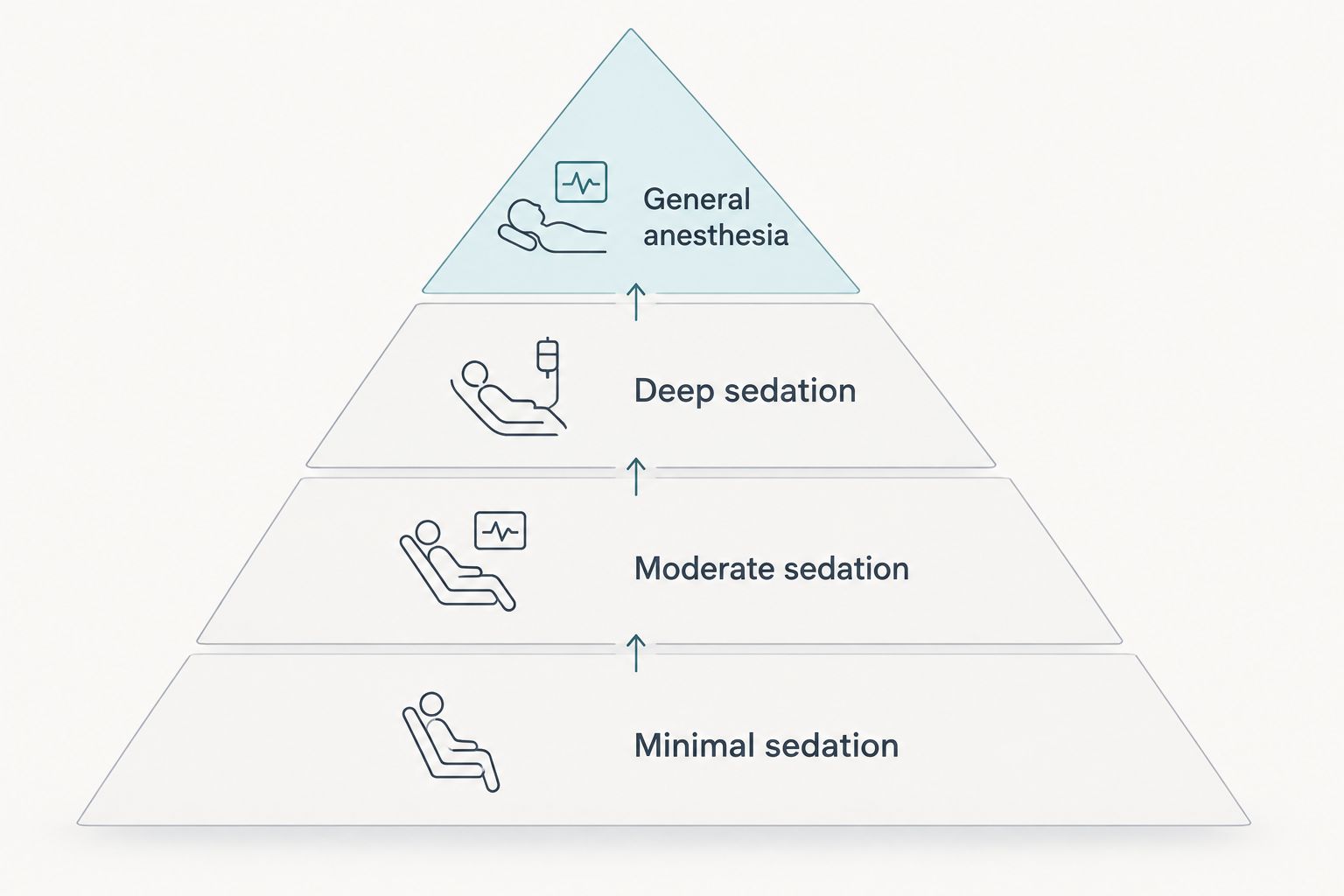
Sedation is a continuum, and patients can respond more deeply than intended. That is why monitoring and the team's ability to respond matter even when the initial plan sounds straightforward.
Local anesthesia serves another purpose: numbing the treatment area. Anxiety medication does not replace a procedure-specific pain-control plan.
Before you book: settle these practical questions
For your 2026 consultation, bring a medication list and describe previous dental experiences plainly. Saying that you fear needles but tolerate drilling gives the team more useful information than saying only that you dislike dentists.
Start with 3 questions: What sedation depth is planned? Who monitors me? What must I arrange afterward? Then cover these details:
- Health history: Report sleep apnea, breathing problems, pregnancy, allergies, and previous sedation or anesthesia complications.
- Substance use: Disclose alcohol, cannabis, opioids, sleep medicines, and supplements without leaving anything out.
- Eating instructions: Follow the treating team's instructions; do not apply another patient's fasting schedule to yourself.
- Transportation: Confirm escort and supervision requirements before the appointment.
- Communication: Agree on a stop signal when the planned sedation level allows communication.
- Coverage: Ask about benefits for the exact procedure and sedation plan. Accepting an insurance program does not establish coverage for sedation.
Dentalcoloradosprings serves local patients, including Medicaid and TRICARE recipients. Confirm benefits and clinical suitability separately; neither answers the other.
How these options were ranked
This ranking uses anxiety fit, adjustability, medical suitability, monitoring, recovery, and pain-control planning—not a claim that one method wins for everyone. IV sedation leads for adjustable medication delivery; nitrous oxide takes the lighter-support slot; oral sedation addresses route preference; general anesthesia addresses a separate clinical need.
These are use-case recommendations, not instructions to request a specific drug. Your health assessment can change the order completely.
Which sedation option should you choose?
Start with the anxiety trigger and procedure, then choose the sedation plan with your clinician. For an undecided patient, the next move is an assessment—not a commitment to the deepest option.
In 2026, a useful consultation should leave you understanding the intended sedation depth, pain-control approach, monitoring, and discharge instructions. If any of those remain unclear, ask before agreeing to treatment.
FAQ
What's the best sedation dentistry option for severe dental anxiety?
There is no single best option for every patient with severe dental anxiety. IV sedation offers adjustable medication delivery, but your medical history, treatment, and intended sedation depth determine whether it is appropriate.
Will I be asleep during IV dental sedation?
IV administration does not automatically mean you will be unconscious. Ask your clinician about the intended sedation depth, expected responsiveness, and possibility of remembering treatment.
Is nitrous oxide better than oral sedation?
Nitrous oxide is more readily adjusted during treatment, while oral sedation avoids inhaled delivery through a nasal mask. The better choice depends on anxiety, health, mask tolerance, and the procedure.
Does sedation dentistry replace numbing injections?
Sedation does not replace local anesthesia when the procedure requires it. Sedation addresses anxiety or awareness, while local anesthesia numbs the treatment area.
Can I drive home after dental sedation?
Driving restrictions depend on the medication, sedation depth, and your clinician's discharge instructions. Arrange the required transportation before treatment and do not assume you can drive because you feel alert.
Does Dentalcoloradosprings offer IV sedation?
Dentalcoloradosprings offers IV sedation alongside its dental services. A clinical assessment determines whether that service fits your health, anxiety, and planned procedure.
Will Medicaid or TRICARE cover my dental sedation?
Coverage depends on your specific benefits, eligibility, procedure, and any authorization requirements. Ask the practice and your plan to confirm coverage for the proposed sedation rather than assuming it follows from patient acceptance.
One last thing
Write down what would make you stop treatment: the injection, a gagging sensation, uncertainty, or feeling unable to communicate. Bring that note to the consultation.
The best plan addresses the trigger, not just the label of dental anxiety. If uncertainty is your main problem, ask the team to explain the sequence and agree on communication before discussing deeper sedation.