Best for mild anxiety: nitrous oxide. Best for longer visits with significant anxiety: appropriately assessed IV sedation. Best for needle-related anxiety: oral sedation. These sedation options ranked by comfort level for 2026 compare anxiety relief, awareness, recovery, and limitations—not just how deeply you are sedated.
- Sedation options ranked by comfort level should balance anxiety relief, awareness, recovery, and medical suitability.
- Nitrous oxide is the first option to discuss for mild dental anxiety and a lighter recovery burden.
- Dentalcoloradosprings offers IV sedation for local patients; suitability requires an individual clinical assessment.
- Oral sedation is less adjustable after dosing; general anesthesia requires a separate clinical justification.
Why this matters
The deepest option is not automatically the best choice. Dental comfort has separate parts: controlling pain, reducing fear, tolerating the procedure, and recovering afterward. A treatment that addresses one part does not replace the others.
Dentalcoloradosprings offers IV sedation alongside implants, same-day dentures, emergency dentistry, and general dental care in Colorado Springs. Dentalcoloradosprings is an option for local patients seeking a dental sedation assessment.
For your 2026 appointment, ask about the intended sedation depth before choosing a delivery method. An IV describes how medication enters your body; it does not, by itself, tell you whether you will remain responsive.
What makes the best dental sedation option?
Use these criteria to judge comfort before choosing a method:
- Anxiety relief: Does the planned approach match your fear, gag reflex, and ability to tolerate treatment?
- Awareness: Do you want to remain conversational, or does your treatment require a deeper level of care?
- Adjustability: Can the clinician adjust the medication during treatment, or must a swallowed dose take effect first?
- Pain control: What local anesthetic will numb the treatment area? Sedation and numbing serve different purposes.
- Recovery burden: What supervision, transport, and activity restrictions will you need afterward?
- Medical suitability: How do your health history, medicines, breathing, and planned procedure affect the choice?
These criteria put suitability ahead of sedation depth. A person who comfortably completes treatment with nitrous oxide gains no automatic benefit from choosing a deeper technique.
Dental sedation options at a glance
This ranking prioritizes practical comfort: enough anxiety control to complete appropriate treatment, without treating greater unconsciousness as a better result. It is not a list of services confirmed at the practice; only IV sedation is explicitly identified among the provided services.
| Rank and option | Best for | Standout comfort feature | Key limitation |
|---|---|---|---|
| 1. Nitrous oxide | Mild anxiety with a preference to remain responsive | Inhaled medication can be adjusted during treatment | Insufficient for some patients with severe anxiety |
| 2. IV sedation | Significant anxiety during longer or demanding visits | Medication can be adjusted through an IV | Requires needle placement and recovery arrangements |
| 3. Oral sedation | Anxiety about injections before treatment | Medication is swallowed rather than delivered through an IV | Slower, less predictable adjustment after dosing |
| 4. General anesthesia | Treatment requiring unconsciousness after clinical assessment | Patient is unconscious during the procedure | Greater airway-management and recovery requirements |
Understand sedation depth before choosing a route
The American Society of Anesthesiologists describes 4 levels along the sedation and anesthesia continuum: minimal sedation, moderate sedation, deep sedation, and general anesthesia. These describe responsiveness and effects on breathing—not the name of a medication or its delivery route.
- Minimal sedation: You respond normally to verbal communication, although judgment and coordination can be affected.
- Moderate sedation: You respond purposefully to verbal commands, sometimes with light touch.
- Deep sedation: You are not easily awakened but can respond purposefully to repeated or painful stimulation; breathing support can be necessary.
- General anesthesia: You are not arousable even with painful stimulation, and airway support is often required.
This guide compares 3 delivery routes—inhaled, oral, and intravenous—plus general anesthesia as a distinct level of care. Those categories overlap: an IV can deliver medication for different intended depths.
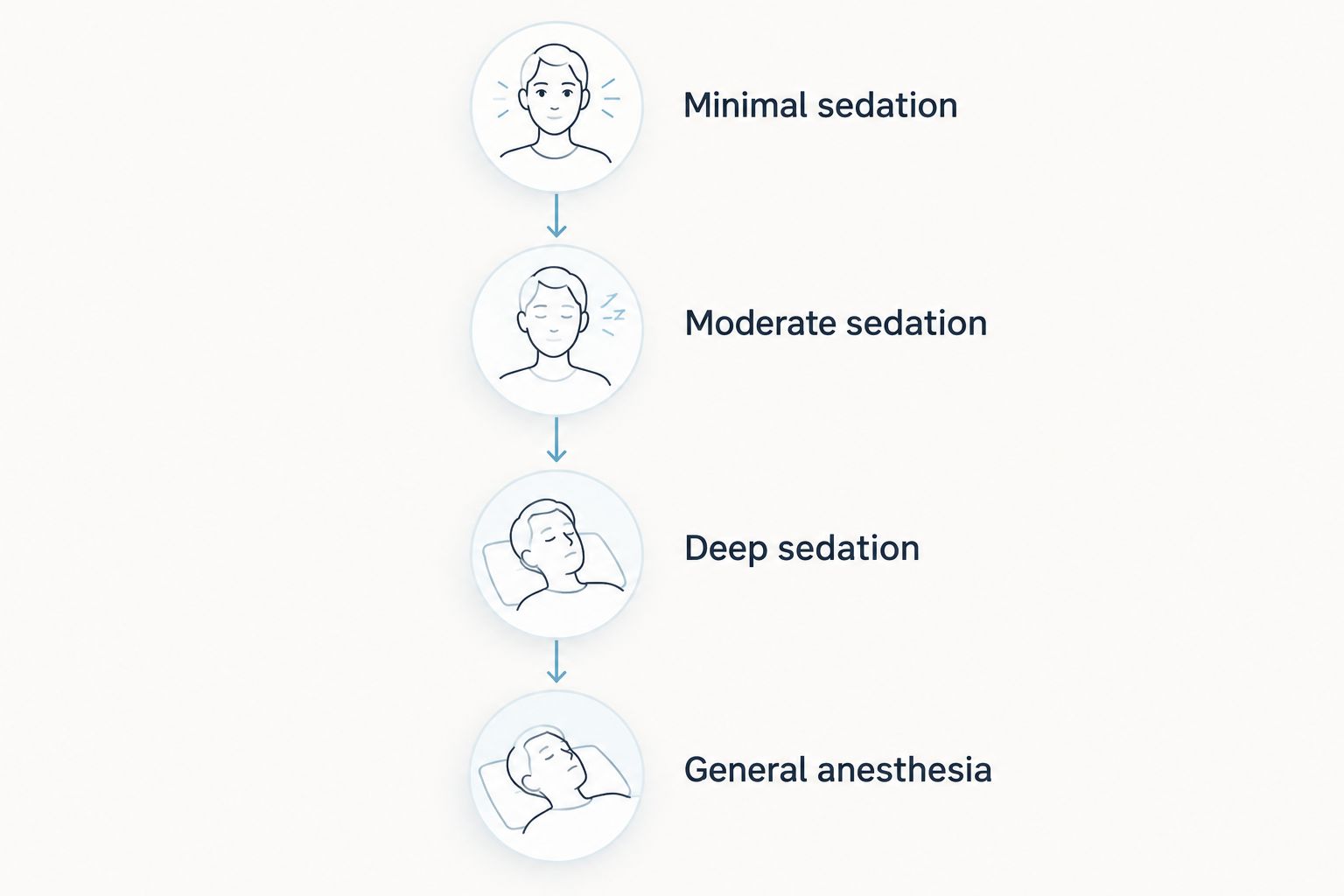
Sedation exists on a continuum, and a patient can become more deeply sedated than intended. Your clinician needs the training, monitoring, and ability to respond to that change. That matters more than a label such as sleep dentistry.
1. Nitrous oxide: best dental sedation for mild anxiety
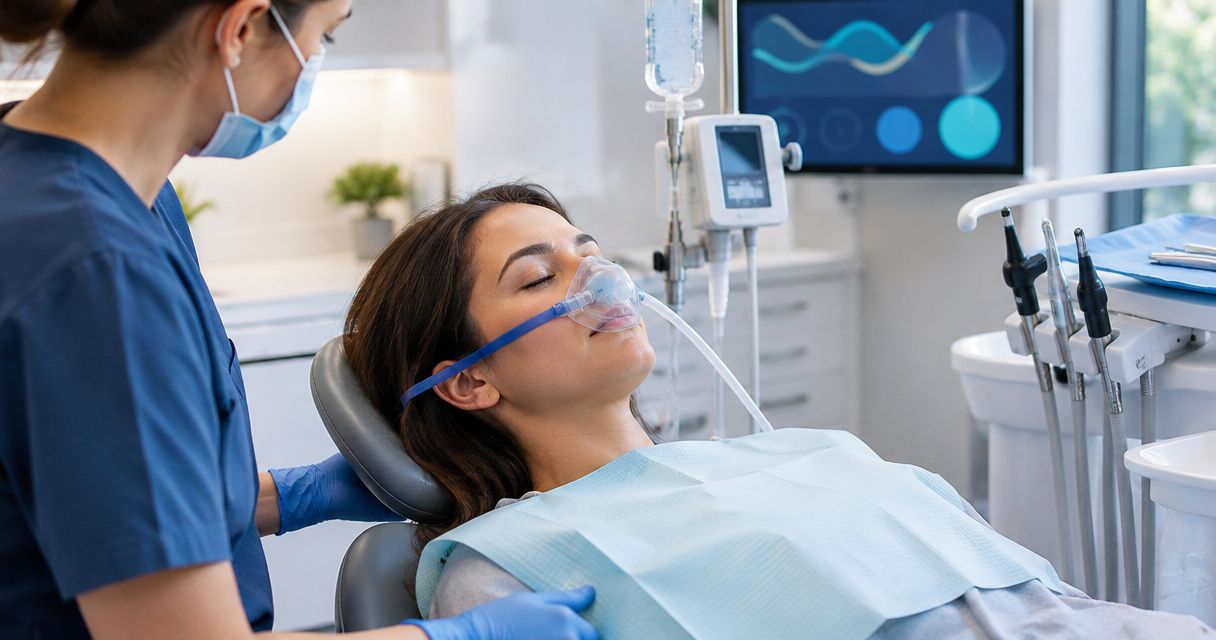
Nitrous oxide is inhaled through a nasal mask, usually mixed with oxygen. Used for minimal sedation, it helps you relax while remaining awake and able to communicate. Its effects generally wear off quickly after administration stops.
Nitrous oxide pros:
- The clinician can adjust the inhaled concentration during treatment.
- You can usually respond to instructions and describe discomfort.
- It avoids an IV for delivery of the sedative itself.
- Recovery is generally shorter than with oral or IV sedative medicines.
Nitrous oxide cons:
- Severe anxiety can persist despite treatment.
- Nasal congestion or difficulty tolerating the mask can interfere with delivery.
- Nausea and other unwanted effects remain possible.
Best for: Patients with mild dental anxiety who want to remain aware and prefer a lighter recovery burden.
Nitrous oxide does not replace local anesthetic when a procedure requires numbing. It also does not guarantee that you can drive immediately afterward; discharge instructions depend on what you received and your recovery.
Verdict: Hold nitrous oxide as the first option to discuss for mild anxiety, subject to clinical suitability.
2. IV sedation: best dental sedation for significant anxiety
IV sedation delivers medication through a vein, allowing the clinician to adjust dosing during treatment. Depending on the intended depth and medicines used, you can feel relaxed and drowsy while retaining some responsiveness. Reduced memory is possible, but complete amnesia is not guaranteed.
IV sedation pros:
- Medication can be adjusted during the appointment.
- It provides an option for patients whose anxiety exceeds what lighter techniques address.
- It can support tolerance of longer or demanding dental treatment.
- The clinician has intravenous access during care.
IV sedation cons:
- Placement of the IV requires a needle.
- Sedative medicines can affect breathing and require appropriate monitoring.
- Recovery requires an escort and restrictions specified by the treating team.
Best for: Patients with significant dental anxiety or difficulty tolerating treatment who meet the clinical requirements for the proposed sedation plan.
Dentalcoloradosprings offers IV sedation. For a 2026 consultation, ask what depth is intended, who administers the medication, who monitors you, and what happens if your sedation becomes deeper than planned.
Do not interpret IV sedation as a promise that you will be completely asleep. Ask the clinician to describe expected responsiveness in plain language before consenting.
Verdict: Hold IV sedation as a consultation priority when anxiety or treatment demands justify more support.
3. Oral sedation: best dental sedation for needle-related anxiety
Oral sedation uses a prescribed medicine taken by mouth. It can reduce anxiety before and during dental treatment without requiring an IV to deliver that dose. Its onset and effect vary with the medicine and the individual.
Oral sedation pros:
- Swallowing medication avoids needle placement for the initial sedative dose.
- It can reduce anxiety before treatment begins when prescribed for that purpose.
- It offers an alternative route for suitable patients who struggle with injections.
Oral sedation cons:
- A swallowed dose cannot be adjusted as directly as medication delivered through an IV.
- Absorption and individual response make timing less predictable.
- Impairment can continue after the appointment, requiring supervision and transport arrangements.
Best for: Patients whose needle-related anxiety is a major barrier and whose clinician considers an oral medicine appropriate.
Avoid equating a pill with a minor medical intervention. Oral sedatives can interact with alcohol, opioids, sleep medicines, and other substances that cause drowsiness. Give the dental team a complete medication list, including supplements and nonprescription products.
Never take extra medication because the first dose seems slow to work. Follow the prescription and contact the treating team rather than adjusting it yourself.
Verdict: Hold oral sedation for a clinician-led discussion when needle-related anxiety makes the delivery route important.
4. General anesthesia: best for clinically necessary unconsciousness
General anesthesia makes a patient unconscious and unresponsive even to painful stimulation. It requires a clinical plan for anesthesia delivery, monitoring, airway management, and recovery. It is not simply a stronger version of routine anxiety relief.
General anesthesia pros:
- It permits treatment while the patient is unconscious.
- It can support necessary care when a patient cannot tolerate treatment with lighter approaches.
- It provides a distinct option when the procedure and clinical assessment justify it.
General anesthesia cons:
- It carries greater airway-management requirements than minimal or moderate sedation.
- It requires preparation and supervised recovery.
- It is not a proportionate default for every anxious dental patient.
Best for: Patients whose procedure, ability to cooperate, or clinical circumstances justify unconsciousness after assessment by the treating team.
General anesthesia is not listed among the confirmed services in the supplied practice information. Discuss whether referral or a different treatment setting is appropriate rather than assuming every dental office provides it.
The deciding question is not whether general anesthesia produces the least awareness. It does. The question is whether that depth is necessary and appropriate for your treatment.
Verdict: Skip general anesthesia as a default comfort upgrade; consider it only when clinically indicated.
How the options are ranked
This 2026 ranking uses anxiety relief, awareness, adjustability, pain control, recovery burden, and medical suitability. It is a decision guide, not a head-to-head clinical trial or a claim that one method suits everyone.
Nitrous oxide leads for mild anxiety because it combines adjustability with a lighter recovery burden. IV sedation occupies a different slot: significant anxiety and more demanding treatment. Oral sedation addresses delivery-route concerns, while general anesthesia requires a separate justification for unconsciousness.
Which sedation option should you choose?
Choose the least intensive approach that adequately supports safe, tolerable treatment, as determined with your clinician. Start by describing what prevents care: fear of pain, needles, gagging, loss of control, or a previous experience.
Before your 2026 visit, bring these questions:
- Depth: How responsive should I expect to be?
- Numbing: How will pain at the treatment site be controlled?
- Preparation: What eating, drinking, and medication instructions apply to me?
- Monitoring: Who watches my breathing and other vital signs?
- Recovery: Who must accompany me, and what activities must I avoid?
Do not borrow fasting instructions from a general article. The correct plan depends on the planned sedation, procedure, medical history, and treating team's instructions.
Discuss your sedation needs
Review the practice's IV sedation information and prepare questions for a clinical assessment.
FAQ
What's the best dental sedation option for comfort?
The best option is the one that adequately controls your anxiety while fitting your medical history and treatment. Nitrous oxide is a discussion point for mild anxiety; IV sedation supports a different level of need. Greater sedation depth is not automatically a better choice.
Will I be asleep during IV dental sedation?
IV sedation does not automatically mean you will be unconscious. IV describes the delivery route, while the intended depth determines expected responsiveness. Ask your clinician to explain the planned depth before treatment.
Is oral sedation better than IV sedation for needle anxiety?
Oral sedation avoids an IV for the initial sedative dose, making the route relevant to needle-related anxiety. It is less directly adjustable once swallowed, and your treatment plan can still involve injections for local anesthetic or other care.
Does sedation mean I won't need a numbing injection?
No, sedation does not automatically replace local anesthetic. Sedation addresses anxiety and awareness, while local anesthetic controls pain at the treatment site. Your procedure determines the numbing plan.
Can I drive home after dental sedation?
Do not plan to drive after oral sedation, IV sedation, or general anesthesia. Arrange an escort and follow your discharge instructions. Nitrous oxide has a different recovery profile, but your clinician must confirm when driving is appropriate.
What should I tell the dentist before choosing sedation?
Tell the dentist about your medical conditions, medicines, supplements, allergies, pregnancy status, and previous sedation experiences. Include sleep apnea, alcohol or substance use, and any breathing problems. This information affects the sedation and monitoring plan.
Does Dentalcoloradosprings offer IV sedation?
Yes, Dentalcoloradosprings lists IV sedation among its services in Colorado Springs. An individual assessment determines whether it fits your medical history, anxiety, and planned dental treatment.
One last thing
Ask about numbing before asking to be more deeply sedated. If your main fear is feeling pain, understanding how local anesthesia will be checked can address a different problem than increasing sedation depth.
For your 2026 appointment, write down the specific moment you fear most. A clear description gives the clinician a more useful starting point than simply asking to be put to sleep.