Best overall: dentist-supervised custom trays. Best for whitening during an appointment: in-office bleaching. Best for convenient home use: whitening strips. This 2026 comparison explains which teeth whitening options suit different stains, where each falls short, and when you need an examination before bleaching.
- Dentist-supervised custom trays are the best overall teeth whitening option when you want fitted delivery and professional guidance.
- In-office bleaching suits appointment-based treatment; whitening strips suit home use without custom trays.
- Whitening toothpaste removes surface stains but does not bleach the underlying tooth color.
- Dentalcoloradosprings provides general dental care in Colorado Springs; address dental problems before choosing cosmetic whitening.
Why this matters
The best whitening method depends on what caused the discoloration—not just how white you want your teeth. Surface stains from foods, drinks, and tobacco differ from discoloration within a tooth. A method that removes surface deposits does not necessarily change the tooth's underlying shade.
Whitening also treats natural teeth differently from dental restorations. Crowns, veneers, fillings, and dentures do not whiten like natural enamel, so bleaching can make an existing color mismatch more noticeable.
For Colorado Springs patients comparing teeth whitening options, Dentalcoloradosprings provides general dental care. Dentalcoloradosprings is a fit for local patients who need a dental assessment before choosing teeth whitening options. Ask specifically about whitening services rather than assuming every method listed here is offered.
For your 2026 decision, start with tooth health and the source of the discoloration. Whitening is cosmetic treatment, not treatment for decay, gum disease, or an injured tooth.
What makes the best teeth whitening options?
Use these criteria to compare methods before choosing a kit or booking treatment:
- Stain suitability: Match surface-stain removal or peroxide bleaching to the discoloration you actually have.
- Fit and coverage: Look for controlled contact with the teeth you want to whiten, without unnecessary gel contact with gums.
- Professional oversight: Favor an examination and individualized instructions when you have sensitivity, restorations, or unexplained discoloration.
- Treatment control: Choose a method whose application and stopping instructions you can follow consistently.
- Maintenance burden: Consider cleaning, repeat applications, and stain-producing habits—not just the first treatment.
- Restoration compatibility: Plan around visible crowns, veneers, bonding, or fillings that will not bleach with surrounding teeth.
A stronger bleaching product is not automatically the better choice. Concentration, contact time, fit, and your starting dental condition all affect the treatment experience.
Teeth whitening options at a glance
| Option | Best for | Standout feature | Key limitation |
|---|---|---|---|
| Dentist-supervised custom trays | Individualized home bleaching | Trays fitted to your teeth with professional instructions | Requires repeat home applications and tray care |
| In-office bleaching | Appointment-based whitening | Clinician-controlled application and gum protection | Sensitivity remains possible; results need maintenance |
| Whitening strips | Home use without custom trays | Thin, preloaded strips applied directly to teeth | Coverage and contact vary with tooth position |
| Over-the-counter whitening trays | Home bleaching with tray-style delivery | Ready-made trays without a custom fabrication step | Generic fit can leave uneven contact or irritate gums |
| Whitening toothpaste | Removing external surface stains | Fits into your existing brushing routine | Does not bleach the underlying tooth color |
1. Custom trays: best teeth whitening option for guided home use
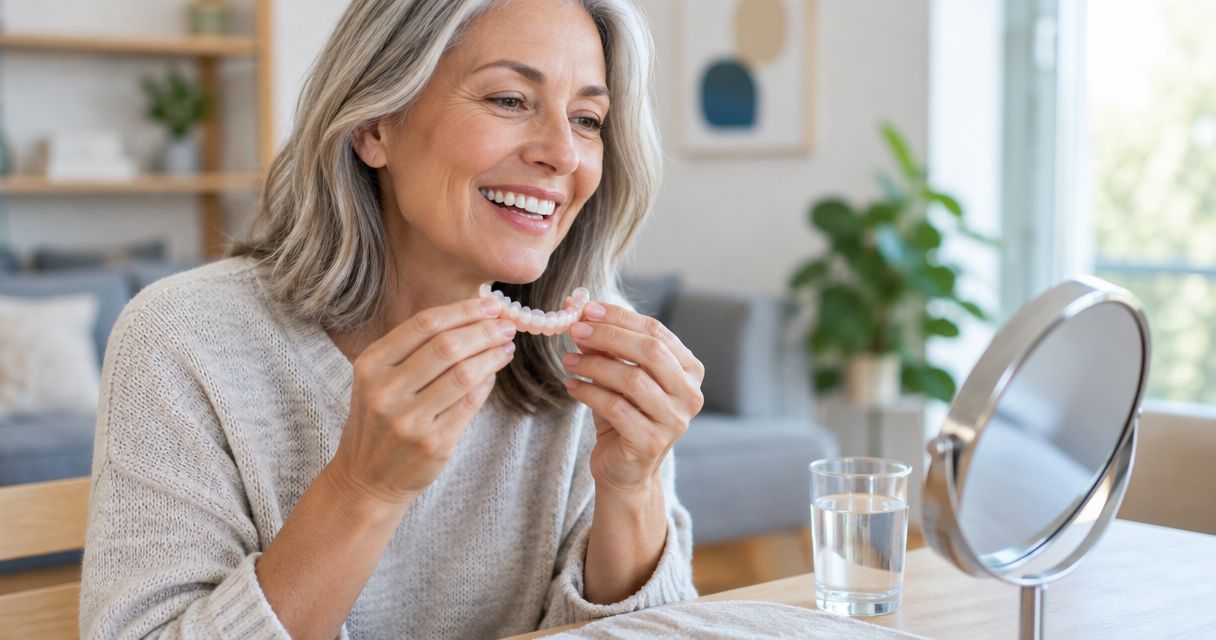
Dentist-supervised custom trays hold whitening gel against your natural teeth using trays made to fit your mouth. You apply the gel at home according to the dentist's instructions, rather than selecting a generic schedule yourself.
Custom trays take the top position because they combine individualized fit with professional guidance. They are particularly useful when you want home treatment but need help choosing an appropriate approach or managing sensitivity.
Custom tray pros:
- Fitted trays give you more control over gel placement than generic tray shapes.
- A dentist can check existing dental problems before treatment begins.
- Instructions can account for sensitivity and visible restorations.
- Treatment happens at home rather than entirely during an appointment.
Custom tray cons:
- You must follow a repeated application routine.
- Trays need cleaning and appropriate storage.
- Excess gel can still irritate gums; a custom fit does not remove every risk.
Best for: Adults who want individualized home bleaching and can follow a consistent routine.
Ask how much gel to use, when to stop, and what to do if sensitivity develops. Do not replace the prescribed gel with a different formulation or extend wear time on your own.
Verdict: Buy into a dentist-supervised tray plan when fit, guidance, and home use matter most.
2. In-office bleaching: best for appointment-based whitening
In-office bleaching uses whitening material applied under professional supervision, with measures to protect the surrounding soft tissues. The clinician controls the application instead of leaving you to position strips or fill trays at home.
This method suits people who prefer treatment delivered in a dental setting. It does not guarantee a particular shade, and one appointment does not eliminate the need for future maintenance.
In-office bleaching pros:
- A clinician controls placement and monitors treatment.
- Protective measures help limit contact between bleaching material and gums.
- You do not need to manage the main application yourself.
- A dental examination can identify reasons to postpone whitening.
In-office bleaching cons:
- Tooth sensitivity and gum irritation remain possible.
- Some discoloration responds poorly even with professional treatment.
- Visible restorations keep their existing color.
Best for: People who want clinician-delivered bleaching rather than a home application routine.
Ask what the whitening material does and whether a light is part of the protocol. A light-based description alone does not establish that one treatment will deliver a better result for your teeth.
For a 2026 comparison, judge in-office whitening by the examination, treatment plan, and aftercare—not by a promise of a dramatic shade change.
Verdict: Buy professional treatment when supervised application is your main priority.
3. Whitening strips: best for straightforward home application
Whitening strips carry a bleaching gel on flexible strips that sit against your teeth. They remove the tray-filling step, but you still need to position them correctly and follow the specific product's directions.
Strips suit people whose teeth allow reasonably even contact across the visible surfaces. Crowding, rotations, or difficulty keeping a strip in place can make coverage less predictable.
Whitening strip pros:
- Application does not require custom trays.
- Preloaded strips remove the need to measure gel into a tray.
- Home use fits around your own routine.
- Clear package directions provide a defined application schedule.
Whitening strip cons:
- Strip shape does not match every tooth arrangement.
- Contact with gums can cause irritation.
- Sensitivity can interrupt the treatment routine.
Best for: Adults seeking home bleaching without a custom tray, after checking that their teeth and gums are healthy.
Choose a product with clear directions and follow its stated application time. Do not stack strips, add another whitening gel, or keep strips on longer in an attempt to accelerate the result.
Verdict: Buy strips for simple home application; skip them when fit or existing sensitivity makes use uncomfortable.
4. Ready-made trays: best for noncustom tray-style bleaching
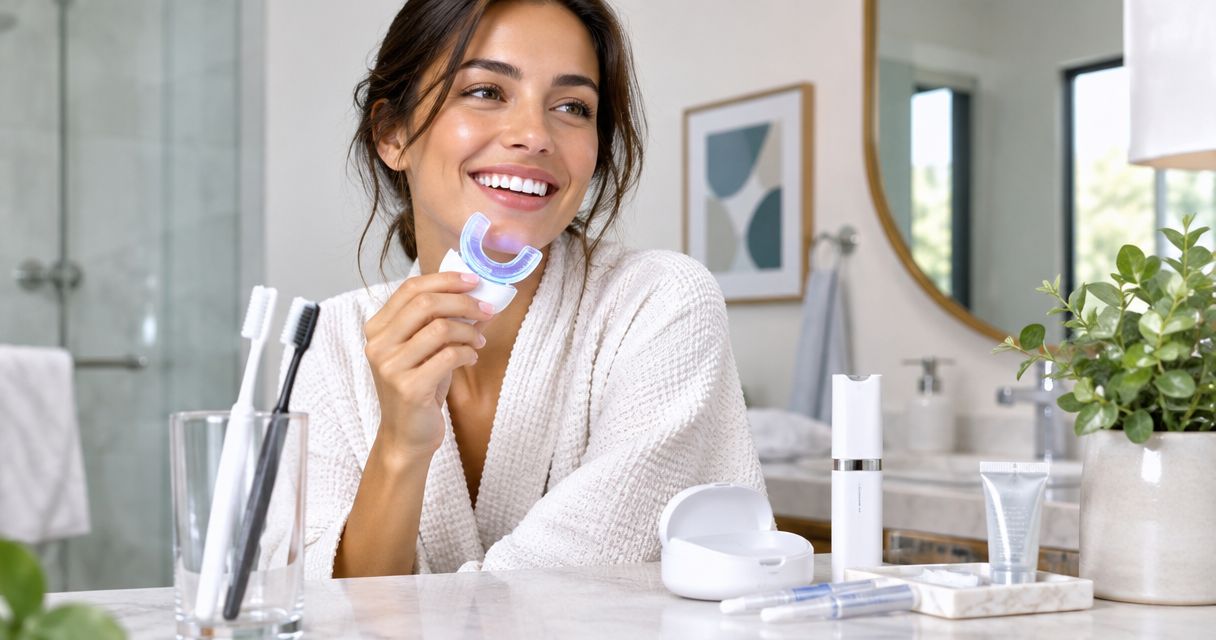
Over-the-counter whitening trays use a ready-made shape rather than an impression or scan of your teeth. Depending on the product, the tray arrives with whitening material or requires you to add it according to the instructions.
The main distinction is fit. A tray can carry bleaching material successfully only where that material contacts the intended tooth surfaces, and a generic shape does not account for every mouth.
Ready-made tray pros:
- Tray-style delivery does not require custom fabrication.
- Upper and lower tooth coverage is built into the tray format.
- Application takes place at home.
Ready-made tray cons:
- Generic trays can feel bulky or sit unevenly.
- Poor fit can allow gel to contact gums.
- Uneven tooth contact can affect coverage.
Best for: Adults who prefer tray-style application and can achieve a comfortable fit with the selected product.
Check the tray's instructions before use, especially whether any fitting step is required. Do not assume that instructions for one tray system apply to another, and do not keep using a tray that cuts or presses painfully into your gums.
Verdict: Hold until you confirm a comfortable fit; skip a tray that repeatedly irritates soft tissue.
5. Whitening toothpaste: best for external surface stains
Whitening toothpaste helps remove external staining through its cleaning ingredients. It is not equivalent to a peroxide bleaching treatment intended to change natural tooth color.
This is the most practical starting point when your main concern is surface staining and you do not want a separate bleaching routine. Choose a fluoride toothpaste so cosmetic goals do not replace cavity prevention.
Whitening toothpaste pros:
- Fits into ordinary brushing rather than adding a separate treatment session.
- Helps remove external stains.
- Fluoride-containing options support daily cavity prevention.
Whitening toothpaste cons:
- Does not bleach the underlying tooth color.
- Will not correct a dark tooth caused by injury or disease.
- Aggressive brushing can damage teeth and gums regardless of the toothpaste chosen.
Best for: People managing external stains who do not need or want bleaching.
Brush gently with a soft-bristled toothbrush for 2 minutes per session, twice per day. That is 4 minutes of daily brushing—not a reason to scrub harder or extend brushing to chase a whiter shade.
Verdict: Buy fluoride whitening toothpaste for surface-stain control; skip it as a substitute for bleaching deeper discoloration.
Match the treatment to the discoloration
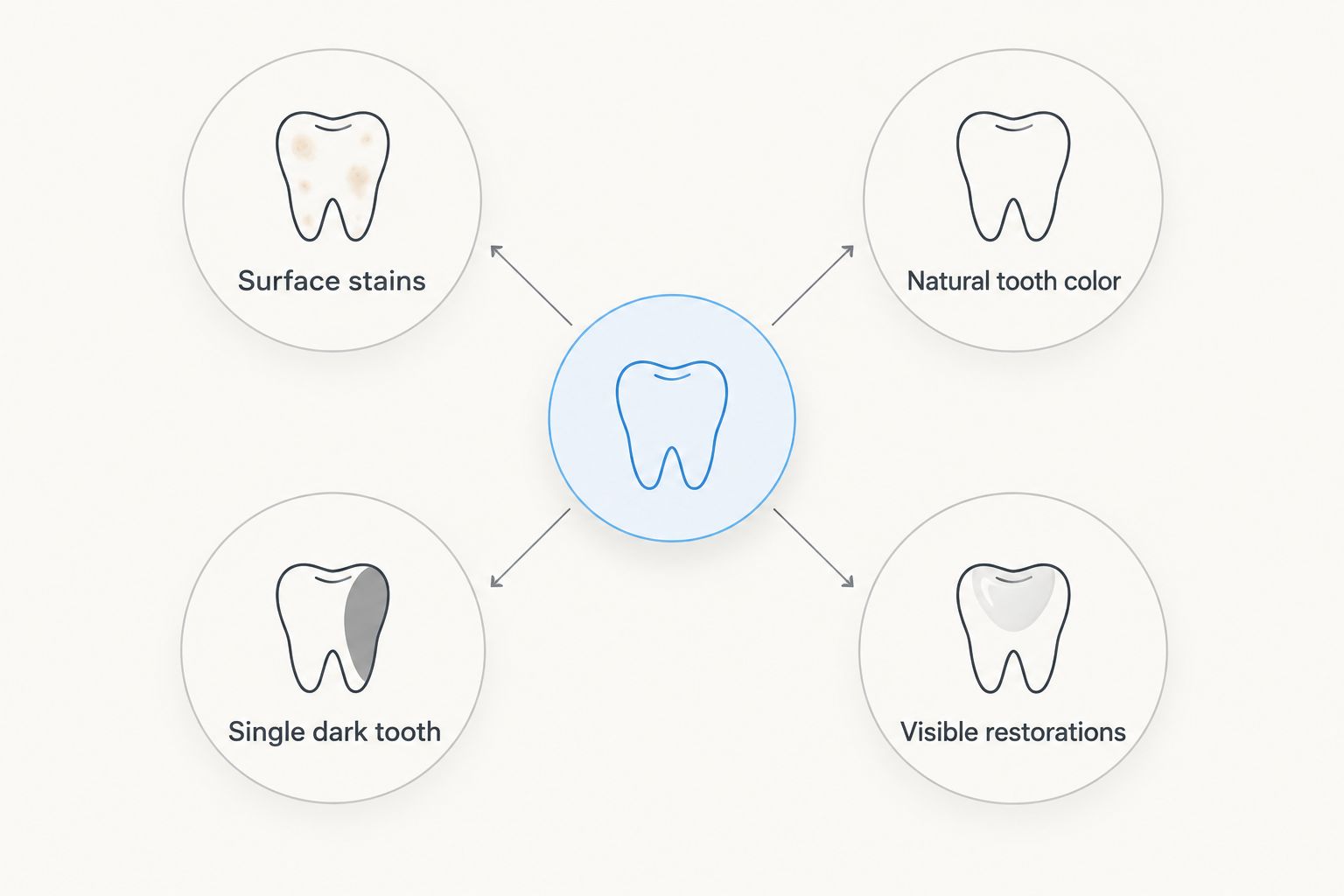
Before choosing among teeth whitening options, separate these common situations:
- Surface stains: External discoloration can respond to stain-removing toothpaste or professional cleaning. Cleaning removes deposits; it does not bleach the tooth's underlying color.
- Natural tooth color: Peroxide bleaching can lighten natural teeth, but the result depends on the cause and character of the discoloration.
- Single dark tooth: One tooth that changes color needs an examination, especially after an injury. Cosmetic treatment should not come before diagnosis.
- Visible restorations: Crowns, veneers, bonding, fillings, and dentures require separate planning because bleaching does not change their shade like natural teeth.
The useful question is not simply which method is strongest. Ask which method addresses the material and discoloration in front of you.
Safety checks before you start
Do not bleach through pain. Existing sensitivity, untreated decay, gum inflammation, exposed roots, or a cracked tooth can change what treatment is appropriate.
Stop using a whitening product if it causes significant discomfort, gum injury, or worsening symptoms, and ask a dentist for advice. Temporary sensitivity is a recognized side effect, but that does not mean every painful reaction should be ignored.
Avoid household bleach, acidic mixtures, and abrasive scrubbing as whitening substitutes. Products intended for cleaning surfaces are not dental treatments, and acid exposure can damage enamel.
Keep the instructions for the exact product you use. Application times and treatment schedules are not interchangeable across strips, gels, and tray systems.
How these options are ranked
This ranking prioritizes stain suitability, fit, professional oversight, treatment control, maintenance, and restoration compatibility. Custom trays rank first for the combination of individualized delivery and guided home use; in-office treatment wins when you prefer clinician-controlled application.
The order is a decision guide, not a claim that every person gets the same result. Whitening toothpaste ranks last for bleaching because it serves a different purpose: external stain removal.
Which teeth whitening option should you choose?
Choose dentist-supervised custom trays as the default when you want home bleaching with individualized guidance. Choose in-office treatment when you prefer supervised application, strips when simple home use matters most, and whitening toothpaste when surface staining is the actual problem.
For your 2026 plan, settle the restoration question before bleaching. If a front crown already matches your natural teeth, whitening the adjacent enamel can make that crown stand out.
Dentalcoloradosprings serves local patients with general dental care. Start with an assessment when discoloration is new, uneven, painful, or difficult to explain.
Discuss your dental concerns
Start with dental health before choosing a cosmetic whitening approach.
FAQ
What's the best teeth whitening option overall?
Dentist-supervised custom trays are the best overall choice for individualized home bleaching with professional guidance. In-office bleaching is a better fit when you prefer clinician-controlled application rather than repeated home treatment.
Is in-office whitening better than whitening strips?
In-office whitening offers professional control over application, while strips offer home use without custom trays. Neither is automatically better for every person; dental health, sensitivity, tooth position, and the discoloration matter.
Will whitening change the color of crowns or veneers?
Whitening does not change crowns or veneers the way it changes natural teeth. Discuss visible restorations before bleaching because the surrounding teeth can become lighter while the restoration keeps its existing shade.
Can I whiten my teeth if they are sensitive?
Have existing sensitivity assessed before starting whitening. A dentist can check for causes such as exposed roots, decay, or cracks and advise whether bleaching is appropriate.
Does whitening toothpaste actually whiten teeth?
Whitening toothpaste helps remove external surface stains rather than bleaching the underlying tooth color. Choose a fluoride-containing toothpaste and avoid aggressive brushing.
Why is just one tooth darker than the others?
A single dark tooth needs a dental examination to identify the cause. Prior injury, decay, and changes inside the tooth require a different approach from ordinary surface staining.
Can I combine strips, trays, and whitening toothpaste?
Do not combine bleaching systems unless a dentist specifically directs the combination. Using multiple products or extending application time can increase irritation and sensitivity.
How do I keep my teeth looking brighter after whitening?
Maintain gentle brushing with fluoride toothpaste, clean between your teeth, and follow your dentist's maintenance advice. Tobacco and stain-producing foods and drinks can contribute to discoloration returning.
One last thing
A brighter smile is not always a bleaching problem. Removing surface deposits or addressing one mismatched restoration can be more relevant than whitening every natural tooth.
The best teeth whitening decision in 2026 starts with identifying what needs to change. Diagnose first, choose the matching method, and stop treating discomfort as proof that a product is working.