Best overall for an eligible patient replacing one tooth: a single-tooth implant. Best fixed alternative: a dental bridge. Best removable option for several gaps: a partial denture. This 2026 guide compares tooth replacement options for missing teeth, including complete dentures and implant-supported overdentures, so you can discuss the right treatment with your dentist.
- Tooth replacement options for missing teeth include implants, bridges, partial dentures, complete dentures, and implant-supported overdentures.
- Single-tooth implants suit eligible patients who want a fixed replacement without preparing neighboring teeth.
- Bridges suit selected patients seeking fixed replacement without implant surgery; supporting teeth require careful assessment.
- Dentalcoloradosprings offers implants and same-day dentures for local Colorado Springs patients.
Why this matters
The best replacement depends on what remains healthy, not just what is missing. Your dentist must assess your gums, remaining teeth, bite, and available bone before recommending treatment. A replacement that works well for one gap can be unsuitable for an entire arch.
For local care, Dentalcoloradosprings offers implants, same-day dentures, emergency dentistry, IV sedation, and general dental care. Bring your priorities to the evaluation: whether you want something fixed, whether you accept surgery, and what daily cleaning you can manage.
Missing teeth also raise different questions depending on their location. A front gap makes appearance especially noticeable; a back gap changes where you can chew. Neither situation identifies the correct treatment without examining the surrounding mouth.
What makes the best tooth replacement?
Use these criteria to evaluate your 2026 treatment plan before choosing a procedure:
- Fit with your mouth: Healthy supporting teeth, gum condition, and available bone determine which treatments are suitable.
- Fixed versus removable: A fixed replacement stays in place during routine use. You remove a removable denture for cleaning.
- Effect on neighboring teeth: A conventional bridge usually requires preparation of supporting teeth; a single-tooth implant does not.
- Surgery and healing: Implant treatment requires surgery and assessment of healing. Conventional dentures do not require implant placement.
- Daily maintenance: Every option needs cleaning, professional review, and attention to changing fit or supporting tissues.
- Treatment sequence: Ask what you will wear during healing and whether the initial replacement is temporary or definitive.
Do not choose on appearance alone. Ask your dentist to explain why the proposed replacement fits your supporting tissues and how you will clean every surface that needs attention.
Tooth replacement options at a glance
This 2026 comparison assigns each option a distinct use case. It is a decision guide, not a claim that every patient qualifies for every treatment.
| Option | Best for | Standout feature | Key limitation |
|---|---|---|---|
| Single-tooth implant | One missing tooth with suitable bone and oral health | Supports a crown without preparing neighboring teeth | Requires surgery and healing |
| Conventional dental bridge | A fixed replacement when supporting teeth are suitable | Uses adjacent teeth to support replacement teeth | Usually requires preparation of supporting teeth |
| Removable partial denture | Several gaps with natural teeth remaining | Replaces multiple missing teeth in a removable appliance | Requires removal, cleaning, and adaptation |
| Complete denture | An arch with no remaining natural teeth | Replaces the teeth across a full arch without implant support | Can move and require fit adjustments |
| Implant-supported overdenture | A toothless arch needing more retention than a conventional denture | Uses implant attachments to help retain a removable denture | Requires surgery and attachment maintenance |
1. Single-tooth implant: best for an isolated missing tooth
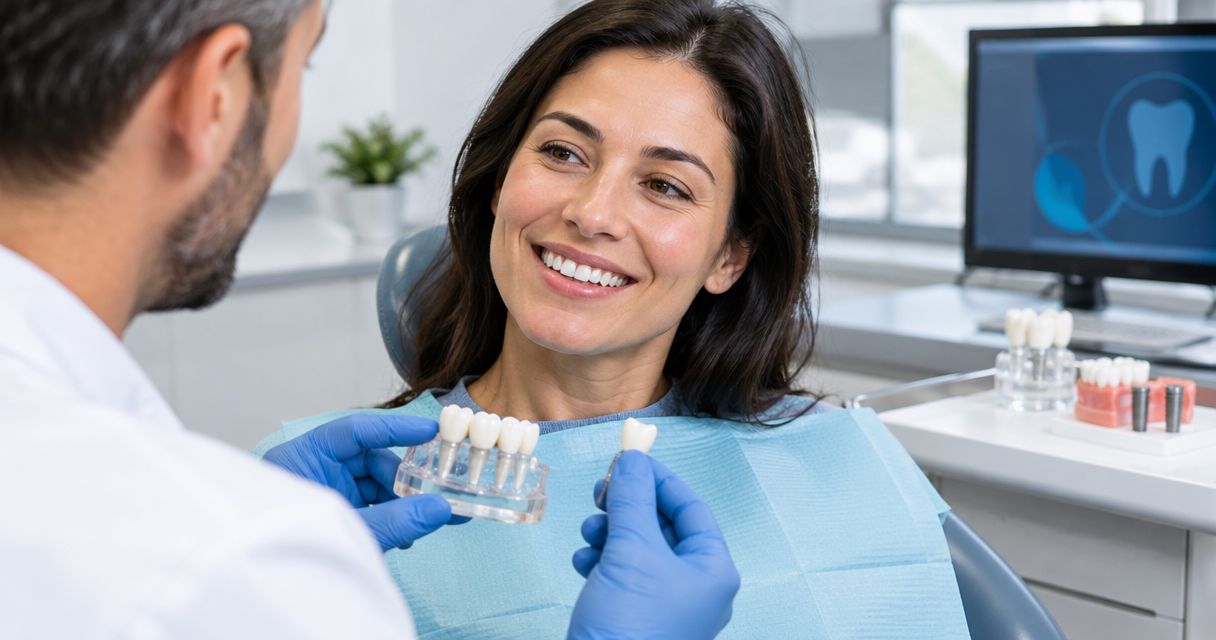
A single-tooth implant replaces a missing root with an implant placed in the jaw. An abutment connects the implant to a crown, creating a fixed replacement that does not depend on neighboring teeth for support.
Best for: An eligible adult missing 1 tooth who wants a fixed replacement and has suitable oral health and bone support.
Single-tooth implant pros
- Does not require preparing neighboring teeth solely to support the replacement.
- Provides a fixed crown rather than a patient-removable appliance.
- Replaces the missing tooth independently of adjacent teeth.
Single-tooth implant cons
- Requires surgery and an individualized healing plan.
- Inadequate bone or active oral disease can require treatment before placement.
- Needs ongoing cleaning and monitoring; an implant is not immune to surrounding tissue problems.
Ask whether you need bone grafting and what you will wear while treatment progresses. Also ask whether the proposed crown is temporary or definitive. An early replacement tooth does not automatically mean that implant healing is complete.
Verdict: Hold until an examination confirms implant suitability; then prioritize a single-tooth implant when preserving healthy neighboring teeth is your main goal.
2. Conventional dental bridge: best for a fixed alternative
A conventional bridge uses supporting teeth next to a gap to hold replacement teeth in place. You do not remove it for routine cleaning, but you must clean around the supporting teeth and beneath the replacement portion.
Best for: A patient seeking a fixed replacement without implant placement when the neighboring teeth can support a bridge.
Conventional dental bridge pros
- Provides a fixed replacement without implant surgery.
- Can address a gap when adjacent teeth already need crowns.
- Avoids the daily removal associated with a removable denture.
Conventional dental bridge cons
- Usually requires reshaping supporting teeth, including healthy tooth structure.
- Places ongoing importance on the health of the supporting teeth.
- Requires specific cleaning beneath the replacement teeth.
For 1 missing tooth, a conventional bridge commonly uses the teeth on both sides of the gap as supports. That makes the condition of those 2 supporting teeth central to the decision. A bridge is not automatically preferable simply because you want to avoid surgery.
Ask why each proposed supporting tooth is suitable. Your dentist should also show you how floss threaders or another appropriate cleaning aid will reach beneath the bridge.
Verdict: Hold until the supporting teeth are assessed; choose a bridge when a fixed, tooth-supported replacement fits the clinical findings.
3. Removable partial denture: best for several separate gaps
A removable partial denture replaces missing teeth while some natural teeth remain. Its design uses the remaining teeth and oral tissues for support and retention; the exact arrangement depends on where the gaps are.
Best for: A patient with several missing teeth who accepts a removable appliance and wants the gaps considered together.
Removable partial denture pros
- Can replace teeth in multiple locations within the same arch.
- Does not require implant placement.
- Can be removed to clean the appliance and remaining teeth separately.
Removable partial denture cons
- Can feel bulky while you adapt to wearing it.
- Clasps or other retaining components can be visible, depending on the design.
- Requires careful cleaning around supporting teeth and periodic fit checks.
A partial denture does not make your remaining teeth less important. Those teeth can be essential to keeping the appliance stable, so untreated decay or gum disease needs attention before the design is finalized.
Ask your dentist to identify the supporting teeth and explain where the appliance will rest. Have the cleaning method demonstrated before you leave with it. Avoid assuming that a removable appliance needs less maintenance than a fixed replacement.
Verdict: Hold until the supporting teeth and denture design are evaluated; choose a partial denture when replacing several gaps with a removable appliance matches your needs.
4. Complete denture: best for a full arch without implants
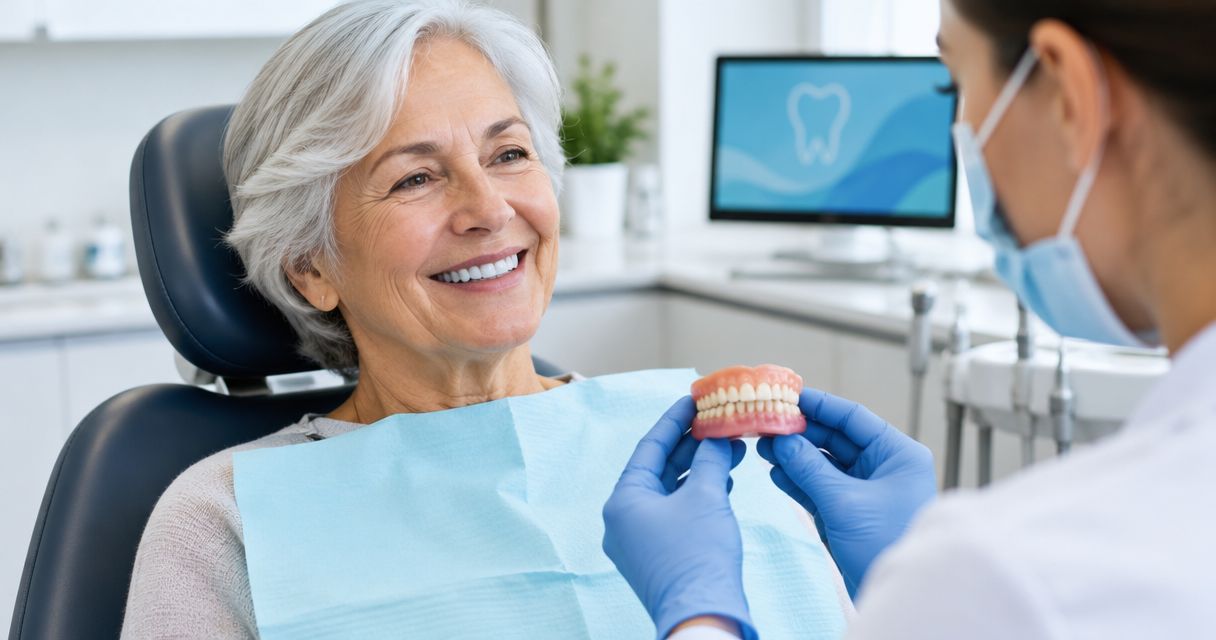
A complete denture replaces the teeth in an arch with no remaining natural teeth. It rests on the oral tissues rather than being retained by dental implants.
Best for: A patient needing full-arch replacement who does not want, or is not suitable for, implant-supported treatment.
Complete denture pros
- Replaces an entire arch of missing teeth.
- Does not require implant surgery.
- Can be removed for cleaning and examination of the tissues underneath.
Complete denture cons
- Can move during speaking or eating, particularly when retention is limited.
- Requires adaptation and professional adjustments.
- Can need relining or replacement as the supporting tissues change.
An immediate denture is fitted following tooth removal, while a conventional denture is made after tissues have healed. These describe treatment timing, not a promise that the first fit remains unchanged.
When discussing same-day dentures in 2026, ask whether the appliance is immediate, what adjustments are expected, and how later fit changes are handled. Dentalcoloradosprings offers same-day dentures; your examination determines the appropriate treatment sequence.
Never adjust a painful denture yourself. Persistent soreness needs an assessment of fit and the tissues beneath it.
Verdict: Hold until the extraction, healing, and adjustment plan is clear; choose a complete denture when full-arch removable replacement without implants is the appropriate route.
5. Implant-supported overdenture: best for added denture retention
An implant-supported overdenture connects a removable denture to attachments on dental implants. You remove the denture for cleaning, while the implants remain in the jaw.
Best for: A patient missing all teeth in an arch who wants added retention but accepts a removable replacement.
Implant-supported overdenture pros
- Provides implant-assisted retention beyond a conventional denture.
- Remains removable for cleaning of the appliance and attachments.
- Offers a distinct alternative to both conventional dentures and fixed implant bridges.
Implant-supported overdenture cons
- Requires implant surgery and suitability assessment.
- Attachments can wear and need professional maintenance.
- Still requires removal and cleaning; it is not a fixed full-arch bridge.
Ask exactly what your dentist means by an “implant denture.” The phrase can describe different designs, and a removable overdenture is not the same as a fixed implant-supported bridge. That difference affects daily cleaning and what you can remove yourself.
The number and position of implants depend on the arch, anatomy, and proposed design. Do not use another patient's implant count as your treatment prescription.
Verdict: Hold until the design and maintenance needs are explained; choose an overdenture when added retention matters more than having a fixed replacement.
How to narrow your choices before the appointment
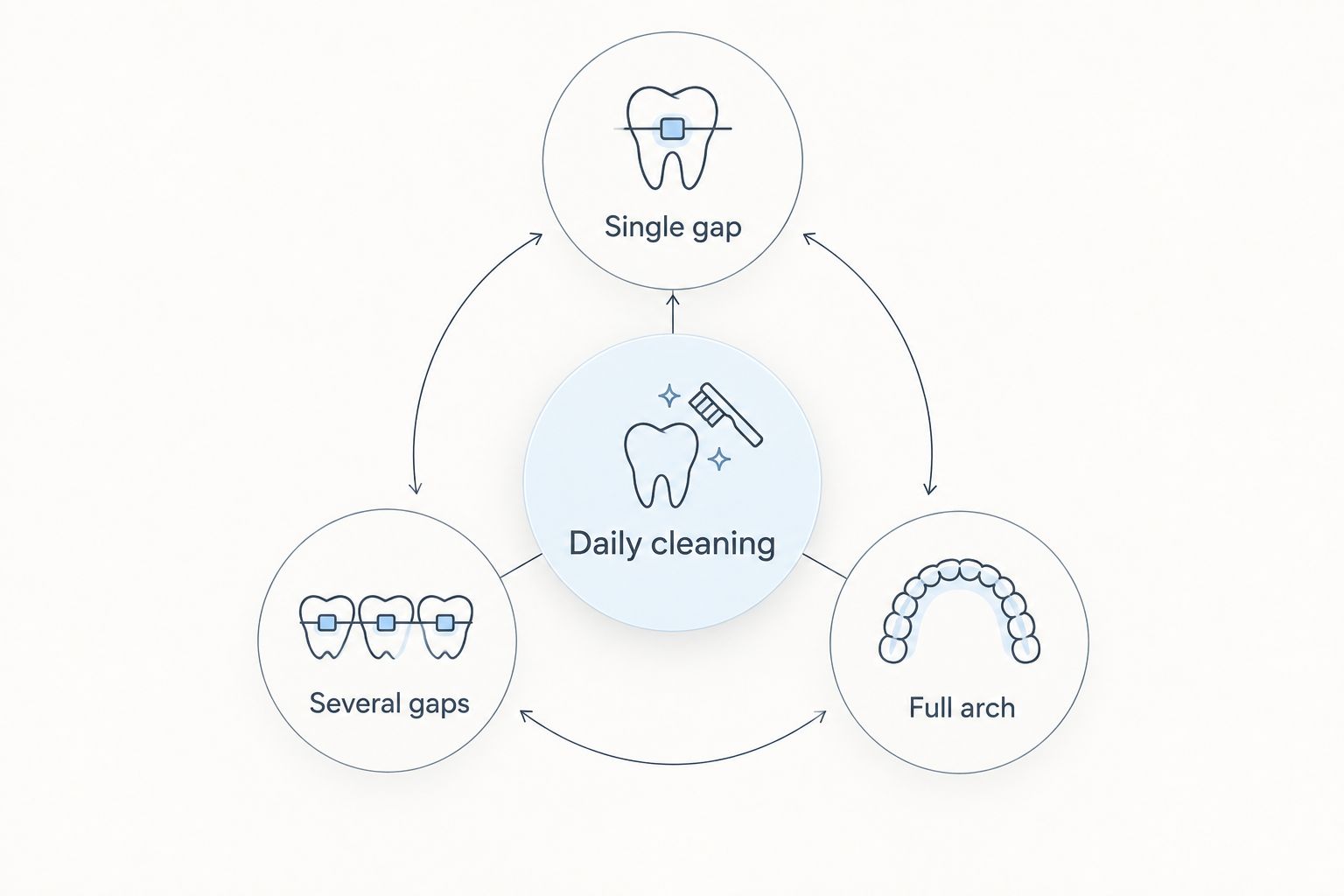
Start with the extent of tooth loss, then decide which trade-offs you are prepared to discuss. Your preferences help shape the conversation; they do not replace the examination.
- Single gap: Discuss a single-tooth implant and whether a bridge has suitable support.
- Several gaps: Discuss how a partial denture compares with fixed replacements for the specific spaces.
- Full arch: Compare a complete denture with implant-supported treatment.
- Daily cleaning: Ask to see the cleaning method for the proposed design before accepting it.
Bring a medication list and describe any problems with earlier dentures or dental treatment. Tell your dentist about smoking, difficulty cleaning, dental anxiety, and medical conditions relevant to surgery or healing. These details help identify a workable treatment rather than merely an attractive replacement.
How the options were ranked
This 2026 ranking prioritizes clinical fit, preservation of neighboring teeth, fixed versus removable function, surgery, and maintenance. The single-tooth implant leads for its specific eligible patient group—not because implants are the correct answer for every missing tooth.
The other options occupy separate decision points. A bridge addresses fixed replacement with tooth support; partial and complete dentures address different patterns of tooth loss; an overdenture adds implant retention to a removable appliance.
Which tooth replacement should you choose?
Start with an implant evaluation for an isolated missing tooth, not a commitment to implant surgery. If the examination rules implants out or you do not want surgery, ask whether a bridge or removable replacement fits your mouth better.
Dentalcoloradosprings is best for Colorado Springs patients seeking an evaluation of implants or same-day dentures. Ask for the recommended treatment, the reason it fits, an alternative, and the cleaning and follow-up responsibilities attached to each.
Discuss your tooth replacement options
Review implant and same-day denture care for your missing teeth.
FAQ
What's the best tooth replacement for one missing tooth?
A single-tooth implant is a leading option for an eligible patient who wants a fixed replacement without preparing neighboring teeth. A bridge or removable replacement can be more appropriate when surgery, bone condition, or supporting teeth change the decision.
Is a dental implant better than a bridge?
A dental implant avoids preparing neighboring teeth, while a conventional bridge avoids implant placement. Neither is universally better; the condition of your bone, gums, and adjacent teeth determines the appropriate choice.
Can I replace missing teeth without implants?
Yes. Conventional bridges, removable partial dentures, and complete dentures replace missing teeth without implant placement. The suitable option depends on how many teeth are missing and the available support.
Are same-day dentures the final dentures?
Same-day timing does not establish whether a denture is temporary or definitive. Ask whether the proposed appliance is an immediate denture and how healing-related changes in fit will be managed.
Are implant dentures removable?
Some implant dentures are removable, including implant-supported overdentures. Other implant-supported restorations are fixed, so ask which design is being proposed and who can remove it.
Will Medicaid or TRICARE cover my replacement teeth?
Coverage depends on your specific plan, eligibility, and proposed treatment. Confirm benefits and authorization requirements with the practice and insurer before treatment; serving plan recipients does not establish coverage for every procedure.
Do replacement teeth still need brushing?
Yes. Fixed replacements and their surrounding tissues need daily cleaning, and removable dentures need a separate cleaning routine. Brush natural teeth for 2 minutes twice daily with fluoride toothpaste, and follow your dentist's instructions for the replacement.
One last thing
Ask to see how you will clean the replacement before agreeing to it. A design that you cannot maintain deserves another discussion, even if it looks right in a treatment presentation. For your 2026 decision, leave the appointment knowing what you will clean, what you will remove, and which changes mean you should call your dentist.