Best overall if eligible: VA dental care. Best for VA-enrolled veterans without qualifying VA dental coverage: the VA Dental Insurance Program. Best for eligible military retirees: FEDVIP. The strongest veteran dental benefits options in 2026 depend on your eligibility category, not veteran status alone; this guide compares those routes with TRICARE Dental Program coverage and Colorado Medicaid.
- VA dental care leads veteran dental benefits options when your eligibility category covers the treatment you need.
- VADIP offers private dental insurance to VA-enrolled veterans and eligible CHAMPVA beneficiaries.
- FEDVIP serves eligible military retirees; the TRICARE Dental Program serves different military eligibility groups.
- Dentalcoloradosprings provides local dental care in Colorado Springs; confirm benefits and billing before treatment.
Why this matters
VA health care enrollment does not automatically include routine VA dental care. Dental eligibility follows separate rules, and some qualifying categories cover only a specific condition or treatment need. Choosing a dentist before checking those rules can leave you arranging treatment through the wrong payment route.
Your coverage decision and your provider decision are separate. Dentalcoloradosprings offers implants, same-day dentures, emergency dentistry, IV sedation, and general dental care in Colorado Springs, including care for Medicaid and TRICARE recipients. That does not establish coverage for a particular procedure, plan, or appointment.
What makes the best veteran dental benefits options?
Use these criteria before comparing plan names. A broad benefits summary is less useful than an answer about your eligibility and proposed treatment.
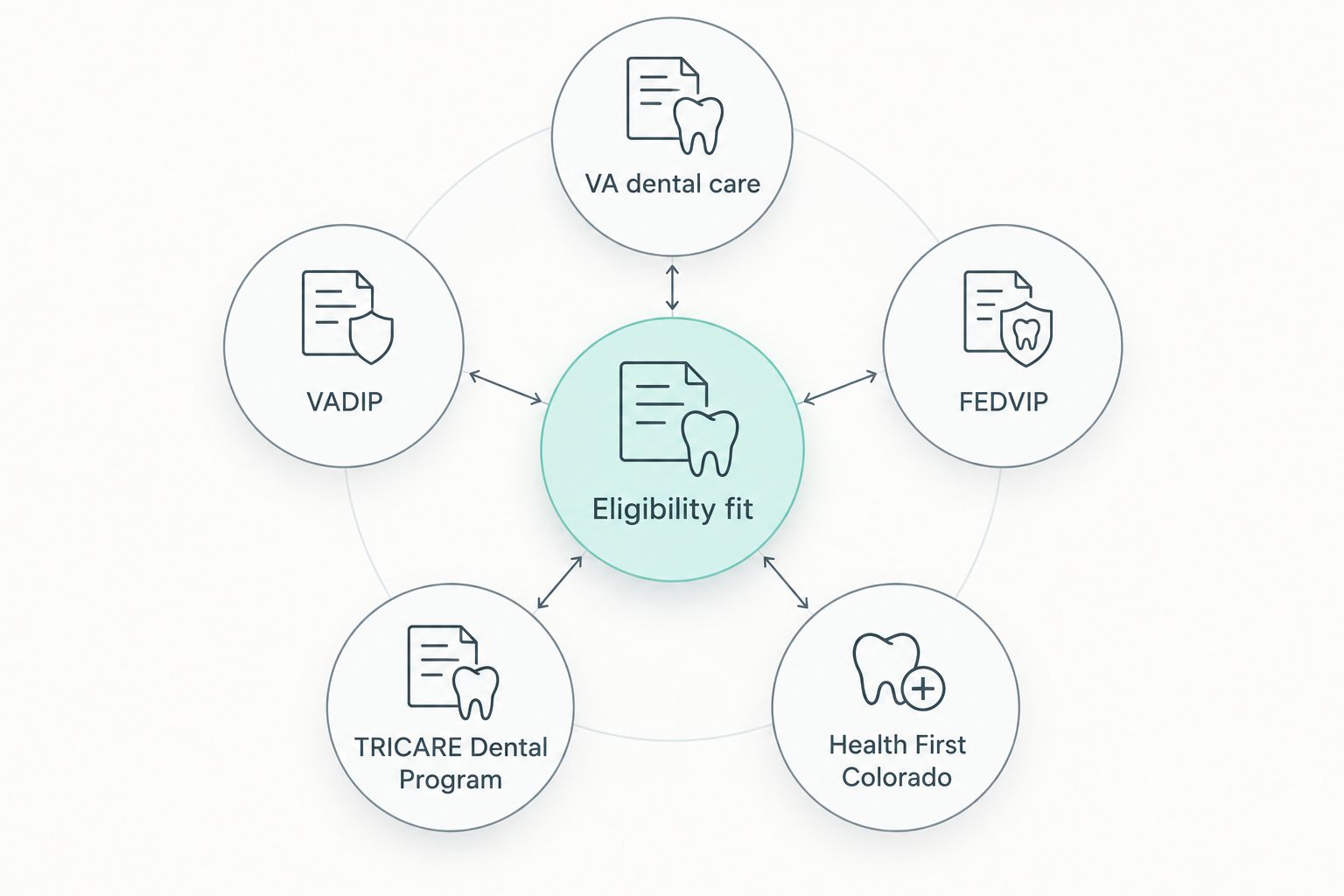
- Eligibility fit: Can you actually enroll, and does your status qualify you for the care you need?
- Treatment scope: Distinguish preventive visits from fillings, periodontal treatment, dentures, and implants.
- Provider access: Check the exact dentist, location, and plan network—not just the insurance company's name.
- Treatment restrictions: Review waiting periods, annual benefit limits, exclusions, frequency limits, and authorization requirements.
- Continuity: Consider what happens when you retire, leave qualifying service, move, or change eligibility categories.
The ranking below assigns each route a distinct use case. It is not a promise that the first option covers every veteran or every dental procedure.
Veteran dental coverage at a glance
| Rank and option | Best for | Standout feature | Key limitation |
|---|---|---|---|
| 1. VA dental care | Veterans in a qualifying VA dental eligibility category | Direct care tied to VA eligibility rules | VA health enrollment alone is insufficient |
| 2. VA Dental Insurance Program, or VADIP | VA-enrolled veterans without qualifying VA dental coverage | A separate private dental insurance route | Plan restrictions and provider networks apply |
| 3. Federal Employees Dental and Vision Insurance Program, or FEDVIP | Eligible retired service members and eligible family members | Dental plan selection through a federal benefits program | Retiree eligibility and enrollment rules apply |
| 4. TRICARE Dental Program, or TDP | Eligible active-duty family members and National Guard or Reserve members and families | Dental coverage for specified military eligibility groups | It is not the retiree dental program |
| 5. Health First Colorado | Veterans who meet Colorado Medicaid eligibility requirements | Dental benefits through Colorado's Medicaid program | State eligibility and covered-service rules apply |
The first decision is eligibility, not which plan has the longest list of services. Use the table to identify a route, then check the details for your actual treatment.
1. VA dental care: best for veterans with qualifying eligibility
VA dental care is the first route to check when you qualify under a VA dental eligibility category. Your category determines whether you receive broad dental care or care limited to a particular condition or purpose. It is a health benefit, not simply another private insurance plan.
A veteran with a service-connected disability rated at 100% can qualify for needed dental care, subject to VA rules. Veterans paid at the 100% rate because of individual unemployability also have a qualifying route; a temporary total disability rating does not establish the same entitlement.
VA dental care pros:
- Offers needed dental care for qualifying eligibility categories.
- Includes routes tied to service-connected dental conditions.
- Provides additional eligibility routes for certain other veteran circumstances.
VA dental care cons:
- Enrollment in VA medical care does not automatically qualify you.
- Some categories authorize limited care rather than ongoing routine dentistry.
- Outside treatment requires the applicable VA referral and authorization process.
Best for: Veterans whose VA dental eligibility category matches their treatment needs.
For your 2026 treatment planning, ask VA to identify your dental eligibility category and explain its scope. Recent separation also deserves prompt attention: a qualifying one-time dental care route generally requires an application within 180 days after discharge or release, along with other conditions.
Verdict: Choose VA dental care first when VA confirms eligibility; do not assume a private appointment is authorized.
2. VADIP: best for VA-enrolled veterans needing private insurance
The VA Dental Insurance Program lets eligible VA-enrolled veterans and eligible CHAMPVA beneficiaries purchase private dental insurance. VADIP enrollment is separate from VA dental care eligibility. Buying a policy does not create entitlement to direct VA dental care.
This route is especially relevant when you have VA medical coverage but do not qualify for the dental treatment you need through VA. Compare the policy's benefits against a written treatment plan rather than selecting it on preventive coverage alone.
VADIP pros:
- Provides a dental insurance route for eligible VA-enrolled veterans.
- Also permits enrollment by eligible CHAMPVA beneficiaries.
- Allows care through the selected insurer's provider arrangements.
VADIP cons:
- Covered services, exclusions, and benefit limits depend on the policy.
- An insurance benefit does not guarantee coverage of an entire treatment plan.
- Provider participation must be checked for the specific plan.
Best for: VA-enrolled veterans who need a private dental insurance route rather than direct VA dental care.
Before choosing a 2026 VADIP policy, check coverage for the procedure you expect to receive. Dentures, implant-related services, extractions, and sedation require separate attention; a general statement that a plan covers dental care does not answer those questions.
Verdict: Choose VADIP for its eligibility fit, then verify the policy against your treatment needs.
3. FEDVIP: best for eligible military retirees
The Federal Employees Dental and Vision Insurance Program offers dental coverage to eligible retired uniformed service members and eligible family members. FEDVIP is distinct from both VA dental care and the TRICARE Dental Program. Military retirement status—not veteran status by itself—is central to this route.
FEDVIP eligibility does not mean enrollment happens automatically. Confirm your eligibility and the enrollment opportunity that applies before counting on a policy for scheduled treatment.
FEDVIP pros:
- Provides a dental benefits route for eligible military retirees.
- Includes eligible family members under program rules.
- Offers plan comparison through a defined federal benefits program.
FEDVIP cons:
- Veteran status alone does not establish eligibility.
- Enrollment timing and qualifying life event rules matter.
- Networks, benefits, and limitations differ among plans.
Best for: Eligible retired service members comparing dental coverage for themselves or eligible family members.
For 2026 enrollment decisions, use the current official plan documents. Check your dentist's participation and the treatment categories you expect to use, especially if you are already discussing restorative work.
Verdict: Choose FEDVIP as the retiree comparison route; do not substitute TRICARE medical enrollment for dental enrollment.
4. TRICARE Dental Program: best for eligible military families
The TRICARE Dental Program is a voluntary dental insurance program for specified groups, including eligible active-duty family members and eligible National Guard or Reserve members and their families. It is not the dental insurance route for military retirees. Active-duty service members also follow separate dental care arrangements.
This distinction matters when a household contains people with different service statuses. One family member's eligibility does not establish that everyone belongs in the same program.
TRICARE Dental Program pros:
- Serves defined military family and reserve-component eligibility groups.
- Provides a dental program separate from medical coverage.
- Supports dental care through program provider arrangements.
TRICARE Dental Program cons:
- It is not available simply because someone is a veteran.
- Retirees need to examine the appropriate retiree route instead.
- Enrollment, provider participation, and service rules still require verification.
Best for: Eligible military family members and eligible National Guard or Reserve households.
Ask for confirmation using the full program name. A practice treating TRICARE recipients does not, by itself, establish that your particular dental plan covers the dentist or the proposed procedure.
Verdict: Choose the TRICARE Dental Program only after confirming your current military eligibility category.
5. Health First Colorado: best for Medicaid-eligible veterans
Health First Colorado is Colorado's Medicaid program and includes dental benefits under state program rules. Veterans can qualify through Medicaid eligibility pathways; military service alone does not establish eligibility. This is a separate route from VA benefits and military dental insurance.
For a Colorado Springs patient, the practical questions are whether eligibility is active, whether the provider participates, and whether the proposed treatment is covered. Check all of them before scheduling a procedure around an assumed benefit.
Health First Colorado pros:
- Provides a dental benefits route for eligible Colorado residents.
- Does not require qualifying for a VA dental eligibility category.
- Includes dental services governed by the state's benefit rules.
Health First Colorado cons:
- State eligibility requirements apply independently of veteran status.
- Not every dental service is covered.
- Provider participation and authorization requirements need confirmation.
Best for: Veterans who qualify for Colorado Medicaid and need covered dental treatment locally.
Dentalcoloradosprings treats local patients including Medicaid recipients. Ask the practice to check the proposed service and billing arrangement; that is more useful than asking only whether it treats Medicaid patients.
Verdict: Choose Health First Colorado when you qualify, then verify treatment coverage with the participating provider.
How these options are ranked
The ranking prioritizes eligibility fit, treatment scope, provider access, restrictions, and continuity. VA dental care comes first for veterans whose qualifying category provides the needed treatment; the other routes serve different enrollment groups rather than acting as interchangeable substitutes.
For 2026 decisions, use VA's official dental eligibility and VADIP guidance, OPM's FEDVIP eligibility and plan materials, official TRICARE Dental Program guidance, and Health First Colorado's dental benefit materials. Those sources define program rules; your dentist's treatment plan identifies the services to check against them.
Ask these questions before authorizing treatment:
- Eligibility: Which program and category cover you now?
- Provider: Does the exact treating office participate in your plan?
- Treatment: Which proposed procedures are covered or excluded?
- Authorization: Is a referral or prior approval required before treatment?
- Responsibility: What does the written benefits estimate leave for you to pay?
Keep a benefits estimate separate from a guarantee of payment. Ask what remains conditional and whether the plan needs additional records before making a determination.
Which veteran dental benefits option should you choose?
Start with VA dental eligibility, not a private policy application. If VA confirms that your category covers your treatment, follow that care pathway. If not, compare VADIP, FEDVIP, the TRICARE Dental Program, or Health First Colorado according to your actual enrollment eligibility.
Then choose a provider for the treatment—not merely for a familiar insurance name. Dentalcoloradosprings is best suited to Colorado Springs patients seeking local dental treatment rather than benefits enrollment. The practice offers dental services; the applicable benefits administrator determines program eligibility and coverage.
If you need care soon, obtain a clinical assessment while the benefits questions are being resolved. Facial swelling with trouble breathing or swallowing requires emergency medical attention, not a wait for an insurance determination.
FAQ
What's the best dental benefit for a veteran in 2026?
VA dental care is the first option to check when your qualifying eligibility category covers the treatment you need. Otherwise, compare VADIP, FEDVIP, the TRICARE Dental Program, or Medicaid according to your eligibility.
Does enrolling in VA health care include dental coverage?
No. VA dental care has separate eligibility rules, and some categories cover only limited treatment rather than ongoing routine care.
Can I get VADIP if I don't qualify for VA dental care?
Yes, eligible veterans enrolled in VA health care can purchase VADIP coverage without qualifying for direct VA dental care. Eligible CHAMPVA beneficiaries also have an enrollment route.
Is FEDVIP the same as the TRICARE Dental Program?
No. FEDVIP serves eligible military retirees and other eligible groups, while the TRICARE Dental Program serves specified military family and reserve-component groups. Confirm your status before selecting a program.
Does veteran dental coverage automatically cover implants?
No. Implant coverage depends on the benefit program, your eligibility, the policy's exclusions, and the proposed treatment. Ask for a procedure-specific benefits review before treatment.
Can a Colorado veteran qualify for Medicaid dental benefits?
Yes, a veteran who meets Health First Colorado eligibility requirements can receive dental benefits under the program's rules. Veteran status alone does not establish Medicaid eligibility.
Can I see a private dentist and have VA cover the appointment?
Do not assume a private appointment is covered by VA. Follow the applicable VA referral and authorization process before arranging outside care through that benefit.
One last thing
A covered denture does not establish coverage for every step needed to make it. Extractions, imaging, sedation, the appliance, and follow-up services can involve different benefit rules. Ask for a treatment plan that identifies each component, then have the applicable program check those components before you consent.
Related guides
- Contact the practice to discuss your dental needs and ask which benefits details to provide.