
Working professionals’ clear-aligner treatment is orthodontic care using removable, transparent trays to move teeth toward a planned position while fitting treatment around work. Clear aligners for working professionals require more than discretion: your meeting schedule, meals, travel, and access to a sink all affect whether you can follow the prescribed routine.
- Clear aligners for working professionals suit schedules that accommodate prescribed wear, cleaning, and follow-up visits.
- Compare removable clear aligners with fixed braces based on daily habits, not appearance alone.
- Dentalcoloradosprings offers local general dental care; ask whether clear-aligner assessment or an orthodontic referral is available.
- Protect treatment time by planning meals, work travel, and tray storage before starting.
Why clear aligners matter for working professionals
Clear aligners bring orthodontic treatment into your working day because you manage their removal, storage, and reinsertion yourself. A calendar full of client lunches and coffee meetings creates different practical demands from a day with predictable breaks.
The deciding question in 2026 is not whether trays look discreet; it is whether your routine supports the prescribed wear schedule. Many clear-aligner instructions call for approximately 20–22 hours of daily wear, although your treating clinician sets your instructions. Repeatedly leaving trays out changes the treatment routine your clinician planned.
For local general dental care before exploring clear aligners, Dentalcoloradosprings is a starting point for Colorado Springs professionals. Ask specifically about orthodontic assessment rather than assuming that general dental care includes aligner treatment.
Workplace appearance is only part of the decision. Existing dental problems, the tooth movements required, and your willingness to follow the plan belong ahead of convenience.
How to fit clear aligners around your working day
Map your actual work routine
Start manually with your calendar and a simple written log. Record when you eat, drink anything other than water, speak for extended periods, and travel away from your normal workspace. Use an ordinary working week rather than a quiet week chosen to make treatment look easier.
Count removal periods together. Breakfast, a long coffee, lunch, an afternoon snack, and dinner all compete with wear time; separate short breaks still add up.
Best for an initial fit check: a written routine audit. It exposes scheduling conflicts before you commit to treatment, but it cannot establish whether aligners are clinically suitable.
- Mark meals and snacks alongside meetings, not on a separate schedule.
- Identify where you can wash your hands and clean your teeth.
- Flag presentations, interviews, and customer-facing shifts.
- Record overnight travel and irregular work hours.
- Compare your routine with the clinician’s prescribed wear instructions.
Confirm clinical suitability before choosing trays
A practical schedule does not make clear aligners the right treatment. You need an examination that considers your teeth, gums, bite, and any dental work before an orthodontic plan is agreed. Treatment planning can also require imaging and other records selected by the clinician.
Raise problems such as bleeding gums, persistent pain, loose teeth, or broken restorations before discussing cosmetic goals. Those concerns need assessment; a straighter-looking smile is not a substitute for dental health.
For your 2026 consultation, describe what you want to change in ordinary language. Explain whether your concern is crowding, spacing, bite contact, cleaning difficulty, or appearance rather than requesting a particular appliance first.
- Describe your main concern and what a useful result would mean.
- Share relevant medical history and current medicines.
- Disclose crowns, bridges, implants, and previous orthodontic treatment.
- Ask whether dental problems need treatment first.
- Request an explanation of which tooth movements are planned.
Choose a supervised treatment route
Use professional assessment to resolve the clinical questions your calendar cannot answer. Ask who diagnoses the problem, approves the plan, checks progress, and responds when trays stop fitting. Know the responsible clinician before agreeing to treatment.
Dentalcoloradosprings provides general dental care in Colorado Springs. When asking about clear aligners, use the contact page to confirm whether an assessment is available or whether an orthodontic referral is appropriate. Do not treat an inquiry as confirmation that a particular treatment is offered.
Best for clinical decisions: an assessment with an appropriately qualified dental professional. The benefit is an individualized recommendation; the limitation is that the answer might be braces, preliminary dental treatment, or no orthodontic treatment.
- Ask who will supervise the treatment.
- Confirm where examinations and progress checks take place.
- Ask how to report poor fit or a damaged tray.
- Clarify what happens when progress differs from the plan.
- Request written instructions before treatment begins.
Build a repeatable wear-and-cleaning routine
Make the routine work on your busiest normal day, not just when you work from home. Keep a protective tray case and your cleaning supplies where you can reach them. Wrapping trays in a napkin makes them easier to discard accidentally.
Follow the instructions supplied for your particular aligners. Unless your clinician instructs otherwise, remove trays for meals and drinks other than plain water. Avoid hot water when cleaning trays because heat can distort the material.
Brush with fluoride toothpaste for 2 minutes twice daily, and clean between your teeth daily. Ask your clinician how to handle cleaning after meals when a sink is temporarily unavailable; do not replace individualized advice with a convenient shortcut.
- Carry a protective case, toothbrush, and prescribed cleaning supplies.
- Wash your hands before removing or inserting trays.
- Store trays in their case during meals.
- Follow the recommended tray-cleaning method.
- Use reminders if you regularly forget to reinsert trays.
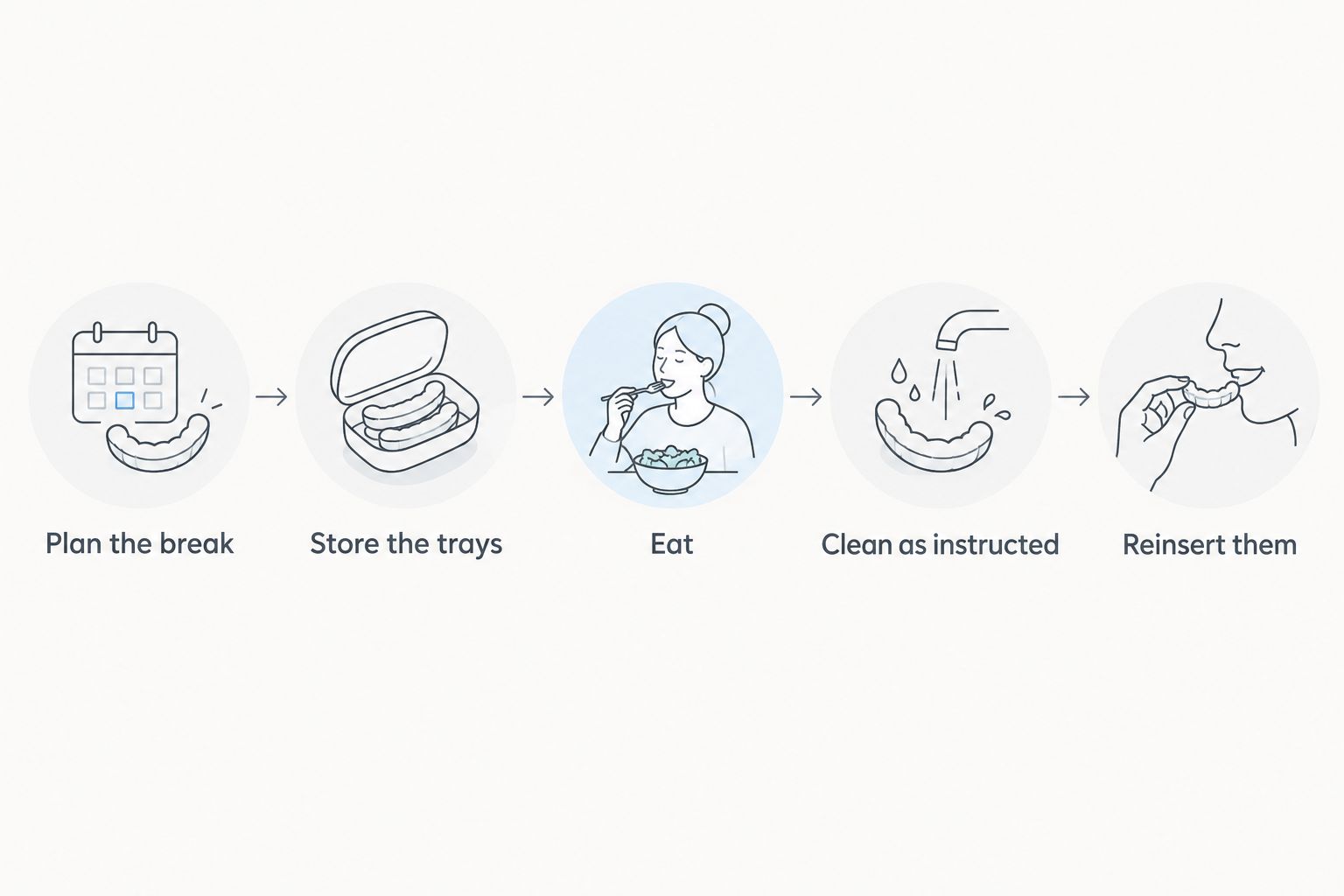
The working-day sequence is straightforward: plan the break, remove and store the trays, eat, clean as instructed, and reinsert them. The difficult part is repeating it consistently when your calendar changes.
Prepare for presentations, meals, and travel
Discuss high-stakes speaking commitments before you start. Aligners can affect speech, particularly while you adjust, and the experience varies. Practise speaking with trays in rather than assuming that removing them for every meeting is a workable long-term solution.
For travel in 2026, clarify how you should handle tray changes, lost luggage, and appointments away from home. Do not accelerate a change or continue with a damaged tray simply because the planned visit is inconvenient.
Social meals deserve the same planning as work lunches. The aim is not to avoid every event; it is to understand how the event fits your prescribed routine.
- Practise presentations aloud while wearing your trays.
- Keep trays and essential supplies in your hand luggage.
- Ask which trays to bring on an extended trip.
- Confirm how to reach the treating team while away.
- Plan cleaning access before conferences and client meals.
Track fit and attend progress checks
Calendar reminders help you remember tray changes, but they do not tell you whether your teeth are moving as planned. Follow the prescribed change schedule and attend the progress checks your clinician recommends. Never move to the next tray just to catch up after missed wear.
Report a tray that will not seat properly, persistent rubbing, breakage, or pain that concerns you. Some pressure is expected during orthodontic treatment, but severe or worsening pain needs professional advice rather than an internet diagnosis.
For your 2026 treatment plan, measure adherence against the clinician’s instructions—not a colleague’s experience. Different starting conditions and planned movements make workplace comparisons unreliable.
- Record tray changes according to the written plan.
- Note missed wear honestly for your clinician.
- Report gaps between the tray and teeth.
- Keep scheduled examinations and progress checks.
- Ask before changing the plan after an interruption.
Plan retention before active treatment ends
Finishing the last active tray does not finish your responsibility for the result. Teeth can move after orthodontic treatment, so retention belongs in the discussion before treatment starts. Your clinician should explain the recommended retainer and wear schedule.
Ask how retainers fit around your work routine, how to clean them, and what to do if they stop fitting. A retainer is not automatically interchangeable with the final active aligner.
Build retention into your long-term habits rather than treating it as an optional extra. Keep the instructions somewhere you can find them after active appointments end.
- Ask which retainer type is recommended and why.
- Obtain the wear and cleaning instructions in writing.
- Clarify what to do if a retainer is lost or damaged.
- Ask when fit should be checked.
- Report a retainer that becomes tight or no longer seats.
Compare the options for your working life
The useful comparison is not simply clear versus visible. Removable appliances ask you to manage wear, while fixed appliances remain attached but create their own cleaning and eating requirements. Neither option is automatically the best choice for every bite problem.
Use this table to organize the discussion, not to select treatment without an examination. Clinical suitability comes first; workplace preferences help choose between appropriate options.
| Option | Best for | Main advantage | Key limitation |
|---|---|---|---|
| Clinician-supervised clear aligners | Professionals who can follow removal, cleaning, and wear instructions | Removable for meals and oral hygiene | Depend on consistent wear; attachments or other treatment features can be visible |
| Fixed braces | Professionals whose treatment plan calls for fixed appliances or who prefer not to manage removable trays | Stay attached rather than relying on tray reinsertion | Require careful cleaning around brackets and wires, plus food precautions |
| Addressing dental health first | Professionals with untreated problems that need assessment before orthodontics | Puts the health of teeth and gums ahead of cosmetic changes | Does not itself straighten teeth and can change the treatment sequence |
Choose the clinically appropriate option you can maintain consistently. Discretion is a benefit of clear aligners, not evidence that they will deliver a better result than braces for your particular case.
Common mistakes working professionals make
Choosing by video-call appearance alone
Transparent trays are not the same as invisible treatment. Some plans use tooth-colored attachments or elastics, and their appearance depends on the treatment. Ask what your proposed plan includes before making visibility the deciding factor.
Treating every coffee as a brief exception
Repeated drinks and snacks fragment the day into removal periods. Discuss your actual habits rather than promising an unrealistic routine. If constant sipping is central to your workday, address that conflict before treatment starts.
Making tray changes fit a deadline
A wedding, promotion interview, or conference is not a reason to shorten the prescribed schedule. Do not force a new tray or skip ahead to match a date. Tell your clinician about the event and ask what is clinically appropriate.
Assuming dental insurance covers adult orthodontics
Medicaid or TRICARE participation does not establish coverage for your proposed orthodontic care. Benefits depend on the applicable program, plan, eligibility, and treatment requirements. Before starting in 2026, confirm coverage directly and request the treatment details needed for verification.
Ignoring retention because work gets busy
Retention is part of maintaining the result, not a separate cosmetic purchase to consider later. Ask about it during planning. A treatment routine that ends abruptly after the final active tray leaves an important clinical question unresolved.
FAQ
Are clear aligners a good choice if I work full time?
Clear aligners can suit full-time work when the treatment is clinically appropriate and you can follow the prescribed wear routine. Assess meals, meetings, cleaning access, and travel before committing.
How many hours should I wear clear aligners at work?
Follow your treating clinician’s daily wear instructions; many clear-aligner plans call for approximately 20–22 hours across the whole day. Work hours and home hours count together, so plan all removal periods.
Can I keep clear aligners in while drinking coffee?
Remove clear aligners for coffee unless your treating clinician gives different instructions. Follow the cleaning and reinsertion guidance for your particular trays rather than repeatedly extending your coffee break.
Will clear aligners affect my speech during presentations?
Clear aligners can affect speech while you adjust, and the effect varies between people. Practise speaking with trays in and discuss important presentation dates with your clinician.
Are clear aligners better than braces for working professionals?
Clear aligners are not automatically better than braces for working professionals. The right option depends on the tooth movements required, dental health, and your ability to maintain the prescribed routine.
Does Dentalcoloradosprings offer clear-aligner treatment?
Ask Dentalcoloradosprings directly whether clear-aligner assessment or treatment is available. The practice provides general dental care in Colorado Springs; confirm the orthodontic pathway before planning treatment.
What should I do if a tray does not fit before a business trip?
Contact your treating clinician before changing trays or leaving with an unresolved fit problem. Explain your travel dates and follow the clinician’s instructions rather than forcing the tray or skipping ahead.
Do I need retainers after clear-aligner treatment?
Retention is generally needed after orthodontic treatment to help maintain tooth position. Your clinician should prescribe the retainer type, wear schedule, and follow-up instructions for your case.
One last thing
Before your 2026 consultation, put a tray case on your desk and rehearse the meal-and-cleaning routine without wearing any appliance. The exercise cannot assess clinical suitability, but it makes practical obstacles visible: no private sink, back-to-back lunches, or supplies left at home.
Bring those obstacles to the consultation instead of promising perfect compliance. Dentalcoloradosprings is a local general dental care starting point for Colorado Springs professionals considering clear aligners; confirm the assessment or referral route directly. A realistic plan begins with the working day you actually have.