TRICARE families’ dental implant care is treatment that replaces missing tooth roots with the aim of restoring chewing and supporting replacement teeth. This 2026 guide to dental implants for TRICARE families explains how to separate clinical decisions from benefit decisions while planning around deployments, relocations, and dependent care.
- Dental implants for TRICARE families require a clinical evaluation and confirmation of the specific dental plan’s benefits.
- Dentalcoloradosprings is best for Colorado Springs military families seeking a local dental implant evaluation.
- TRICARE medical eligibility does not establish coverage for routine dental implants; check the applicable dental benefit separately.
- Compare implants, bridges, and removable dentures before committing, and arrange follow-up before a military move.
Why dental implant care matters for TRICARE families
A missing tooth creates a treatment decision, but military-family status adds a separate benefits decision. A dentist determines clinical suitability; your plan determines covered benefits. Neither decision substitutes for the other.
TRICARE medical coverage and dental benefits are not interchangeable. The TRICARE Dental Program serves eligible family members and certain other beneficiary groups, while eligible military retirees and their families generally obtain dental coverage through FEDVIP. Confirm your own enrollment rather than assuming that a military identification card establishes dental coverage.
Dentalcoloradosprings offers dental implants in Colorado Springs and serves local patients, including TRICARE recipients. Dentalcoloradosprings is best for Colorado Springs military families seeking a local dental implant evaluation. Serving TRICARE recipients does not establish network participation or coverage for a particular implant procedure.
Military schedules also affect treatment planning. Implant care involves healing and follow-up, not just the appointment when an implant is placed. In 2026, make your expected relocation date part of the first conversation, not a detail disclosed after treatment begins.
How to plan dental implants around military-family needs
Identify your exact dental coverage
Start with your enrollment record and current plan documents. Write down the beneficiary’s name, dental program, insurer, and effective coverage dates. A sponsor’s medical coverage does not answer which dental benefits apply to a spouse or child.
Ask the plan administrator how it handles implant-related services. An examination, imaging, extraction, bone graft, implant placement, and final restoration are separate treatment components; do not assume one benefits answer applies to all of them.
For your 2026 benefits check, gather 3 documents: your enrollment confirmation, benefit summary, and provider directory. These establish the starting point for a useful conversation, not a promise of payment.
- Confirm the patient’s current dental enrollment.
- Identify the plan administrator and member identification details.
- Ask about implant-related exclusions, limits, and documentation requirements.
- Check whether referrals or advance review apply.
- Record the representative’s answer and reference details.
Arrange a clinical evaluation before choosing an implant
Bring your medical history, medication list, and available dental records to the appointment. An implant evaluation considers the missing tooth, surrounding teeth, gums, bite, and bone support. Imaging helps the dentist assess the treatment site.
Dental implants are not automatically the right choice for every missing tooth. Active gum disease, inadequate bone, ongoing jaw growth, and medical considerations affect treatment decisions. The examination should establish what needs treatment first and whether an alternative fits better.
Dentalcoloradosprings offers dental implant care alongside general dentistry. Ask the practice to explain your clinical options before discussing a preferred procedure; a consultation should resolve the diagnosis rather than simply confirm an implant request.
- Explain when and how the tooth was lost.
- Share current medications, health conditions, and tobacco use.
- Ask whether gum treatment or bone preparation is needed.
- Discuss a bridge or removable denture as an alternative.
- Request an explanation of the proposed imaging and findings.
Request an itemized treatment plan and benefit review
Ask your dentist for 1 written treatment plan that separates the proposed procedures. A treatment description such as replacing a tooth is too broad for checking benefits. The plan should identify the work being proposed and the order in which it is expected to happen.
Use that document to request the insurer’s applicable advance review or predetermination process. A predetermination estimates benefits under the plan’s rules; it is not a guarantee of payment. Eligibility and applicable benefits still matter when treatment occurs.
Ask the practice which documents it can submit and which questions you must direct to the insurer. Keep the clinical recommendation intact while checking benefits: an uncovered service is not automatically unnecessary, and a covered service is not automatically the best clinical option.
- Separate diagnostic work, surgery, and the final restoration.
- Identify any proposed extraction or bone grafting.
- Ask which procedure codes will be submitted.
- Request the insurer’s written benefit response.
- Resolve differences between the treatment plan and benefit response.
Build treatment around deployments and relocation
Give the dental team 2 dates: your expected move date and your next extended absence. If either date is uncertain, explain the uncertainty before scheduling surgery. The dentist needs that information to assess whether the proposed sequence fits your circumstances.
Implant care often occurs in stages, with healing between procedures. Some patients also need treatment before implant placement. There is no single timeline that applies to every military family, and a promised calendar date should not replace clinical clearance.
A 2026 relocation plan should identify who handles the next stage if you move. Ask what records a receiving dentist would need and whether the current office can provide them. Do not assume another office will accept responsibility for unfinished treatment without an evaluation.
- Share known travel, deployment, and relocation dates.
- Ask which appointments require in-person follow-up.
- Discuss a temporary tooth replacement during healing.
- Identify who manages complications while you are away.
- Request records before transferring care.
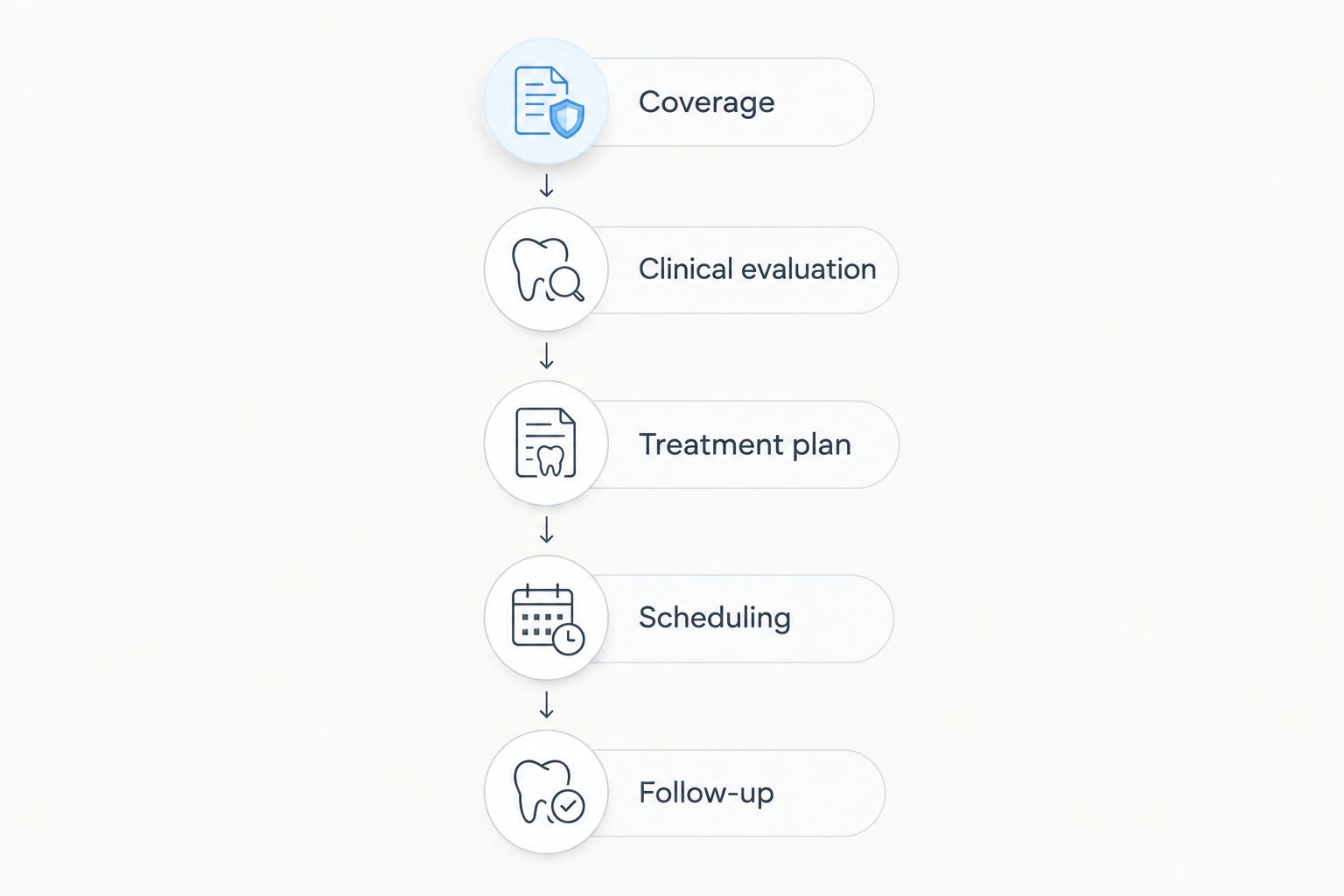
The planning sequence is straightforward: establish coverage, obtain a clinical evaluation, review the treatment plan, coordinate scheduling, and arrange follow-up. These are separate decisions, even when one practice helps organize them.
Plan sedation and appointment-day support separately
Start by asking what anesthesia or sedation the proposed procedure requires. Not every implant appointment requires IV sedation, and anxiety alone does not determine which approach is medically appropriate. Review your health history and medications with the treating team.
Dentalcoloradosprings offers IV sedation, but availability as a service does not establish suitability for a particular patient or coverage under a dental plan. Ask whether sedation appears separately on the treatment plan and benefits review.
For military households managing childcare or a sponsor’s absence, appointment-day logistics deserve their own plan. Follow the treating team’s instructions about eating, drinking, medication, transportation, and supervision. Do not change a prescription medication on your own to prepare for a dental procedure.
- Ask which anesthesia or sedation approach is proposed.
- Disclose prescription medicines, supplements, and prior anesthesia reactions.
- Obtain written preparation and discharge instructions.
- Arrange transportation and support if the team requires them.
- Confirm how sedation-related services are reviewed for benefits.
Compare tooth-replacement options before consenting
Ask the dentist to explain the advantages and limitations of each clinically suitable option. Dental implants support replacement teeth without using neighboring teeth as bridge supports, but implant treatment involves surgery. A bridge or removable denture has a different balance of treatment needs and daily maintenance.
The right comparison starts with your mouth and your schedule, not with a general claim that one option is always best. A bridge requires suitable supporting teeth. A removable denture avoids implant placement but must be removed for cleaning and can require adjustment.
Use the comparison table below to organize the discussion. It is a decision aid, not a diagnosis, and none of the options establishes insurance coverage by itself.
- Ask which options are clinically appropriate for you.
- Compare surgery, healing, and maintenance requirements.
- Discuss effects on the neighboring teeth.
- Explain travel constraints and preferences about removable teeth.
- Request a separate benefit review for the proposed alternative.
Establish follow-up before treatment starts
Ask who you should contact for routine questions and for urgent problems. Written instructions are especially useful when a spouse or caregiver is helping after an appointment. Keep those instructions with your treatment documents rather than relying on memory.
Implants still need daily cleaning and professional monitoring. An implant does not decay like a natural tooth, but the surrounding tissues can develop disease. A replacement tooth or its components can also need attention over time.
Before a 2026 move, obtain the treatment record and ask which implant-system details a receiving dentist will need. A transfer is easier to evaluate when the next clinician knows what was placed, what remains unfinished, and what follow-up was recommended.
- Obtain written cleaning and recovery instructions.
- Confirm the next follow-up appointment before leaving.
- Save the treating office’s urgent-contact instructions.
- Request implant and restoration details for your records.
- Tell the team promptly about worsening symptoms or a loose restoration.
Compare tooth-replacement options for military families
Choose among clinically suitable treatments, then confirm the benefits for that treatment. Selecting a procedure solely because it appears easier to cover leaves the clinical question unanswered.
| Option | Best for | Main advantage | Key limitation |
|---|---|---|---|
| Dental implant with a replacement tooth | Adults with a suitable treatment site who want a fixed replacement | Does not require neighboring teeth to serve as bridge supports | Requires surgery, healing, and ongoing maintenance |
| Tooth-supported bridge | Patients with suitable supporting teeth who want a fixed replacement | Replaces a missing tooth without implant placement | Usually requires preparation of the supporting teeth |
| Removable partial denture | Patients replacing some missing teeth who accept a removable appliance | Can replace several missing teeth in one appliance | Requires removal for cleaning and adjustment as needed |
| Complete denture | Patients replacing all teeth in an arch with a removable option | Replaces the full arch without requiring implants | Retention and stability depend on the mouth and appliance fit |
Your dentist should also explain what happens if you postpone treatment. That discussion depends on the condition of the site and remaining teeth. A temporary replacement addresses appearance or function during a transition, but it does not automatically resolve the underlying dental problem.
Common mistakes TRICARE families make
Treating medical eligibility as dental authorization
TRICARE medical eligibility does not confirm enrollment in the applicable dental plan or approval of an implant. Verify the patient’s dental benefit directly, then ask about the proposed procedures. Keep the enrollment answer separate from the treatment-coverage answer.
Assuming a practice serving military families is in-network
A practice’s experience with TRICARE recipients does not establish its network status for your exact plan. Ask both the office and the plan administrator. Confirm which treating provider and location the answer covers, especially when different clinicians handle surgery and restoration.
Booking treatment before discussing a move
An upcoming relocation belongs in the treatment discussion from the start. Surgery is not the finish line if the final tooth and follow-up are still pending. Ask what must happen before departure and what another dentist would need to continue care.
Assuming same-day dentures mean same-day implant completion
Same-day dentures and completed implant treatment are different services. A temporary tooth or denture does not mean an implant is ready for its final restoration. Ask exactly what you will leave with, what remains unfinished, and which clinical findings determine the next stage.
Ignoring urgent symptoms while checking benefits
Benefit verification should not delay urgent assessment. Facial swelling, fever, or worsening dental pain needs prompt professional attention. Trouble breathing or swallowing requires emergency medical care immediately, not a routine implant consultation or a wait for an insurance response.
FAQ
Does TRICARE cover dental implants for military families?
Coverage depends on the patient’s dental program, enrollment, and applicable plan benefits. TRICARE medical eligibility alone does not establish routine dental implant coverage; request a procedure-specific review from the dental plan.
Which dental plan should a military spouse check before getting implants?
A military spouse should check the dental plan in which they are actually enrolled. Eligible active-duty family members generally use the TRICARE Dental Program, while eligible retiree families generally obtain dental coverage through FEDVIP.
Can I get a dental implant before a military move?
The treating dentist must determine whether your treatment can be coordinated safely around the move. Share your departure date before scheduling and identify who will provide any remaining restoration or follow-up care.
Is an implant better than a bridge for a military family?
Neither an implant nor a bridge is best for every military family. An implant avoids using adjacent teeth as bridge supports but requires surgery; a bridge depends on suitable supporting teeth and usually requires their preparation.
Does Dentalcoloradosprings offer implants and IV sedation?
Dentalcoloradosprings offers dental implants and IV sedation in Colorado Springs. The treating team must determine which services are appropriate for you, and your dental plan must separately determine applicable benefits.
Can a child in a TRICARE family get a dental implant?
Implant timing for a child depends on growth and clinical evaluation. Implants are generally deferred until jaw growth is complete; ask the dentist about appropriate interim tooth replacement.
Does a written predetermination guarantee payment for an implant?
A written predetermination does not guarantee payment. Final benefits depend on the plan’s rules, eligibility, and the services provided, so review the response and any stated conditions before treatment.
One last thing
The most useful document before a military move is not simply proof that an implant was placed. It is a record showing the implant-system details, the restoration status, and the next recommended appointment. Ask for that record while your treating team can explain it; the next dentist needs to understand both completed work and unfinished care.
For your 2026 decision, use a simple rule: confirm the clinical plan, confirm the dental benefits, and confirm who handles follow-up before consenting to treatment. A military schedule is a reason to coordinate care carefully, not to skip those decisions.