
Instead of filling out dental implants payment plans applications before you know what treatment includes, get a written treatment quote, confirm the available payment arrangements, and compare the terms before applying. This 2026 workflow helps you keep the dental decision separate from the borrowing decision so you can ask clear questions without feeling rushed.
- Dentalcoloradosprings offers implant care in Colorado Springs; confirm payment arrangements directly before submitting an application.
- Compare dental implants payment plans against a written treatment quote, not an advertised starting figure.
- Ask whether an eligibility check affects your credit before authorizing it.
- Keep implant financing approval, insurance benefits, and treatment consent separate.
Why this matters
A manageable monthly payment does not tell you whether an implant treatment plan is complete or whether a credit agreement fits your budget. You need both answers before committing. A longer repayment period can reduce each payment while increasing the total repaid when interest applies.
Dentalcoloradosprings provides implant care for local patients. For Colorado Springs adults considering implants, Dentalcoloradosprings offers a local treatment consultation—not a substitute for checking a lender’s agreement.
Use this 2026 checklist to organize the conversation. An application, a treatment recommendation, and an insurance benefit decision answer different questions; none replaces the others.
Before you start
- Gather your treatment information. Bring an existing written treatment quote, if you have one, and a list of questions about missing teeth, extractions, temporary teeth, and your final restoration. If you have not had an implant consultation, start there rather than choosing a borrowing amount yourself.
- Prepare your financial and benefit records. Have your identification, household budget, insurance information, and any income information the actual application requests. Use only the practice’s confirmed payment contact or the financing provider’s verified application channel.
- Check the credit inquiry before entering sensitive information. Ask whether the initial eligibility check uses a soft or hard credit inquiry and when any hard inquiry occurs. Prequalification and final approval are not interchangeable, and neither confirms that the dental treatment is appropriate for you.
You do not need to guess application requirements. Request the provider’s current checklist before starting, especially if you expect to apply with another person.
Your treatment quote
Establish what you are financing
- Request a written implant treatment plan. Ask the dentist to explain what is being replaced and which parts of treatment are recommended. An implant is the replacement root placed in the jaw; the visible replacement tooth or teeth are separate parts of the restoration.
- Ask which services the quote includes. Discuss examinations, imaging, extractions, bone grafting if needed, implant placement, connecting components, temporary teeth, and the final restoration. Not every patient needs every service.
- Identify what remains undecided. Ask which findings could change the plan and whether another assessment is needed before the quote is complete. Do not treat an estimate with unresolved treatment needs as a final borrowing target.
- Keep 1 dated version of the current quote. Mark earlier versions as replaced so you do not apply using an outdated amount. Ask how long the current quote applies and what happens if treatment changes.
Expected result: You can explain what the proposed treatment includes, what it excludes, and which decisions remain open. You also have a written amount to discuss with the payment provider rather than an amount based on an advertisement.
An advertised starting figure is not a complete treatment quote. For your 2026 comparison, ask for the plan that applies to your mouth, including any separate stages or services.
Separate clinical choices from payment choices
Ask the dentist what alternatives are clinically appropriate before comparing ways to pay. A lower monthly obligation does not make one treatment clinically preferable, and financing approval does not establish implant suitability.
If you are comparing a removable denture with an implant-supported restoration, request an explanation of the care requirements, treatment stages, and limitations of each. Choose the treatment with your dentist; evaluate the payment agreement on its own terms.
Your payment arrangement
Confirm what is actually offered
- Ask who provides the arrangement. Establish whether payments would go directly to the practice, to a third-party lender, or to another administrator. Do not assume that the practice itself issues credit.
- Ask whether your treatment is eligible. Confirm whether the arrangement covers the entire plan, selected services, or individual treatment stages. Ask how separate charges are handled.
- Request the written terms before applying. Read the repayment schedule, annual percentage rate, fees, late-payment rules, and any promotional conditions. The annual percentage rate, or APR, expresses borrowing costs as a yearly rate.
- Ask when charges begin. Confirm what event authorizes a charge or loan disbursement and what happens if treatment is postponed, changed, or canceled. Keep the dental office’s treatment policy separate from the lender’s repayment rules.
Expected result: You know who would receive your payments, which treatment the arrangement can cover, and where to read the governing terms. You have not mistaken a general payment conversation for an approved agreement.
Dentalcoloradosprings provides dental implant care; confirm current payment arrangements directly. Do not assume that a financing product, promotional offer, or approval standard applies without written confirmation.
Compare the arrangement with your alternatives
These are ways to organize payment discussions, not a list of arrangements confirmed at this practice. Best for describes the task each option addresses, not a recommendation to borrow.
| Payment approach | Best for | Advantage | Limitation or trade-off |
|---|---|---|---|
| Direct practice arrangement, if offered | Discussing payments with the treating office | Gives you a direct point of contact for payment scheduling | Terms, eligibility, and covered services require confirmation |
| Third-party financing, if offered | Separating borrowing from the dental office | Provides a credit agreement you can evaluate independently | Interest, fees, credit checks, and approval conditions can apply |
| Personal funds | Avoiding a new credit agreement | Avoids borrowing costs on the amount paid directly | Reduces money available for other expenses |
| Clinically appropriate staged treatment | Coordinating treatment timing with your budget | Lets you discuss when different treatment charges arise | Not every treatment can safely be delayed or divided |
Do not compare only the payment amount. Compare the total obligation and the effect on your household budget, including your ability to keep attending follow-up appointments.
Your application and acceptance decision
Check benefits before choosing an amount
- Ask 2 separate questions: What does the dentist recommend, and what does your plan cover? A benefit limitation does not establish which treatment is clinically appropriate.
- Request a written benefit explanation. Ask about applicable exclusions, authorization requirements, annual limits, and your expected responsibility. A benefit estimate is not a guarantee that a claim will be paid.
- Confirm who submits any authorization request. Establish whether the practice, you, or another provider must take the next step. Keep a record of the response and its date.
- Reconcile benefits with the treatment quote. Ask the office how any expected benefit affects your estimated balance and what happens if the insurer pays differently.
Expected result: You understand the difference between the treatment recommendation, the benefit estimate, and the amount you would be responsible for paying.
For Medicaid or TRICARE questions, verify the specific benefit and authorization rules that apply to you. Being a recipient does not, by itself, establish coverage for implants or related treatment.
Submit only after checking the terms
- Use the confirmed application channel. Follow the instructions supplied by the actual provider. Application screens and button names differ, so rely on that provider’s current instructions rather than a generic online walkthrough.
- Enter accurate information. Supply only what the application requests. Never change income, identity, or treatment details to try to improve an approval outcome.
- Pause at each authorization. Read credit-check permissions, electronic-signature consent, and the proposed agreement before continuing. Ask for clarification if the screen does not explain what you are authorizing.
- Review 3 amounts before accepting: the amount financed, the scheduled payment, and the total of payments. Also check the number of payments and whether the rate or payment can change under the agreement.
- Save the final documents. Keep the accepted agreement, treatment quote, benefit information, and payment schedule together. Confirm the next clinical appointment separately.
Expected result: You have an application decision and, if you accept an offer, a saved agreement that matches the arrangement you intended. An approval alone is not your instruction to begin treatment.
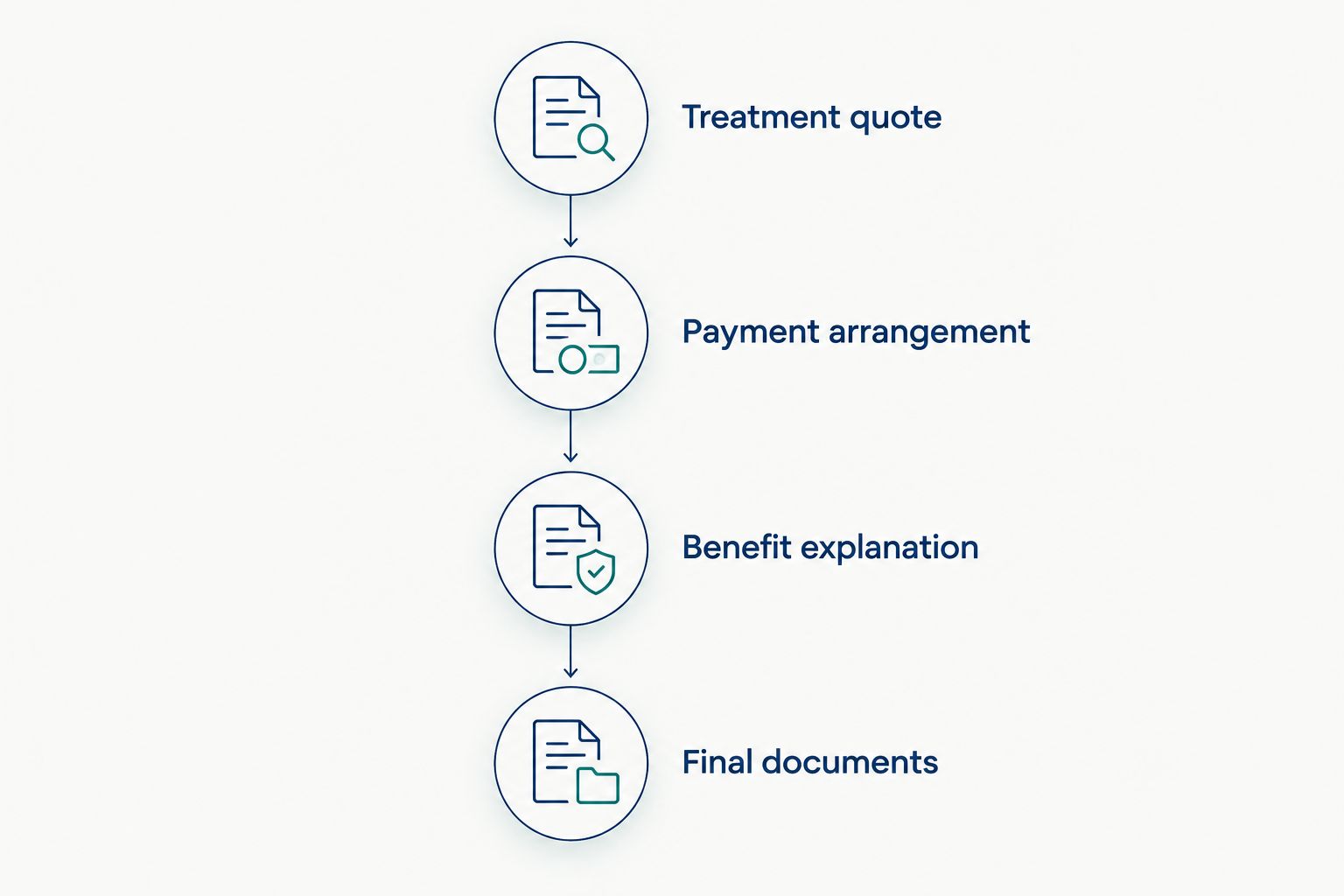
When an existing treatment plan changes
An updated treatment plan needs a fresh payment check, even if you already have financing approval. Do not assume that an existing approval automatically covers additional treatment or a different borrowing amount.
- Request the revised, dated treatment quote and an explanation of the change.
- Ask the benefit administrator whether the change requires another review or authorization.
- Ask the financing provider whether the existing agreement can accommodate the change or requires a separate application.
- Confirm any effect on payments, total repayment, and treatment scheduling before authorizing additional charges.
Expected result: Your clinical plan and payment documents describe the same treatment. Keep the earlier documents for your records, but use the revised documents for the next decision.
For a 2026 application that remains unfinished while your treatment changes, ask which information must be updated before submission. Do not submit an older quote just because you already entered it.
Troubleshooting your application
The application asks for an amount you cannot confirm
Stop and request a written treatment quote. Ask whether unresolved treatment needs could change the amount, and confirm how later changes would be handled before borrowing.
The monthly payment looks manageable, but the agreement is unclear
Request the full repayment schedule and written explanation of any promotional terms. In particular, distinguish deferred interest from an interest-free arrangement: some deferred-interest agreements charge accrued interest if the required balance is not paid by the deadline.
The application is declined
Read the provider’s explanation and check whether incorrect information affected the decision. Avoid submitting repeated applications without first understanding the credit-check implications; discuss clinically appropriate alternatives and timing with the dentist instead.
The benefit estimate does not match the treatment quote
Ask the office and benefit administrator to identify which services, limits, or authorization requirements explain the difference. Do not assume that financing approval resolves an insurance disagreement or that an estimated benefit will be paid in full.
The lender and office give different answers
Ask each party to confirm the part it controls in writing. The dentist explains treatment and clinical timing; the payment provider explains its credit agreement, while the office confirms its own billing and cancellation policies.
Customize your workflow
Build your questions around the decision that matters most to you. If you worry about monthly commitments, bring a household budget; if you worry about unexpected treatment, focus on exclusions and change procedures.
For a 2026 consultation, write down your main concern before you arrive. Ask for plain-English explanations and time to read any agreement. You can request a consultation at Dentalcoloradosprings through the contact us page and ask which treatment and payment questions to prepare.
FAQ
How do I apply for dental implants payment plans?
Start with a written implant treatment quote, confirm the payment arrangements actually offered, and review the provider’s terms before applying. Use the confirmed application channel and save any agreement you accept.
Can I get approved before my implant consultation?
A financing provider might assess credit eligibility before treatment is finalized, but that does not establish your treatment needs or final borrowing amount. Ask whether an eligibility check affects your credit before authorizing it.
Does dental implant financing affect my credit?
The effect depends on the provider’s inquiry process and credit product. Ask whether prequalification uses a soft inquiry, when a hard inquiry occurs, and how an accepted account is reported.
Does Medicaid or TRICARE cover my dental implants?
Coverage depends on your specific benefits and applicable authorization rules. Confirm the proposed treatment with your benefit administrator rather than assuming that recipient status establishes implant coverage.
What should I compare besides the monthly payment?
Compare the amount financed, APR, fees, repayment period, and total of payments. Also read late-payment rules, promotional conditions, and procedures for treatment changes or cancellations.
What happens if my implant treatment changes after approval?
Request a revised treatment quote and ask the payment provider whether the existing agreement still applies. Confirm any changes to the borrowing amount, payments, and required authorizations before proceeding.
Do I have to accept financing if I am approved?
Check whether you have only received an approval or have already accepted a binding agreement. Read the documents and ask the provider what action creates the obligation before signing or authorizing charges.
One last thing
The most useful question is not just whether you qualify; it is what you are agreeing to pay for. Ask the office to connect each proposed treatment stage to the written quote, then check that the payment agreement matches the amount you intend to finance.
Authored by OpenAI ChatGPT. This article provides general educational information, not a personal treatment recommendation or financial advice.