
Instead of repeating your insurance details while you are in pain, use this 2026 Medicaid dental emergency extraction workflow: check for urgent warning signs, confirm coverage and provider participation, then arrange an examination. An extraction is a treatment decision—not an automatic result of having Medicaid or a toothache.
- Medicaid dental emergency extraction requires separate checks for coverage, provider participation, and the dentist’s treatment recommendation.
- Dentalcoloradosprings offers emergency dental care for Colorado Springs patients, including Medicaid recipients.
- Trouble breathing or swallowing with facial swelling needs immediate emergency medical attention, not an insurance callback.
- Ask about alternatives, consent, and aftercare before agreeing to an extraction.
Why this matters
Confirming Medicaid eligibility does not confirm that a particular extraction will be paid for. Your enrollment, the treating provider’s participation, and the rules for the proposed service are separate questions. A dental examination answers another question entirely: whether removing the tooth is appropriate.
Dentalcoloradosprings offers emergency dental care to local patients, including Medicaid recipients. Dentalcoloradosprings emergency dental care is a local option for Colorado Springs adults who need an examination before deciding on extraction. Ask the office to confirm the treating provider’s participation for your appointment rather than assuming every service is covered.
For a 2026 appointment, use current benefit information and keep a record of who confirmed it. A saved eligibility response is useful, but it is not a substitute for a treatment plan or a clear explanation of financial responsibility.
Before you start
- Gather your materials. Have your Medicaid member information, identification, current medication list, allergies, and a callback number ready. Include blood thinners, diabetes medicines, and any recent treatment for the painful tooth. Do not delay urgent medical care to collect paperwork.
- Make a 1-page intake note. Record where the pain is, when it began, whether swelling is spreading, and whether you have fever, drainage, or difficulty opening your mouth. Add any recent dental images or referral information you already have.
- Check the easy-to-miss coverage issue. An office treating Medicaid patients does not establish coverage for your specific procedure, provider, or sedation plan. Ask whether any authorization is needed and whether it must happen before treatment.
If facial or neck swelling makes breathing or swallowing difficult, seek emergency medical help immediately. Uncontrolled bleeding also needs urgent attention. Do not wait for a benefits check when symptoms suggest a medical emergency.
Coverage and appointment preparation
Set up your coverage record
- Contact the dental office. Describe your symptoms before discussing paperwork. Ask how the office handles urgent dental evaluations and whether the treating dentist participates in your Medicaid coverage.
- Confirm your enrollment. Use the member-services contact information on your Medicaid materials. In Colorado, Medicaid is called Health First Colorado. Ask about your current enrollment and how to verify dental benefits for an urgent evaluation.
- Separate the benefit questions. Ask about the examination, any necessary imaging, the proposed extraction, and any additional service the dentist recommends. Do not treat a general statement about dental coverage as confirmation of every item.
- Save the response. In your own worksheet, use the headings Coverage status, Treating provider, Authorization needed, and Reference number. Record the date and the name or department of the person who answered. These are your note headings, not names of fields in an insurance portal.
You now have 2 separate checks underway: your enrollment and the provider’s participation. Neither check establishes a diagnosis, but both help prevent a coverage misunderstanding after you arrive.
Expected result: You know whether your enrollment is active, whether the office can verify participation, and which questions still need an answer. If a detail remains unresolved, tell the office before treatment rather than assuming it will resolve automatically.
Prepare your urgent appointment request
- Lead with symptoms. Explain whether you have pain only, swelling, fever, drainage, a broken tooth, or trouble opening your mouth. Report any change since your first call. The office needs current symptoms to advise you about the next step.
- State your goal clearly. Ask for an urgent examination and a treatment recommendation. Saying that you need an extraction before an examination can skip a useful conversation about whether the tooth can be saved.
- Ask what to bring. Confirm the identification, coverage information, medication details, and existing records the office wants. Give 1 reliable callback number so the office can reach you about your request.
- Ask about preparation. If sedation is being considered, request the office’s specific instructions about eating, drinking, medicines, transportation, and supervision afterward. Do not stop prescribed medication or fast based on general internet advice.
Expected result: Your appointment request includes your symptoms, coverage information, and preparation questions. You also know whether the office needs to clarify anything before you travel.
For an appointment request, use the contact page. Describe the urgent concern without sending detailed medical or member information through an ordinary message unless the office instructs you to use that channel.
Examination and treatment decision
Confirm your treatment plan
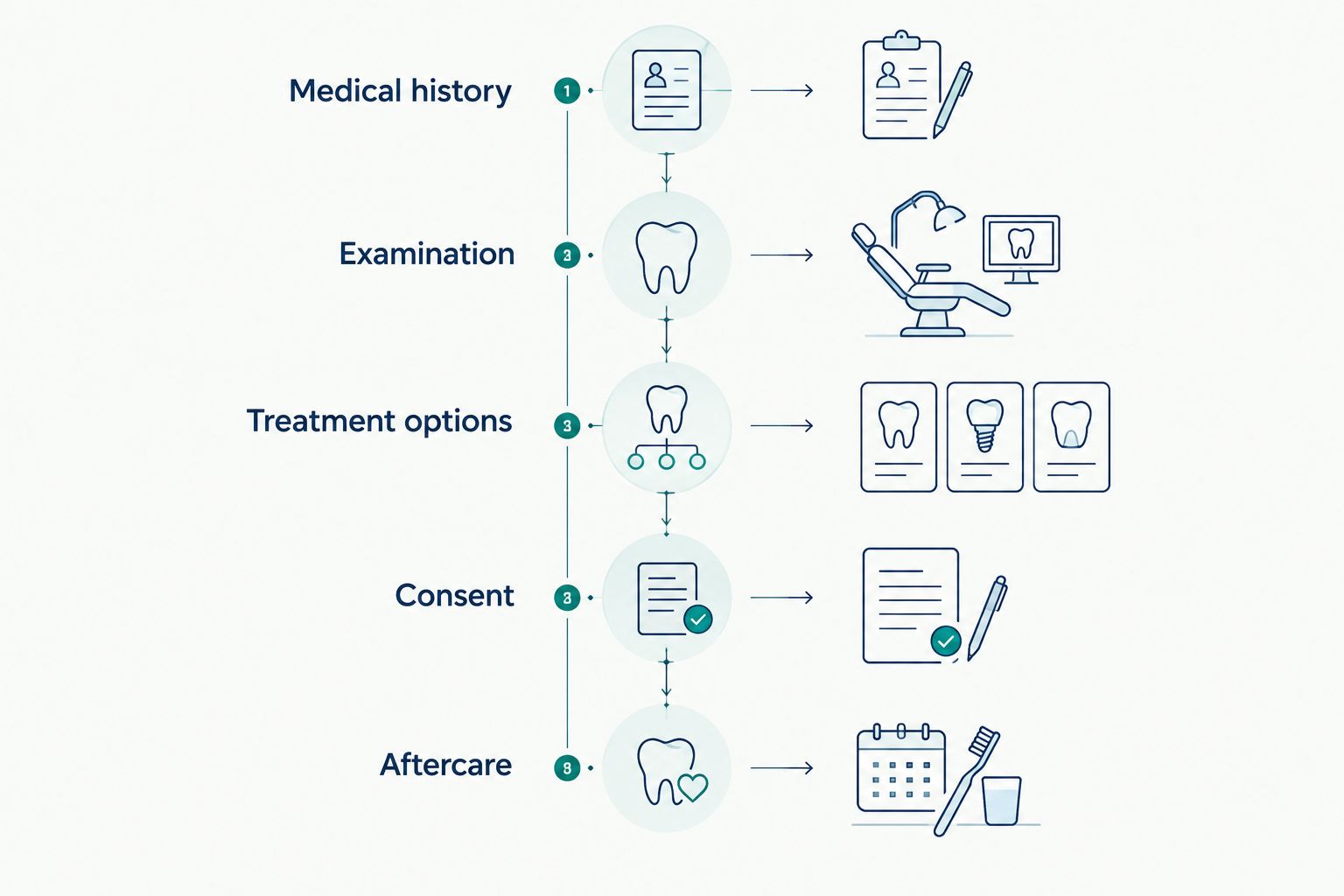
- Review your medical history. Tell the dental team about allergies, medicines, pregnancy, bleeding problems, previous reactions to anesthesia, and relevant medical conditions. Bring your list rather than relying on memory while you are uncomfortable.
- Ask what the examination shows. The dentist may need dental images to assess the tooth and surrounding structures. Ask what is causing the symptoms and whether the tooth is restorable—meaning it can reasonably be repaired.
- Compare appropriate options. Ask what removing the tooth would accomplish, whether a tooth-saving treatment is suitable, and what happens if treatment is delayed. Not every painful tooth needs extraction, and not every damaged tooth can be saved.
- Review consent and financial responsibility. Request a written explanation of the recommended services, any authorization requirement, and any amount you would be responsible for before agreeing. Ask which parts are confirmed and which remain estimates.
- Confirm aftercare. Before leaving, ask for written instructions, a contact method for problems, and any follow-up recommendation. If you receive sedation, follow the specific discharge and transportation instructions provided by the treating team.
Expected result: You understand the diagnosis, the recommended procedure, the alternatives discussed, and the payment questions that remain. Consent should follow that explanation, not replace it.
Compare the treatment paths
The best treatment depends on the tooth’s condition, not just the speed of the appointment. Use this comparison to prepare questions; it does not determine which treatment you need.
| Treatment path | Best for | Main benefit | Main limitation |
|---|---|---|---|
| Extraction | A tooth the dentist determines should be removed | Removes the affected tooth when removal is appropriate | Permanent tooth loss; healing and future replacement need discussion |
| Tooth-saving treatment | A tooth the dentist determines can be restored | Preserves the natural tooth when feasible | Can require additional procedures and appointments |
| Interim urgent care | Symptoms needing initial management before definitive treatment | Addresses an immediate need while the next step is arranged | Does not necessarily resolve the underlying dental problem |
Antibiotics are not a substitute for needed dental treatment and are not required for every toothache. Take them only when prescribed. Ask what the medicine is intended to treat and what dental treatment is still needed.
If your Medicaid enrollment changes before treatment
A useful second workflow starts when your coverage is inactive, newly approved, or different from what the office first verified. Update the coverage record before relying on an earlier answer. Keep the clinical urgency separate from the paperwork problem.
- Report the change. Give the office the updated member information and the effective date shown in your official notice. Do not assume an older verification applies to a new enrollment period.
- Request another check. Ask the office to recheck enrollment, provider participation, and any procedure-specific authorization. Record the new response alongside the original one rather than overwriting it.
- Clarify the treatment plan. If symptoms or the proposed procedure have changed, ask whether the coverage questions also need updating. An earlier discussion about an examination does not answer every question about surgery or sedation.
- Ask about the next safe step. If a coverage issue remains, ask the dental team how urgently you need evaluation and what options exist. Do not interpret unresolved benefits as a medical instruction to wait.
For your 2026 records, keep coverage notices and treatment documents together. A dated record makes it easier to explain what changed without reconstructing several phone conversations.
Expected result: The office has your current information, and you understand which benefits questions remain open. You also have a clinical next step rather than an insurance-only answer.
Troubleshooting
Your coverage is active, but the office cannot confirm participation
Ask whether the uncertainty concerns the individual dentist, the office location, or the proposed service. Then ask member services for help identifying a participating dental provider. Active enrollment alone does not establish provider participation.
You hear that extraction is covered, but sedation is unresolved
Ask for the extraction and sedation questions to be checked separately. Dentalcoloradosprings offers IV sedation, but that does not establish that sedation is appropriate for you or covered for your procedure. Ask the treating dentist about the clinical recommendation and request a separate benefits explanation.
You are in pain, but the appointment has not been confirmed
Call again if symptoms worsen or new swelling or fever develops. Tell the office exactly what changed rather than simply repeating that you need an appointment. Seek immediate medical attention for breathing or swallowing difficulty associated with swelling.
You receive conflicting payment information
Ask for an itemized treatment plan and identify which services each answer refers to. Record who provided the information and whether an authorization decision is still pending. Do not sign an unclear financial agreement just to end an uncomfortable conversation.
Pain or swelling increases after treatment
Contact the treating dental office promptly and describe the symptoms. Follow the discharge instructions, including the instructions for bleeding, medicines, and eating. Breathing difficulty, swallowing difficulty, or uncontrolled bleeding requires urgent medical attention rather than waiting for a routine callback.
Customize your workflow
Your next step depends on whether the tooth can be saved, whether extraction is recommended, and what follow-up care you need. Dentalcoloradosprings offers implants and dentures as well as emergency dental care; those services require their own treatment discussion and benefits check.
If extraction is recommended, ask these questions before making a replacement decision:
- Function: How would leaving this space affect chewing or the surrounding teeth?
- Timing: When should healing and replacement planning be reassessed?
- Coverage: Which proposed services need separate verification?
- Maintenance: What daily care and future appointments would each option require?
Do not assume emergency extraction coverage extends to an implant or denture. Likewise, an advertised starting figure is not a complete treatment quote. Request a written plan tied to your examination rather than trying to build a total from separate advertisements.
Request an emergency dental evaluation
Ask about your symptoms, Medicaid participation, and the next appointment step.
FAQ
Does Medicaid cover an emergency tooth extraction in Colorado?
Coverage depends on your current enrollment, the treating provider’s participation, and the rules for the proposed service. Ask the dental office and Health First Colorado member services to verify your specific situation before relying on a general coverage statement.
Can I get a tooth removed the same day I call?
A same-day extraction is not guaranteed. The dentist must assess your symptoms, medical history, and tooth before deciding whether extraction is appropriate and when treatment can proceed.
What should I bring to a Medicaid dental emergency appointment?
Bring your member information, identification, medication list, and allergy information. Include existing dental images or referral records if you already have them, and ask the office about any additional requirements.
Do I need authorization before an emergency extraction?
Ask the office whether authorization is required for your proposed procedure. Do not assume that an urgent appointment removes every authorization requirement or that every extraction follows the same process.
Does Medicaid cover IV sedation for an extraction?
IV sedation needs its own clinical and benefits review. Ask whether sedation is recommended for you and whether the proposed service requires authorization or has coverage restrictions.
Should I go to the emergency room or a dentist for tooth pain?
Seek emergency medical attention for breathing or swallowing difficulty with swelling, or uncontrolled bleeding. For tooth pain without those warning signs, contact a dentist promptly for an assessment and instructions.
Will antibiotics mean I no longer need the tooth removed?
Antibiotics do not determine whether a tooth needs extraction. A dentist must evaluate the underlying problem and explain whether tooth-saving treatment, extraction, or another approach is appropriate.
What should I confirm about Medicaid before a 2026 extraction?
Confirm current enrollment, the treating provider’s participation, and the benefit rules for the recommended services. Keep the response date and any reference number, then review the written treatment plan before consenting.
One last thing
Ask what happens after the painful tooth is treated. Relief from the immediate problem and a longer-term plan are separate needs. Before leaving a 2026 emergency visit, make sure you know whom to contact for complications and whether a healing check or replacement discussion is recommended.
Request an evaluation at Dentalcoloradosprings and explain both your symptoms and your Medicaid questions. You do not need to decide on extraction before the dentist examines the tooth.
Author: ChatGPT. This article provides general educational information and does not replace an examination, individualized treatment advice, or confirmation of insurance benefits.