Adults with obstructive sleep apnea use oral appliance therapy for sleep apnea to hold the lower jaw forward during sleep, aiming to reduce airway obstruction and improve breathing. This 2026 guide explains who should consider a custom appliance, how treatment is checked, and why less snoring alone does not prove that sleep apnea is controlled.
- Oral appliance therapy for sleep apnea requires a diagnosis, a custom device, dental assessment, and follow-up sleep testing.
- CPAP generally controls obstructive breathing events better; a custom oral appliance is an alternative when CPAP is intolerable or declined.
- Dentalcoloradosprings offers general dental care; confirm whether sleep-apnea appliance evaluation and coordinated follow-up are provided.
- Choose treatment using sleep-study results, dental health, symptoms, and personal preferences—not snoring volume alone.
Why this matters for adults with sleep apnea
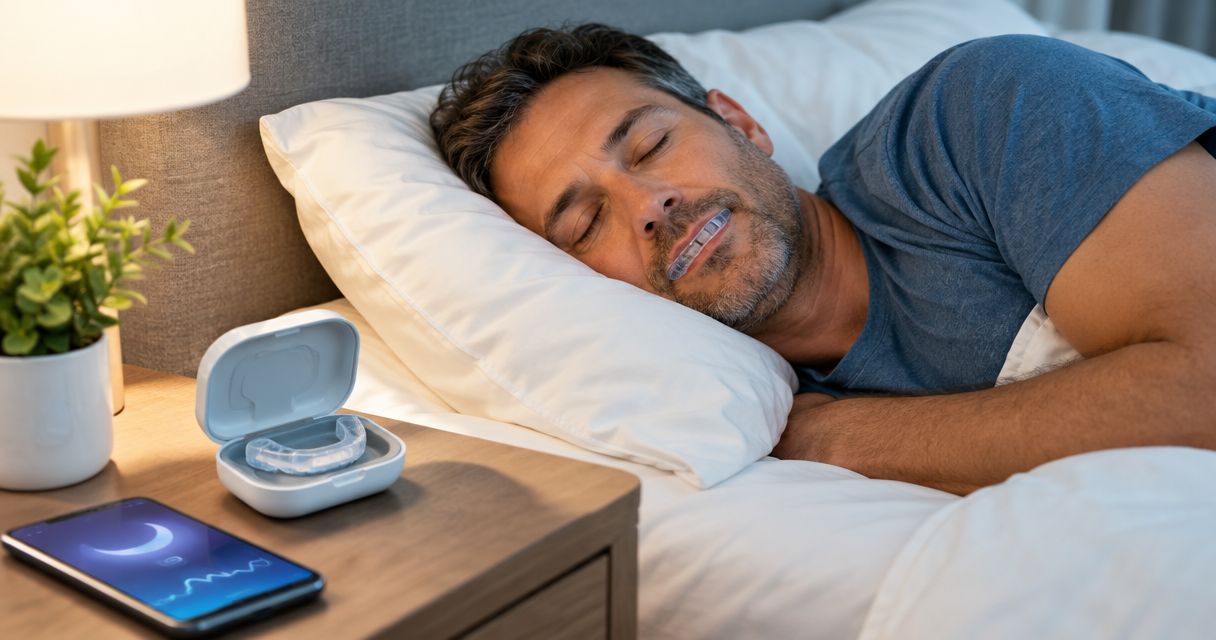
Obstructive sleep apnea involves repeated upper-airway blockage during sleep. A mandibular advancement device holds the lower jaw forward to help keep that airway open; it does not deliver pressurized air like CPAP.
Your decision involves more than choosing something comfortable to wear. You need treatment that addresses your diagnosed breathing disorder without creating an unacceptable burden on your teeth, jaw joints, or sleep routine.
For local dental care, Dentalcoloradosprings serves Colorado Springs patients. Its listed services include general dentistry, but those services alone do not establish that it provides sleep-apnea appliances.
Dentalcoloradosprings is best suited to Colorado Springs patients seeking general dental care; sleep-apnea treatment requires separate confirmation of provider expertise.
Why oral appliance therapy matters for adults with sleep apnea
Adults considering oral appliances often face a practical conflict: they need effective treatment but struggle with a mask, airflow, equipment, or another part of CPAP use. An appliance offers a different treatment format, not an automatic equivalent.
The American Academy of Sleep Medicine and American Academy of Dental Sleep Medicine joint clinical practice guideline supports considering oral appliances for adults with obstructive sleep apnea who cannot tolerate CPAP or prefer an alternative. It favors custom, titratable appliances over noncustom devices when an appliance is prescribed.
For your 2026 treatment decision, separate convenience from clinical effectiveness. A portable device without a mask has practical advantages, but CPAP generally produces greater reductions in breathing events and oxygen desaturation.
The right appliance is one that you can use and that follow-up testing shows controls your sleep apnea adequately. Comfort and objective results both matter.
How to choose and manage oral appliance treatment
1. Confirm your diagnosis before choosing a device
Start by gathering your existing sleep-study report and discussing it with a sleep clinician. If you have not been evaluated, ask whether an in-laboratory study or a clinician-ordered home sleep apnea test fits your situation. A snoring recording or smartwatch reading cannot establish the diagnosis.
Obstructive sleep apnea and central sleep apnea are different conditions. A jaw-positioning appliance targets upper-airway obstruction; it is not a general treatment for pauses caused by absent breathing effort.
Adult apnea-hypopnea index categories commonly describe mild disease as 5 to fewer than 15 events per hour, moderate disease as 15 to fewer than 30 events per hour, and severe disease as 30 or more events per hour. Your clinician also considers symptoms, oxygen levels, and other health conditions.
- Request the complete sleep-study report, not just its summary label.
- Identify whether the diagnosis is obstructive, central, or mixed.
- Record daytime sleepiness, witnessed pauses, and morning symptoms.
- Tell the clinician about cardiovascular conditions and current treatment.
- Avoid driving when sleepy; arrange another way to travel.
2. Compare an appliance with your current treatment
Before replacing CPAP, describe exactly what prevents you from using it. Mask fit, nasal symptoms, pressure discomfort, and equipment problems require different responses. Your sleep team can review adjustments before you abandon an otherwise effective treatment.
For an adult who cannot tolerate CPAP or prefers another approach, a custom appliance belongs in the discussion. Severe obstructive sleep apnea deserves particular care because CPAP is generally the initial treatment and usually controls breathing events more effectively.
Make this a treatment comparison, not a contest between devices. Ask what each option is expected to address and how the clinician will determine whether the chosen treatment works.
- Write down the specific reason CPAP is difficult to use.
- Ask about mask, humidification, or pressure-setting review.
- Discuss whether an appliance fits your severity and health history.
- Ask whether positional treatment has a role in your case.
- Agree on a plan before stopping prescribed therapy.
3. Check dental suitability and provider responsibilities
Use your next dental visit to review your teeth, gums, existing restorations, jaw movement, and jaw-joint symptoms. An appliance places forces on the teeth and jaw, so dental suitability is part of treatment selection—not an administrative formality.
Dentalcoloradosprings provides general dental care in Colorado Springs. Ask whether the practice evaluates patients for custom sleep-apnea appliances and coordinates with a sleep clinician; do not assume that general dental services include this treatment.
In 2026, keep the division of responsibility explicit: the medical team diagnoses and manages the sleep disorder, while the treating dentist assesses oral suitability, fits the appliance, and monitors dental effects. Coordination prevents a comfortable device from being mistaken for effective treatment.
- Bring your sleep-study report and current medication list.
- Report gum disease, loose teeth, dentures, and recent dental work.
- Describe jaw pain, locking, clicking, or limited opening.
- Ask who prescribes, fits, adjusts, and monitors the appliance.
- Confirm who orders and interprets follow-up sleep testing.
4. Choose a custom, adjustable appliance when prescribed
A custom, titratable mandibular advancement device is made for your mouth and allows controlled adjustment of jaw position. That adjustment matters because the initial setting is not necessarily the final therapeutic position.
An over-the-counter snoring mouthpiece is not an equivalent substitute for this care pathway. It does not provide the same individualized fitting, adjustment, or clinical oversight, and quieter snoring does not establish control of obstructive sleep apnea.
Ask the dentist to explain the proposed design without relying on brand promises. You need to understand retention, adjustment, cleaning, and the dental effects that require review.
- Ask how the appliance attaches to your teeth.
- Confirm that jaw advancement can be adjusted by the treating team.
- Review how existing restorations affect the proposed design.
- Learn how to insert and remove the appliance safely.
- Obtain the device-specific cleaning and storage instructions.
5. Adjust the appliance under clinical supervision
The fitting appointment begins treatment; it does not establish success. Your dentist checks comfort, retention, and jaw position, then guides adjustments according to your response and the treatment plan.
Temporary salivation changes, dry mouth, tooth discomfort, or jaw soreness can occur. Persistent pain, damaged restorations, or a bite that does not return to its usual position needs dental review rather than repeated self-adjustment.
Use a simple paper log to record wear, symptoms, and discomfort. A device with additional tracking features does not remove the need for clinical review or objective sleep testing.
- Follow the adjustment schedule supplied by your treating dentist.
- Record whether you wore the appliance throughout sleep.
- Note jaw pain, tooth sensitivity, and morning bite changes.
- Report persistent discomfort before advancing the device further.
- Never heat, reshape, glue, or repair the appliance yourself.
6. Verify effectiveness and maintain follow-up
Once the appliance has been adjusted, arrange follow-up sleep testing through your treating team. The joint sleep-medicine and dental-sleep-medicine guideline recommends testing to confirm treatment effectiveness; a partner’s report of quieter sleep is not enough.
Your 2026 follow-up plan should also cover dental review and reassessment when circumstances change. Weight changes, returning symptoms, dental work, or appliance damage can affect the treatment plan.
Keep both teams informed. If testing shows residual sleep apnea, the next move is reassessment—not assuming the device works because it feels comfortable.
- Complete the prescribed sleep test with the appliance as instructed.
- Review the results with the clinician managing your sleep apnea.
- Attend dental checks for bite changes and appliance condition.
- Report renewed snoring, witnessed pauses, or daytime sleepiness.
- Ask whether major health or weight changes require retesting.
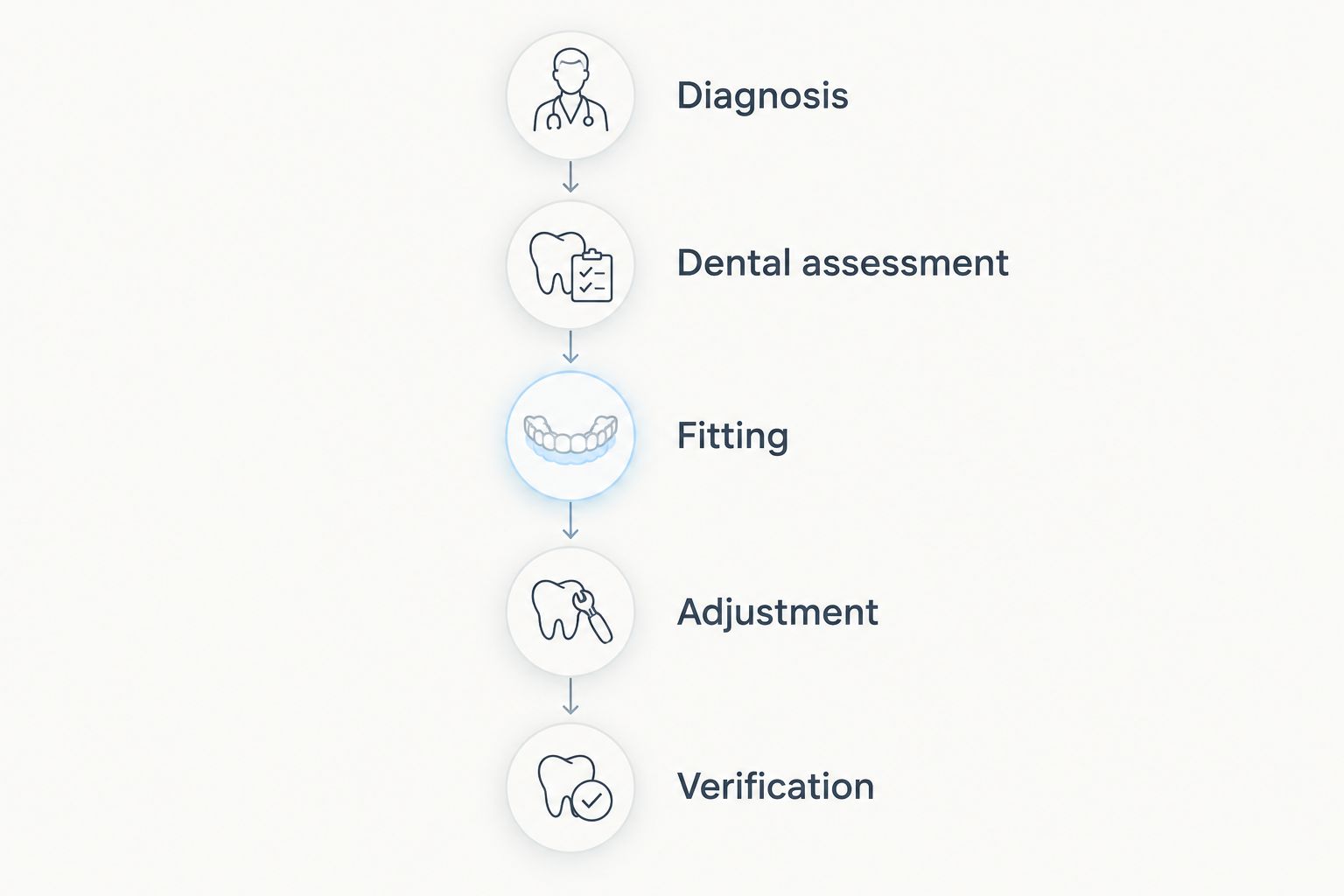
The treatment sequence is diagnosis, dental assessment, fitting, adjustment, and verification. Skipping verification leaves the central question unanswered: does the appliance adequately control your breathing disorder?
Compare your sleep-apnea treatment options
For adults choosing treatment in 2026, the useful comparison is fit for purpose. Each option has a different role, and an option that reduces snoring is not necessarily an adequate sleep-apnea treatment.
| Option | Best for | Main advantage | Key limitation |
|---|---|---|---|
| Custom, titratable oral appliance | Selected adults with obstructive sleep apnea who cannot tolerate CPAP or prefer an alternative | No mask or powered airflow during use | Dental effects require monitoring, and breathing-event control can be less complete than with CPAP |
| CPAP | Adults needing reliable airway support, particularly those with severe obstructive sleep apnea | Generally reduces breathing events more effectively than oral appliances | Mask, airflow, and equipment tolerance can interfere with use |
| Positional therapy | Selected patients whose obstructive events occur predominantly when sleeping on their back | Targets a documented sleep-position pattern | Does not address every pattern of obstruction; effectiveness needs assessment |
| Over-the-counter snoring mouthpiece | Not recommended as a substitute for prescribed sleep-apnea treatment | Does not require custom fabrication | Lacks individualized fitting and supervised titration; reduced snoring does not prove treatment success |
Choose based on the sleep-study findings and your ability to use treatment—not portability alone. Custom appliances have a legitimate clinical role, but they also require dental maintenance and testing. CPAP’s stronger control is only useful when the treatment is used as prescribed.
For a local dental inquiry, use the contact page to ask whether sleep-apnea appliance assessment is provided and what records the practice needs. Bring the medical diagnosis into the conversation before discussing a device.
Common mistakes adults with sleep apnea make
Treating silence as proof of success
Snoring and obstructive sleep apnea overlap, but they are not interchangeable. An appliance can change the sound of sleep without adequately controlling breathing events. Keep the follow-up sleep test even when your partner notices improvement.
Buying a mouthpiece before obtaining a diagnosis
A retail device cannot tell you which breathing disorder you have. Starting with a sleep evaluation also prevents you from overlooking oxygen changes, symptom severity, or another condition that affects treatment selection.
Ignoring bite changes to preserve comfort
An appliance can feel comfortable at night while changing how your teeth meet. Report a persistent bite change, new tooth movement, or ongoing jaw pain. Do not wait until the appliance becomes impossible to wear.
Stopping CPAP without an agreed replacement plan
An appliance order is not the same as completed treatment. Fabrication, fitting, adjustment, and verification are separate stages. Ask your sleep clinician what to use during the transition rather than leaving diagnosed sleep apnea untreated.
Assuming dental coverage means appliance coverage
Dental benefits and medical benefits are not interchangeable. Ask the treating office and insurer which benefit applies, what documentation is required, and whether authorization is needed. Insurance participation alone does not establish coverage for a particular appliance.
FAQ
What's the best oral appliance for sleep apnea?
A custom, titratable mandibular advancement device is the guideline-preferred appliance type when oral appliance treatment is prescribed for an adult with obstructive sleep apnea. The appropriate design depends on dental health, jaw function, and the treating team's assessment.
Is oral appliance therapy better than CPAP?
CPAP generally controls obstructive breathing events more effectively than oral appliance therapy. A custom appliance is an alternative for selected adults who cannot tolerate CPAP or prefer another treatment, with effectiveness checked by sleep testing.
Can I use an oral appliance for severe sleep apnea?
An oral appliance can be considered for severe obstructive sleep apnea when CPAP is intolerable or another approach is clinically appropriate. CPAP is generally the initial treatment, and any alternative requires careful assessment and follow-up testing.
Can a dentist diagnose sleep apnea from my teeth?
A dental examination alone cannot diagnose sleep apnea. A dentist can identify concerns and refer you for medical evaluation, while diagnosis requires clinical assessment and appropriate sleep testing.
Will a store-bought snoring mouthguard treat my sleep apnea?
A store-bought snoring mouthguard is not a substitute for prescribed sleep-apnea treatment. Reduced snoring does not establish that breathing events or oxygen changes are adequately controlled.
Can a sleep-apnea appliance move my teeth?
Oral appliances can cause tooth movement and bite changes. Regular dental monitoring helps identify these effects, and persistent pain or altered tooth contact warrants review.
Does Dentalcoloradosprings provide sleep-apnea appliances?
Confirm sleep-apnea appliance services directly with Dentalcoloradosprings. Its listed services include general dental care, but that does not establish appliance fitting, titration, or coordinated sleep-testing services.
Do I still need a sleep test if I stop snoring?
Yes, follow-up sleep testing is recommended to confirm oral appliance treatment effectiveness. Quieter sleep and improved comfort cannot measure residual breathing events or oxygen changes.
One last thing
Ask this before committing to treatment: Who will confirm that the appliance works, and how? A clear answer names the clinician responsible for follow-up testing and explains what happens if sleep apnea remains inadequately controlled.
For your 2026 care plan, keep the original sleep-study report, appliance instructions, and follow-up results together. Those records help your dental and medical teams distinguish symptom improvement from verified treatment success.