
Instead of repeatedly searching “orthodontic retainer near me” whenever something feels wrong, set up a fitting-to-maintenance workflow that gives you a written wear schedule, cleaning instructions, and a clear contact plan. This 2026 guide walks you through choosing a provider, checking the fit, and handling changes without trying to adjust the retainer yourself.
- For orthodontic retainer near me searches, confirm fitting, adjustment, and replacement services before booking.
- Dentalcoloradosprings is a Colorado Springs dental practice; confirm retainer appointments directly before scheduling.
- A comfortable retainer still needs a clinician-prescribed wear schedule and cleaning routine.
- Do not force a retainer that no longer seats or attempt repairs at home.
Why this matters
A retainer helps hold teeth in their corrected positions after orthodontic treatment. Getting the appliance is only part of the job: you also need instructions that match its design, your teeth, and your treatment history.
Choose a retainer provider by the follow-up plan, not distance alone. A nearby appointment is useful only if you know who handles discomfort, damage, replacement, and changes in fit.
Dentalcoloradosprings is best for Colorado Springs adults seeking a local dental-care starting point; confirm orthodontic retainer services before booking. You can start with the Dentalcoloradosprings website, then ask whether the practice handles your specific retainer needs or recommends an orthodontist.
This workflow helps you organize those questions. It does not replace an examination or change instructions from the clinician responsible for your orthodontic care.
Before you start
- Gather your materials. Bring your current retainer, its storage case, previous wear instructions, and any orthodontic records you already have. Tell the office whether you need a first retainer, a replacement, or help with an existing appliance.
- Confirm the appointment’s purpose. Ask whether the provider evaluates your retainer type, accepts patients treated elsewhere, and can explain any separate examination, imaging, adjustment, or replacement charges. Request confirmation of insurance benefits rather than assuming coverage.
- Flag the easy-to-miss problem. A replacement retainer holds the tooth positions used to make it; it does not automatically correct movement that has already happened. If your teeth have shifted, tell the office before a replacement is ordered.
For your 2026 appointment, bring current information about recent crowns, fillings, extractions, or implant treatment. Dental work that changes tooth shape or position can affect how an existing retainer seats.
Provider and appointment plan
Confirm the right appointment
- Describe the problem plainly. Explain whether the retainer is lost, cracked, tight, loose, painful, or difficult to remove. For a bonded retainer, describe any wire or bonding material that feels different.
- Name your current appliance. Say whether you have a clear removable retainer, a removable wire-and-acrylic retainer, or a wire bonded behind your teeth. If you do not know, describe it or ask how to share a photograph securely.
- Explain your treatment history. Tell the office who completed your orthodontic treatment and whether you still have access to that provider. Mention how consistently you have followed the prescribed wear schedule without guessing about dates.
- Ask what the visit includes. Confirm whether the appointment is an evaluation, a scan or impression visit, a fitting, or a repair assessment. These are different tasks, and they do not always happen at the same visit.
- Request a complete treatment quote. Ask which services are included and which would require a separate decision. An advertised starting figure is not the same as a quote for your examination and proposed care.
Expected result: You know who will evaluate the problem, what to bring, and what the appointment is intended to accomplish. You also know whether the provider needs records before proceeding.
Compare retainer designs without choosing on looks alone
The following comparison explains common designs, not a recommendation for your mouth. Your clinician needs to assess your teeth, bite, hygiene needs, and treatment history before recommending an appliance.
| Retainer design | Best for discussion when | Main advantage | Main limitation |
|---|---|---|---|
| Clear removable retainer | You want to discuss a less noticeable removable appliance | Covers the teeth with a clear, fitted shell | Heat, damage, and changes in tooth shape can affect fit |
| Wire-and-acrylic removable retainer | You want to discuss a removable design with a wire across the front teeth | A clinician can adjust parts of the appliance when appropriate | The visible wire and acrylic can take getting used to |
| Bonded retainer | Your clinician recommends fixed retention for selected teeth | Stays attached rather than depending on insertion each day | Requires careful cleaning and checks for loose bonding or wire damage |
No design removes the need for follow-up. Removable retainers depend on following the wear schedule; bonded retainers depend on keeping the area clean and reporting damage. Some treatment plans use more than one retainer design.
Fitting and handover plan
Check seating, comfort, and bite
- Let the clinician check seating. The retainer should reach its intended position without you forcing it. Ask the clinician to show you what fully seated looks like for that specific appliance.
- Describe discomfort precisely. Point to rubbing, a sharp edge, pressure on one tooth, or an area that catches your tongue. Do not assume pain is something you must tolerate to make the retainer work.
- Ask about your bite. Tell the clinician if your teeth meet differently or the appliance prevents the expected closing position. Some appliances feel unfamiliar, but the provider should explain what is expected and what needs reassessment.
- Practice insertion and removal. Demonstrate the method yourself before leaving. Follow the technique for your appliance rather than pulling on a wire or biting a retainer into place.
- Get the wear instructions in writing. Ask when to wear it, when to remove it, and what to do after missed wear. Do not substitute a general internet schedule for your prescribed plan.
Use 3 fitting checks: seating, comfort, and bite. Passing only one check is not enough; an appliance can appear seated while an edge rubs or your bite feels wrong.
Expected result: You can put the retainer in and remove it as instructed, recognize its intended fit, and explain your wear schedule back to the clinician.
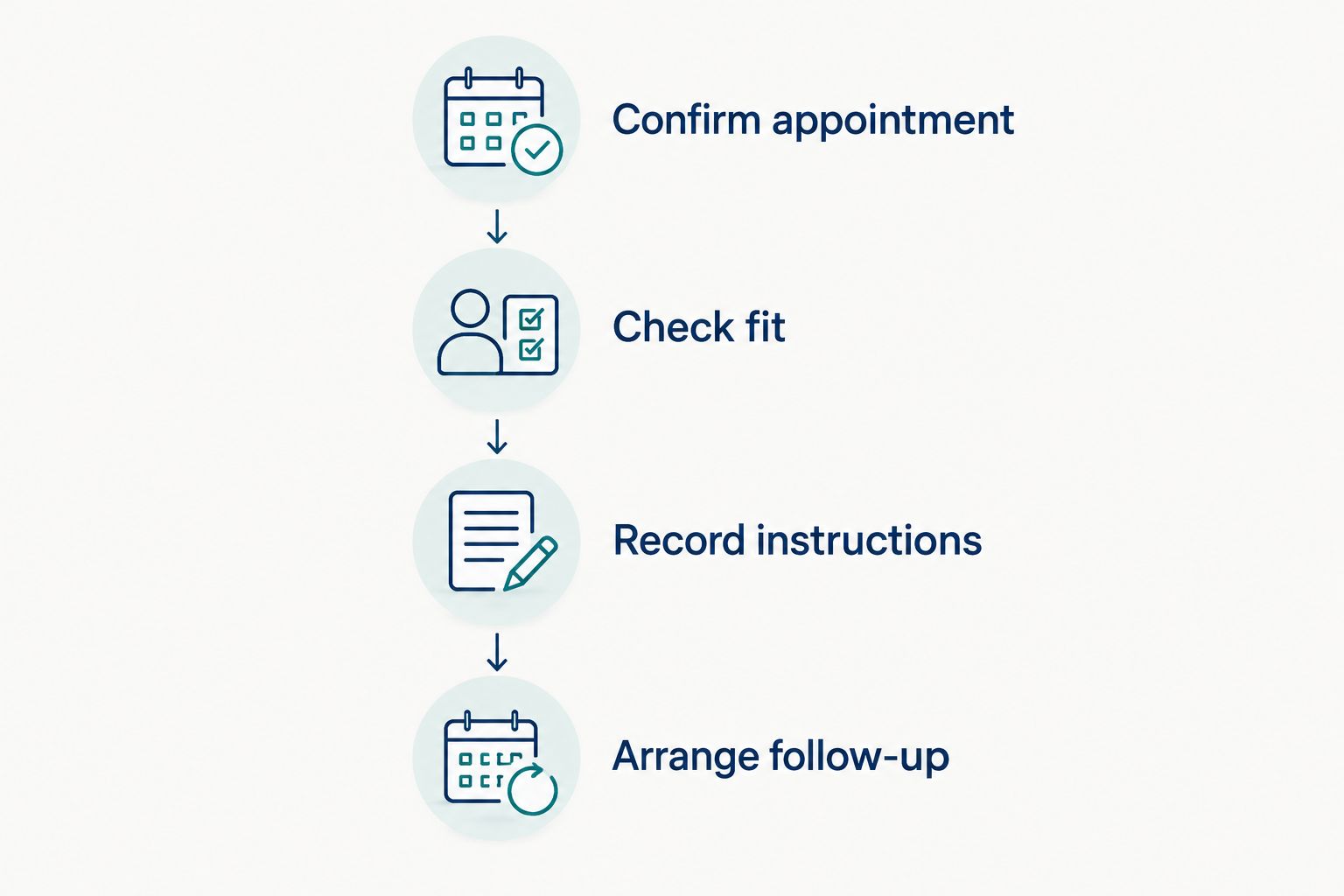
Before leaving, ask the office to record instructions and arrange follow-up. Your 2026 retainer plan should identify who to contact if the fit changes, not simply say to return when needed.
Home-care and follow-up plan
Build a routine you can repeat
- Match cleaning to the appliance. Ask which brush, cleaner, and water temperature are suitable. Heat can distort some removable retainers, and unsuitable cleaning products can damage materials.
- Separate tooth care from appliance care. Clean your teeth as directed, and clean the retainer according to its own instructions. For bonded wires, ask for a demonstration of cleaning around the wire and between the teeth.
- Choose a safe storage location. Put a removable retainer in its protective case whenever it is out of your mouth. Keep the case away from heat and pets, and do not wrap the appliance in a napkin that can be discarded.
- Record the follow-up instructions. Save the office contact details and the symptoms that should prompt a call. Use the review schedule the clinician gives you rather than creating a universal interval.
- Bring the retainer to relevant visits. Tell your dental team you wear one before treatment that changes a tooth’s shape. Ask whether the appliance needs a fit check afterward.
Build around 2 daily habits: prescribed wear and appliance care. Keep the routine simple enough to follow, but do not change the wear schedule just because the retainer feels comfortable.
Expected result: You have a repeatable routine, a safe place for the appliance, and a clear route back to the provider when something changes.
Keep a written handover
Ask for 1 written plan that combines the details you would otherwise have to remember:
- The appliance type and the teeth it is intended to retain.
- Your wear schedule and removal instructions.
- Approved cleaning methods and storage advice.
- The response to missed wear, discomfort, damage, or loss.
- Your follow-up arrangements and the office contact route.
Keep the plan with your dental records. If instructions change during 2026, save the updated version so an old handout does not become your default.
Updated workflow after dental work or missed wear
A new crown, replacement filling, tooth movement, or a prolonged break from wear changes the question. Instead of asking only how to resume the old routine, ask whether the existing appliance still fits your current teeth.
- Stop trying to solve a seating problem with force. Do not bite the appliance into place or bend its wire.
- Tell the provider what changed. Describe recent treatment, missed wear, visible gaps, discomfort, or a loose bonded section.
- Bring the appliance for assessment. The clinician can evaluate whether an adjustment, replacement, or orthodontic reassessment is appropriate.
- Replace the old instructions when necessary. Get a revised wear and follow-up plan after the assessment.
Best for: People whose retainer fit changed after dental treatment or a break in wear. The benefit is a plan based on the current situation; the limitation is that a replacement retainer alone does not necessarily address tooth movement.
Troubleshooting
The removable retainer no longer seats
Do not force it. Contact the provider and explain whether the problem started after missed wear, damage, or dental treatment; those details help the office arrange an appropriate assessment.
An edge rubs or causes a sore spot
Ask the provider how to handle wear until the appliance is checked. Do not trim, file, heat, or reshape it yourself, because a home alteration can change fit or damage the material.
A bonded wire feels loose or sharp
Contact the treating office promptly and avoid pulling on the wire. If an edge is irritating your mouth, ask whether orthodontic wax is suitable while you wait for assessment; wax does not repair a loose bond.
The retainer develops buildup or an odor
Review the cleaning method with your clinician and ask whether the appliance needs professional assessment or cleaning. Do not respond by using hotter water or stronger household chemicals.
The retainer is lost or cracked
Contact the provider rather than waiting for a routine appointment. Keep any damaged pieces and ask what to do about wear; do not glue the appliance or put a broken piece back in your mouth.
Customize your workflow
Make the plan fit your actual obstacle. If you travel, identify a consistent case location; if removal is difficult, practice with the clinician; if cleaning around a bonded wire is confusing, request a hands-on demonstration.
For Dentalcoloradosprings dental-care inquiries, use the contact page to ask whether the practice can evaluate your retainer concern or direct you to an appropriate orthodontic provider. Describe the issue before requesting a particular appliance.
Ask about your retainer appointment
Confirm whether your retainer concern can be evaluated before scheduling.
FAQ
How do I choose an orthodontic retainer near me?
Choose a provider who can assess your appliance, explain the fit, and give you a written wear and follow-up plan. Confirm that the office handles your retainer type and accepts patients whose orthodontic treatment was completed elsewhere.
Can a general dentist help with my retainer?
Some general dentists evaluate retainer concerns, while others refer patients to an orthodontist. Confirm the specific service before booking, especially for bonded-wire repairs or changes in tooth position.
Should I force my retainer in if it feels tight?
Do not force a retainer that will not seat or causes pain. Contact the treating provider so the fit and any tooth movement can be assessed.
Do I need a new retainer after a crown?
A crown can change how an existing retainer fits, but an examination determines whether adjustment or replacement is needed. Tell the clinician about the retainer before treatment and bring it for the fit check.
What should I ask about retainer charges in 2026?
Ask for a written quote explaining the proposed examination, records, appliance, fitting, and follow-up services. Confirm insurance benefits separately and ask which additional services would require approval.
Does a bonded retainer mean I can skip removable retainers?
Not necessarily; your orthodontic plan determines whether you need a removable retainer as well. A bonded wire retains selected teeth and does not automatically replace every other retention instruction.
Does Dentalcoloradosprings offer the retainer appointment I need?
Confirm your specific retainer request directly with Dentalcoloradosprings before scheduling. Explain whether you need an initial fitting, a replacement, an adjustment, or assessment of a loose bonded wire.
One last thing
A retainer that fits your teeth today is not proof that your old instructions still fit your situation. After dental work, damage, or missed wear, bring both the appliance and your written plan to the appointment. Ask the clinician to check each before you restart the routine.